
On the Ancestors
of
JD Eduard Brzorád, a Young Czech member of the
Austrian Imperial Council and the Diet of Bohemia.
Chronicles of the von Herites,
von Krziwanek, Delorme and Brzorád
families.
Written by Jan
Steinbauer, translation © Mary Petersen
Email for your comments and additions:
This website works best with Internet Explorer, for the time being. :o(
Familie Brzorád
Contents:
The
first generations in Chrudim
Filip
Brzorád (1737-1812) and Nymburk
Jan
Filip Brzorád, JD et PhD (1765-1851)
Vincenc/Čeněk
Brzorád (1769-1844) Nymburk’s Mayor
Božena
Němcová‘s Stay (1840-1850) at mayor Antonín Brzorád’s (1809-1877)
Bohumil
Hrabal about Gustav Brzorád MD (1844-1914)
Antonín
‘Gruntorád‘ Brzorád MD (1876-1953)
Kateřina
Černá née Brzorádová (1771-1831)
Josef
Calasanz Brzorád (1777-1857), state councilor, owner of Lochkov estate
The
Danish princess visiting Lochkov
The
painter Thorald Læssøe at Lochkov.
From
the diary of Tomáš Černý JD (1840-1909), a lawyer in Prague and the nephew of
Josef Brzorád.
Philippine
Brzorádová (1812-1886)
Karl Brzorád (1813-1871), the owner
of the Lochkov estate
Tulka the painter and Augusta
Brzorádová (1873-1879)
The
Memories of Dobříč and Lochkov by Prague
Vilém
Brzorád JD (1814-1898), advocate and owner of a brick factory
Marie
Hauptmannová née Brzorádová (1818-1888)
Ferdinand
Brzorád (1821-1863), deputy judge to the country court in Prague
Rudolf J.
Brzorád (1823-1890), owner of the estate and a mine in Hungary
Anna Erben
née Brzorád (1833-1865), friend of Kateřina Fügner
Eduard
Ferdinand Brzorád JD (1820-1898)
Marie Komers née Brzorádová (1861-1920)
Karla
Kratochvílová née Brzorádová (1868-1937)
Anna
Dostálová roz. Brzorádová (1876-1919)
Eduard
Brzorád Jr., JD (1856-1904)
Introduction
We begin the Family history of Brzorád’s with an impecunious “šlotýř”[1] Jan Brzorád (1623-1675) from Kovářov, who later settled in Chrudim. His son, who rented a nearby mill in Májov also lived there. Two generations later, the mill was purchased by Filip Brzorád (1623-1675), who in 1766 boldly and with debt bought the mill in Nymburk and developed it into the largest mill in the country. Besides other properties in Nymburk he bought a house nr. 627 in Prague’s Týnská street, which he gave to his eldest son JUDr. and PhDr. (doctor of law and philosophy) Jan Filip (1765-1851), who later became the Lord of the Chlum and Vidovice estate, and in 1848 a member of „St. Wenceslas’ committee of 1848“[2], later of The National Committee. Jan Filip’s son Joseph (1810 -1898) was a provincial deputy.
Filip the miller (1623-1675), however, also provided for his second son JD Adalbert Wilhelm (1767-1839), a lawyer, the provincial governor and president of the appellate court in Galicia. Filip had two daughters: Marie (*1774), who married prof. Jan Nejedlý and Catherine (1771-1831), who married Tomáš Černý, and became the mother of a prominent Prague mayor JD Tomáš Černý (1840-1909). Filip’s third son was Vincent Brzorád (1769-1844), the mayor of the city of Nymburk. Family members of the Brzoráds and the Černýs can be found among the members of the National Guard in 1848.
The writer Božena Němcová, during her stay in Nymburk in the years 1848-1850, lived at Vincent’s son Antonín’s (1809-1877), also a mayor. . When poverty fell on her later on, the Brzoráds were among those who willingly helped. The Brzorád’s children together with the Černý’s children spent lots of time with the writer and her four children. Among these was Gustl, the future MUDr. Gustav Brzorád (1844-1917), who is remembered in a text by Bohumil Hrabal as well as his son MUDr. Antonín Brzorád, who was immortalized in Hrabal’s novel Postřižiny as Dr. Gruntorád.
The successful Nymburk’s miller Filip (1623-1675) had two more sons. Filip (1776-1882), the fourth son, of the same name, drowned unfortunately, at the age of six in the millrace while playing with a ball. Filip’s last son, Josef (1777-1857), however, lived to an old age. It was for him that his father bought the estate of Lochkov near Prague. Because the amount of meadows and forests did not seem sufficient to him, Filip bought some more land in Smíchov, across the river from Vyšehrad and a coal mine. Josef (“Kalasánský” - named after a major saint Joseph Calasanz) went to the Piarists’ high school with the Czech poet and linguist, and a leading figure of the Czech National Revival, Joseph Jungman and after studying the law he worked in state administration. But after 1808 he moved to the Lochkov estate, to whose management he was devoted until his death – and thanks to his education he also exercised jurisdiction there. There he built a nice mansion with a chapel. The preserved letters document his relationship with his wife Anna Delorme and her interesting family who owned Dienzenhofer’s palace, today called Portheimka in Smíchov. In his letter from 1811 for example we read instructions on how to pronounce the name Brzorád properly.
Josef’s love was science - his meteorological observations were written down 3 times daily for 40 years. He had an extensive library. He exchanged letters in Czech with his father, but with his wife, children and brothers in German. But from his children he demanded Czech language skills and otherwise felt warmly Czech. He was among the supporters of the National Museum and among the founders of Matice Česká[3], although following the advice of Josef Jungmann he had his son Vilém listed as such. JD Vilém Brzorád (1814-1898) who later became a lawyer and administrator, and a tenant of the Jinonice estate. Among the friends of Lochkov’s Brzoráds were revivalists and participants in the revolutionary year of 1848, prof. Helcelet and philosopher Hanuš. They socialized mainly with Vilém and his brother Karl (1813-1871), who had numerous offsprings and later took over the Lochkov estate and soon sold it.
Rare are the memories of the fate of Vilém's grandson Jan (1883-1970), a leading figure of national economic life in pre-war Czechoslovakia, who was at the age of 72 imprisoned for six years by the Communists. Equally important are references to the lives of his sons Jiří, an X-ray mammography specialist (nicknamed "Dr. Prsorád[4]”) and Vilém, a leading exiled lawyer, politician and economist active in the Committee for Free Europe and in the magazine Svědectví, who was awarded state honors from the hands of Václav Havel. His daughter is the prominent ballet dancer Nina Brzorad.
Karl’s daughters were governesses and one of them was the love of National Theatre’s painter Josef Tulka. Another of his daughters wrote vivid memories of her life at Lochkov.
Other children of Josef’s were Ferdinand, adjutant of the Provincial Court in Prague, a daughter Philippa, who, after the death of their mother took care of the household, a daughter Marie, whose offspring Goppolt von Nordenegg achieved ennoblement, and a son Rudolph, who from his aunt Delorme inherited the estate Mogyorós in Hungary with a coal mine. He was very rich and even set up a port named Brzorád on the Danube in Pest. His son Julius was a distinguished sculptor and took the name Gyula Bezerédi; Rudolf’s second son and namesake - Rudolf’s (Rösze) descendants - still live under the name Bozorády .
This work will focus on the last son born in Lochkov - Eduard Ferdinand (1820-1898), who after studying law - first in Prague in the same year as FL Rieger, then at the University of Vienna - became a lawyer and notary in Německý Brod. Later, he became a district mayor and a Knight of the Order of Franz Joseph. He corresponded with his friend Josef A. baron Helfert, later an Austrian minister and he was a close friend of Vojtěch Weidenhoffer. With Marie née von Křivánek he had three daughters and a son.
The daughter Karla became the mother of the Minister of Industry and Trade in the Protectorate government, JD Jaroslav Kratochvíl; the daughter Anna and her husband emigrated to the US, where they actively assisted in the birth of an independent Czechoslovak state – her husband JD Hynek Dostál, editor, Knight of the Orders of St. Gregory and of St. George and the holder of the papal awards "Pro Ecclesia et Pontifice" and "Pro Ecclesia et Fide", cosigned the Pittsburgh Agreement in 1918. The grandson of the daughter Marie, who married the District Governor Komers, became an employee in the secretariat of the Presidium of the Supreme Court in the era of Emil Hácha, whom he respected.
We will also observe the private, political and community life of the only son, Eduard, a Young Czech Party’s member, politician and a radical nationalist, otherwise also a lawyer and mayor of the town and the district.
Finally, we briefly mention the fate of those he left behind as dependents, after his unexpectedly early demise. His wife Vlasta, a telegraph operator and the daughter of a “k.u.k.” telegraph supervisor, became a postmistress; her two sons Jaromír and Eduard were also in mail services. Future generations would also remain in telecommunications and freight services.
The first generations in Chrudim
Jan Brzorád (1623-1675)
Jan Brzorád from the small village of Kovářov, the estate of Nasavrky, was the grandfather of the family clan. He is listed that way on the marriage certificate, a copy of which is, along with many other copies of baptismal and death certificates and letters of the oldest Brzorád’s, preserved in the National Museum Archive. Kovářov was not big - in 1667 numbering only 75 souls. Later we find Brzoráds in Chrudim. In the inventory of subjects according to their faith[5], which was conducted in 1651 we read: "John Brzorád 28 years, Catholic – sojourner (live-in farm labourer), šlotýř in Chrudim, quarter - Bohatá". Jan Brzorád apparently did not belong among the rich. Masaryk’s Encyclopaedia said this about “šlotýř”: "šlotýř (also šrotýř, skladčí, líhař) an old Czech name for laborers who drove lumber and malt, delivered the beer and wine, rolling and lowering barrels on skids - timber joined together." In 1654[6] Jan married Kateřina, the daughter of Jan Kope(r)náč from Chrudim. In that year, as recorded in Chrudim’s town books, Kateřina and he bought a “Vobořilovský“ house N. 11 / III. in St. Catharina’s district, next door to a neighbor Jiří, also a “šrotýř” for 235 zl. (Gulden). About 1675 the city book says: "12 of June the guardians of the late Jan Brzorád’s children sold the „Vobořilovský“ house with a garden and a barn next to the house of Petr Tauš to the stepfather of the chidlren, Daniel Holub and his wife Kateřina." The house had already been called “Brzorádovský” - Brzorád’s and the heirs finally sold it in 1697 for 166 zl.[7]
Samuel Brzorád (1674-1728)
Jan's son Samuel Karel also lived in Chrudim[8]. He was just two years old
at the time
of his father's funeral. Fathers died to small Brzoráds in other generations. Samuel was born in 1674 and in 1703 he married
Anna Šlemová (Šlemeriana) from
Chrudim. He was
probably a miller and a tenant of Májov’s
mill.[9] It was at the time
when the mill belonged to Count František Josef Schönfeld. Today, we can see
the mill No. 148 / IV in the form it
received in the mid-19th century. The same owner
owned also an adjacent courtyard
with the flat in a manorial flat number 147 / IV. After Samuel the courtyard was
rented by Jan Makalouš. Later Samuel's grandson Philip bought the mill. In 1707, Samuel bought
a 'house in Chrudim for 175 zl.. It was in the district Putrkaská,
nr. 105 / IV " lying
on the right hand side, alongside municipal bridges along the way
from local brewery to Putrkasy.” After Samuel's death in 1728 his son
Jan Brzorád took over the house (according to the debated inheritance) for 233 zl.
20 crowns. Jan's brother, Samuel Brzorád, a soldier gave his justice (his rightful share) 178 zl. 53 crowns to Jan when leaving Bohemia.
Jan Brzorad (1706-1737)
Jan was born
three years after the wedding
in 1706. He married
Anna, the daughter of Jan Wolf of Chrudim, when he was 21. He did not live
long, as he died at the age of
31 on December 3, 1737. So it was a close shave
that one of the most enterprising
Brzoráds, father of numerous offspring
and a significant generation
of the family,
Filip Vojtěch Jakub was born
at all. House No. 105 / IV., worth
233 zl. 20 kr, was taken after Jan Brzorad by the widow Anna Brzoradova in. January 17, 1744.
Filip Brzorád (1737-1812) and Nymburk
Vojtech Filip Jakub Brzorád was born just two weeks before his father's death – on November 17, 1737. On the 10th of September 1761 he bought Májov’s mill Number 148 / IV.[10], which has already been mentioned, because this mill on the Chrudimka river, just outside of Chrudim, was already rented by Philip's grandfather Samuel. This notation in the town of Chrudim’s books is worth reading: " Nr. 148 district IV. - On September 10, 1761 Alžběta Koblíková sold a mill with one weir, triple construction and a crusher, situated by Májov’s farmyard, to which it formerly belonged, and which is now in possession of the seller, with an attached little barn, 14 korec 3 věrtel[11] (over 4 ha) and a quarter of a field, a little vineyard and the surroundings of the mill for 3150 zl. to Philip Brzorád. It is natural that by the mill some farm buildings were also built since there were also fields."[12]
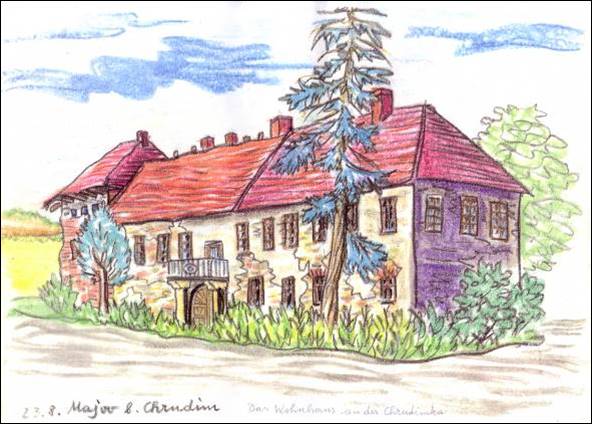
Agricultural farmyard Nr. 147 / IV , adjacent to Májov’s mill.[13]
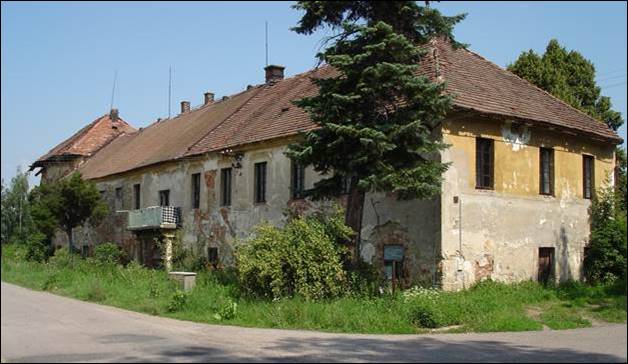
Agricultural farmyard Nr. 147 / IV , adjacent to Májov’s mill.[14]
On 17the November 1761 Philip Brzorád, who is already a miller in Májov, married Ludmila Všetečková from Chrudim. She was related to the Všetečkas from Nymburk, later pharmacists in Chrudim and in Poděbrady.
Nymburk (1766)[15]
On the 7th of June 1766 Filip Brzorád together with his wife Ludmila born Všetečková bought a mill from Jan Šulc in Nymburk’s auction " ... because, after all the festivities had gone they did not find anyone else who would pay more for the mill than Brzorád was willing to give. From the purchase price the debts were paid to the urban funds, contributions, attorney's fees 60zl and other debts. The rest of the price was handed to Marie Magdalena Schwarz, who had insured 5628 zl. 20 krowns on the mill. The Brzoráds insured part of this debt to Schwarz at their mill in Chrudim, purchased for 3150zl from Alžběta Koblíková."[16] First they leased it (the mill in Nymburk), then they bought it, rebuilt and modernized it so it became the largest in the country.[17]
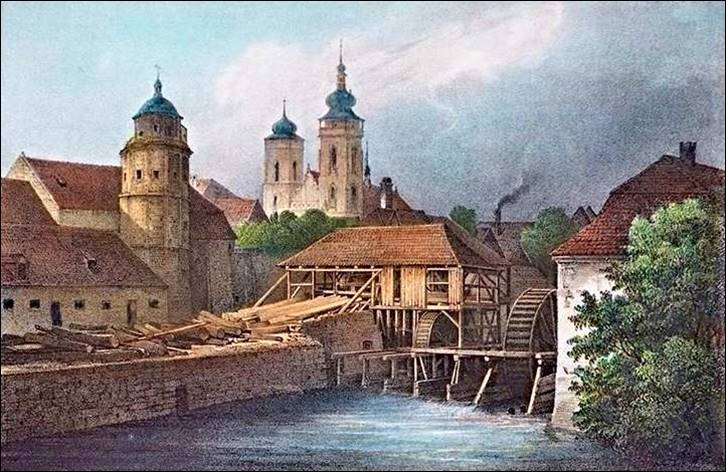
A coloured view
of Brzorád’s mill at around 1840, „Gez. und Lit. C. W. Arldt Malerishe Partie in Nimburg“[18]
In the interior of the Nymburk Municipal Mill, which was owned by Filip Brzorad in 1766-1807. "On the wooden beam we find two inscription cartridges “LETA PANNE MDCCLXXXVII NAKLADEMPANA BRZORADAFILIPA”, meaning “Anno Domini MDCCLXXXVII” and “Financed by Mister FILIP BRZORAD.”[19]

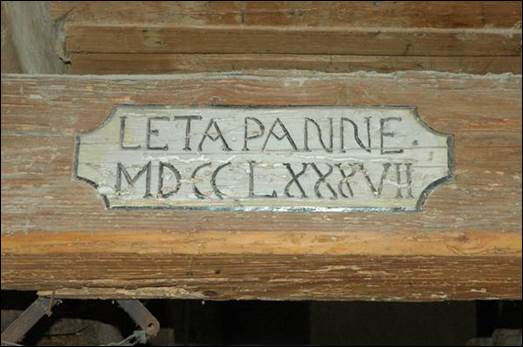
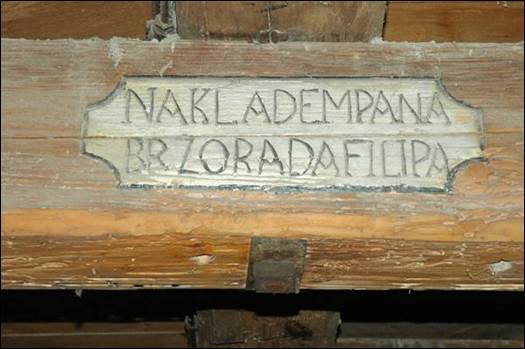
In the interior of the Nymburk Municipal Mill, which was owned by Filip Brzorad in 1766-1807. "On the wooden beam we find two inscription cartridges “LETA PANNE MDCCLXXXVII NAKLADEMPANA BRZORADAFILIPA”, meaning “Anno Domini MDCCLXXXVII” and “Financed by Mister FILIP BRZORAD.”[20]
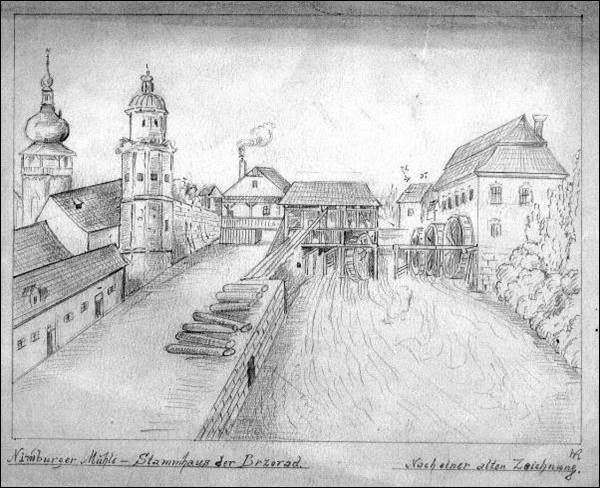
Nymbursk’s mill - Stammhaus der Brzorad – based on an old drawing.[21]
An entry of the inventory of houses and their owners in Nymburk from year 1772 says “Fillip Brzorad, Mlinarž” meaning “F.B. the miller”.[22]

the inventory of houses and their owners in Nymburk from year 1772 says “Fillip Brzorad, Mlinarž” meaning “F.B. the miller”.[23]
August 26, 1773 Filip Brzorád sold Májov’s mill near Chrudim Nr. 148 , District IV. and its accessories to Václav Všetečka, for his son František, as Brzorád bought it, for 3500 zl in cash.[24] We know that the Všetečkas from Chrudim were related through Philip's wife Ludmila.
In 1774 Phillip’s daughter Marie Brzorádová was born, who later married Professor Jan Nejedlý from Chrudim. William Brzorád mentioned him later as a councilor to the magistrate of Český Brod.[25] They had a son Antonín, who married Josefa Bergmannova.
In 1775 the Brzorád couple bought a house no. 165 (also known as Hlavovský or Kadeřávkovský) in Nymburk together "with a beer court – a brew place at the back of the house".
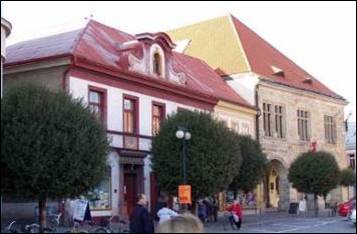
Nymburk house No. 165 (on the left), Renaissance town hall (on the right) in 2006
21 April 1776 was born and on September 1st 1776, Phillip’s son Philip Brzorád died in Nymburk.
In 1777 in Nymburk for us the most important Brzorád - son Joseph (1777-1857 ) was born. To him we will devote the next section.
In 1779 in Nymburk Philip’s second son Philip and daughter Anna were born. Anna, however, died four years later in 1783 and Philip drowned in Nymburk at six years of age in 1785, when he tried to catch a ball with which he was playing and fell into the Elbe, “Filip Brzorád ertrank als Knabe in der Elbe, als er beim Ballspiele nach dem hineingefallenen Ball haschte.“[26]
In 1784 Philip Brzorád rented nearly 46 měr[27] (over 8 ha) of municipal land for a small amount, but with a payment of permanent interest to the municipal retirement.
From the year 1791 there is a purchase contract on fields for Ph. Jak. Brzorád for 590zl.[28]. In the same year - in 1791, the Nymburk town councillor Fil. Jak. Brzorád Nymburk bought a house 627/7 in Prague’s Týnská Street. "In this house there is a very spacious old great hall, now built up, but should be restored; there is an arcaded way being planned to unclog the street"[29] Apparently, shortly before 1800 there was a major renovation carried out by Philip Heger, who owned the house from 1777.[30]
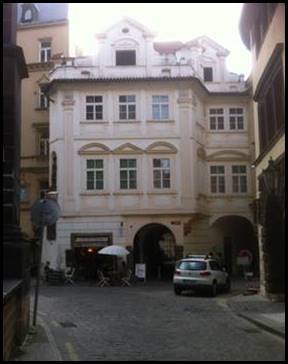
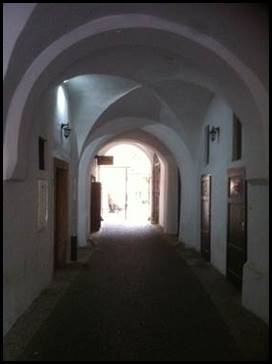
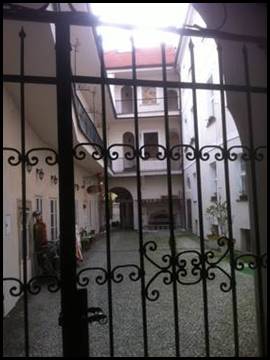
Praha, Staré Město, Týnská street, house nr. 627/7, photo by JS in 2017
In 1792 Filip Brzorád sold a farm house N 227 in the Nymburk suburbs of St. George (today Tyršova 29) to Vincent and his bride for 2,750 zl.. In the same year he bought for 1,250 gold coins house No. 237 (now demolished). From the year 1795 there is a contract for the purchase of land at St. George for 3030 zl.[31]
In 1796 at an auction his son in-law Tomáš Černý bought the neighboring yard nr. 236 (old No. 8) with a barn, a building, a garden and a piece of field for 710 zl.
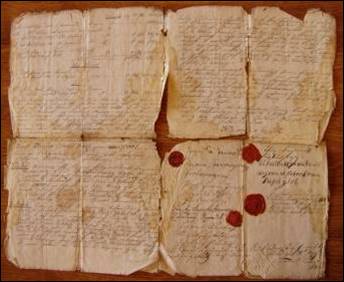
Purchase Agreement from 1796[32]
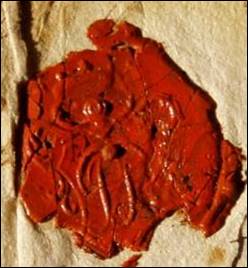
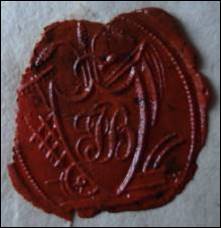
The detail of Filip Brzorád’s seal on the purchase
contract from 1796[33]
In the same year - the year 1796 - for 9.000zl the Councillor Philip Brzorád, an inspector, with his wife bought the Švechníř’s farmyard Nr. 243. This, at that time – a farmyard, will be, after the great fire of 1838, rebuilt by Philip’s son Vincent to include the house with the famous garden ( now a park of Dr. Antonín Brzorád) , in which the grandson of Philip, Antonín Brzorád hosted Božena Němcová. For more see the section "Vincent Brzorád, Božena Němcova in Nymburk." A three-page contract with all fields and meadows listed, and a detailed description of the house was drafted to cover this purchase. At the bottom of the contract we find the seal and signatures of both spouses.
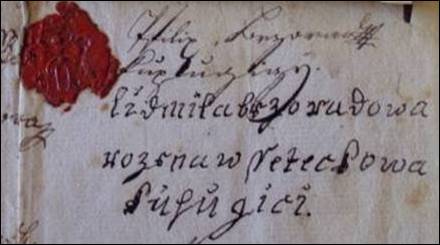
Detail of the contract from 1796: "Filip Brzorád the buyer and Lidmila Brzorádová born Všetečková the buyer“
In Nymburk’s archive there is also a contract covering a purchase of a quarry from 1801. [34]
In 1805 Filip Brzorád signed a municipality's document as "Philip Brzorád, the councilor".
On the 18th of January 1806 Ludmila Brzorádová born Všetečková dies.
1807 Filip Brzorád sold the mill (in Nymburk, purchased in 1766 ) for 120.000zl. „The mill was assigned as an inheritance to Vincent (Čeněk); His wife, however, declared: "I do not want to be a miller’s wife"; to which the grandfather said, "So I will sell the mill ..." and so he did and the kids evenly shared the proceeds. “Dessen Frau hatte sich aber hören lassen „Ich will keine Müllerin sein“; worauf der Grossvater sagte: „so werde ich die Mühle verkaufen …“ und tat es auch, um die Kinder gleich mässig zu beteilen.”[35]
1808 Filip Brzorád bought the “free hold” Lochkov manor near Prague from Alois Arioli for 134,000 gulden. Arioli bought the farm in 1804 from Ferdinand Delorme.
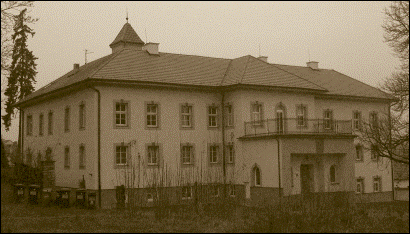
Lochkov castle, image from the yard taken in 2002
Filip Brzorád died on 25th of January 1812. His grandson, William Brzorád (1814-1898) wrote: "Grandpa Philip James was healthy, strong and energetic, also an affectionate father and husband, clever and prudent. Mother told us that the night before the sale (or rather the purchase) of Nymburk mill he asked his wife Liduska for advice. Should they dare buy the mill, even though the expense exceeded their assets. He decided in favour of the purchase because they were known for the profitability of their trading, diligence and knowledge of business matters. When he purchased Lochkov he realized that there was lack of meadows and woods. Therefore he quickly bought Smíchov’s meadow[36] and two coal mines in "Pulep"(?). He talked about his sons to my mother; Then he put on one name such an emphasis that one knew which one (Adalbert) was his favorite. From the letter, which Adalbert wrote after grandfather's death to my father, one can see how deep his grief was. [37]
In 1813 the heirs, dividing the assets in the sum 117,180zl.52 Kr, left the house (Nr. 165 in Nymburk) to brother Vincent. The assets, except that of the house were: dominical house Nr. 237 worth 6261 zl, a house in Prague Nr 627 worth 4000zl. (Týnská 7), about 30 morgens[38] (cca 18ha) of fields and the rest in cash and in debts of his neighbors and elsewhere. In that year's inventory of the Nymburk houses Philip’s son Vincent Brzorád is listed as the owner of house numbers 165 (with registered 2 people), 243, 246 and 247.
Philip Brzorád is remembered once more in a letter in German from his grandson, William, "Both grandfathers[39] were men who raised themselves with their own power from a low status and were able to provide their children with good education and a decent provision at which they have been successfully supported by their wives. In 1866 Filip Brzorád was a tenant of a small mill on the Chrudimka river (Májov) under Chrudim. That year he rented Nymburk’s mill on the River Elbe, and a few years later bought it and built it into one of the largest and best-equipped mills in the country. He led his business to such a great success that he was able to educate and provide well for his 4 sons and 2 daughters. ... Philip Jakub Brzorád was also an advocate (der Anwalt) of the town of Nymburk and won public merit in times of the need for water and during fires.[40] He knew the German language to such an extent that he could use it in the office and his business. His children corresponded with him and he with them only in Czech.... Grandfather Brzorád did not have the opportunity of scientific education, but his head and heart were in the right place. He wrote once to his son Vojtěch: “The last time you drove through Český Brod, without ever visiting your brother in law and sister.” I know that you don’t like them, and I do not blame you. But don’t do it any more because it would be an insult to your good sister." [41]
Philip descendants are therefore four sons: Jan Philip (1765-1851), William Vojtech (1767-1839), Vincent (1769-1844) and Joseph (1777-1857) and two daughters Marie Nejedlý and Kateřina Černý (1771-1831).
Jan Filip Brzorád, JD et PhD (1765-1851)
JUDr. et PhDr.[42] Jan Filip Brzorád (1765-1851) was born in 1765 in Chrudim. He was a provincial lawyer in Prague. In 1813 he inherited a house from his father, nr. 128 in Týnská street in Prague (now nr. 627/7) worth 4000 gulden. There his brother Joseph also registered his stay in 1805[43]. In 1811 during Josef’s wedding ceremony in the Smíchov church Jan Filip served as his witness.
From 1812 (when his father died), Jan Filip was the owner of an agricultural estate in Chlum and Vidovice[44]. He married Eleanor Holanová, daughter of the owner of an estate in Unhošť - Hofbesitzertochter. Dr. Jan Brzorád was named among the members of the St. Wenceslas’ committee of 1848“, later of The National Committee.[45]
His nephew said about him: " Jan, the eldest son of my grandfather, was extremely diligent in his studies, always an excellent student who became a doctor of law and philosophy. ... At first he was the owner and administrator of the estate in Zbuzany, then the Hadovka vineyards, later for an extended period of time the manager (Wirtschafter) of the estate Chlum and Vidovice and finally manager in Vysočany, where he died in 1851. Phlegmatic "come il faut" he left the household decision making to his wife and helped only with decisions about the sale of grain. ... He corresponded in German, with my father (Vilém’s father Josef) and with Grandpa in Czech. We visited them, as far as I remember once a year. He was large and strong, as were his wife and their children: Ludmila (1794-1878), Filip (1799-1873) and Josef Jan (1810-1899)."[46]
Ludmila (1794-1878), married Johann Boržicky, an administrative clerk in Nemysl(?) by Čechtice. Their son Johann was the owner of the farm estate Wollowitz[47] and married Emma Pokorny in 1848. Ludmila’s daughter Eleanore (*1820) married Emanuel Daubek, a postmaster in Čechtice. Their children were Johann (*1845), a postexpeditor in Čechtice, Eleonore (*1848), Emanuel (*1849), Franz (*1850), a technician, Ludmilla (*1852) and Betty (*1856). Ludmila’s daughter Rosalie died in 1841.
Filip (1799-1873) was an official valuator for the land registry in Prague. the postmaster in Gonobitz. One of their daughters, Františka, married a municipal architect in Krakow Marles Robel and their son was an engineer; the second daughter Luisa married a geodetic engineer, in Prague, Václav Mikeš. The third daughter Johanna married a geodetic engineer in Hungary, J. Wallenfels. Filip’s only son Josef "Peppi" Richard Brzorád (1846-1918) - he added the name Richard at the wedding - graduated from engineering and chemistry and was a tax official at a sugar plant in Jičín, later k.u.k. financial inspector, retired and died in Prague. He probably had no offspring.[48]
Josef Jan Brzorád (1810-1899) was the landowner in Chlum and Vidovice beginning in 1840. He also inherited a house in Týnská street in Prague, and was a member of the Bohemian provincial parliament. For many years he held the office of the mayor of the district; he was the chairman of the economic association in Jílové, enjoying the reputation of an honest patriot. He died on 13 July 1899 in Kosova Hora at Baron Mladota's castle, and was buried in Mnichovice.[49] In 1835 he married the daughter of the postmaster Doubek / Daubek from Votice. Their only daughter Eleanora married Lieutenant Rudolf Kainz, with whom she had seven children, and inherited estates in Chlum and Vidovice. In 1894 they sold the farm to Jan and Marie Milner, who in 1904 made the most important building modifications of the castle. In 1906 the mansion was referred to as "the newly built castle with a park".[50] Their children were Alfred *1854, Friedrich *1860, Adele *1863, Marie *1865, Leontine (*1868 in Vidovice, oo Bernhard Zechner, later Oberstudiendirector in Rumburg, + 1955 Tutzing, near Munich[51]), Zdenka *1870 and Anna *1871.[52]
Adalbert William Brzorád, JD (1767-1839), a provincial governor, president of the Court of Appeal in Galizia
Born in Nymburk in 1767 JUDr. Adalbert William Brzorád (1767-1839), was the provincial governor and the councilor to the court of appeal in Galizia, a lawyer and president of the Bar Association in Czernowitz, Bukovina and a Prague citizen. He married Eleanor Kemper (+1848 in Chernowitz). Adalbert’s nephew, William Brzorád (1814-1898) recalls his uncle, "He was my strongest and most talented uncle. He was very ambitious, an excellent lawyer, attorney in Poděbrady, then Magistrate Councilor in Krakow, councilor to the Court of Appeal in Lvov (Galicia), and finally the president of the provincial court in Czernowitz (Bukovina), where he died in retirement.” His tombstone can still be found in the catholic cemetery.[53] “He was my godfather. On his way to Karlsbad in 1833 and 1834 he stopped each time for a week in Lochkov. He corresponded with my father only in German. His letters are interesting because of remarks he made about the local social conditions and historical events. To his father he wrote in Czech. Adalbert Wilhelm (1767-1839) had two children, Antonia Laura(1816-1902) and Adalbert (+1879).
The daughter Antonia Laura (1816-1902) married a Polish landowner in in Ober-Scheroutz / Scheronitz[54], who probably also had some land in Kuschwarda,[55] Josef von Zadurovič / Zadurowicz. Antonia corresponded with William Brzorád (1814-1898) and used to go to Karlsbad.[56] Her letters are funny and well informed, and are therefore quite fun to read. Their son Adalbert Ritter von Zadurowicz - Vojtěch von Zadurovič[57] (1838-1915) was a "wealthy" owner of the farm in Bukovina and to his mother he paid an annuity of 3.000zl. He would meet William Brzorád. He died childless and single in Vienna. In 1888 after she was widowed, the landlady of Kushwarda /Kušvarda – Antonie von Zadurowicz (1816-1902) married the local mayor Heinrich Rak (1828-1901).[58]
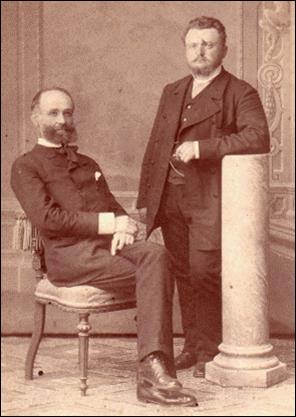
von Zadurowicz and Wilhelm Brzorád in Czernowitz 1853[59]
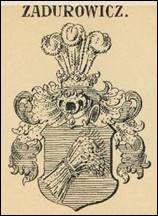
von
Zadurowicz’s coat of arms[60]
Adalbert Wilhelm’s son Adalbert / Vojtěch Brzorád (+1879) got a farm estate, Buneška, from his father. As the landlord in Bukovina, he was somewhat profligate “der etwas messailiert war.” He had two daughters[61] and his two sons became depraved as a result of irregular dissolute life in Sučava (mainly German dist. city in Bukovina) "... Söhne verkommen infolge unregelmässigen Lebens in Suczawa.”[62] His two sons were Adalbert / Vojtěch and Kazimír, the daughters were: Jeanetta, who married Stefanovitz (they had a son Stefan), Josefine, Klaudine, who married Mandjezenski (they had 3 daughters: Josefina, Veronika Dr., Marie, who married Bella) and Albertina, who married Kalumerský (they had 3 sons: Trojan, Mikon, Eugen).[63]
Vincenc/Čeněk Brzorád (1769-1844) Nymburk’s Mayor
Vincenc / Čeněk Brzorád (1769-1844) was born in Nymburk in 1769; he later became the owner of a prominent town farm, Nymburk’s mayor and the founder of an important family branch of Nymburk. He was Philip's third son and, unlike his brothers he stayed in Nymburk. In 1799 he married Antonie Pokorná, the daughter of Nymburk’s administrator. In the 1812‘s list of homeowners (and after his father's death), the following numbers are given for Vincenc Brozrad: No. 165 (2l), 243 (zu 165), 246 (zu 165), 247 (zu 165). So he owned four houses. He provided well for 3 sons and 3 daughters. After a great fire in 1838, he rebuilt the farm yard No. 243 on today's Boleslavská Street. He died in 1844. His nephew Vilém Brzorad (1814-1898) remembers him: "Vincenc, in his time a wealthy burgher, ... was bright and good-natured. He had three daughters and three sons: Philip (1803-1871), Vincenc / Čeněk (1813-1870) and Antonin (1809-1877), all of whom lived and died in Nymburk."[64]
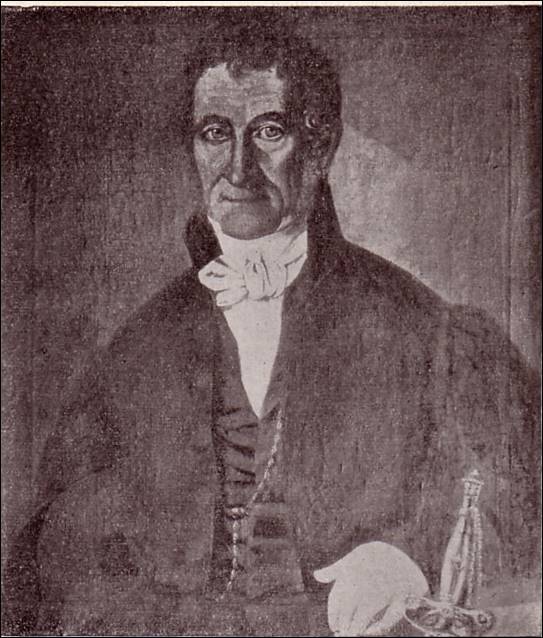
Vincenc Brzorád
(1769-1844) [65]
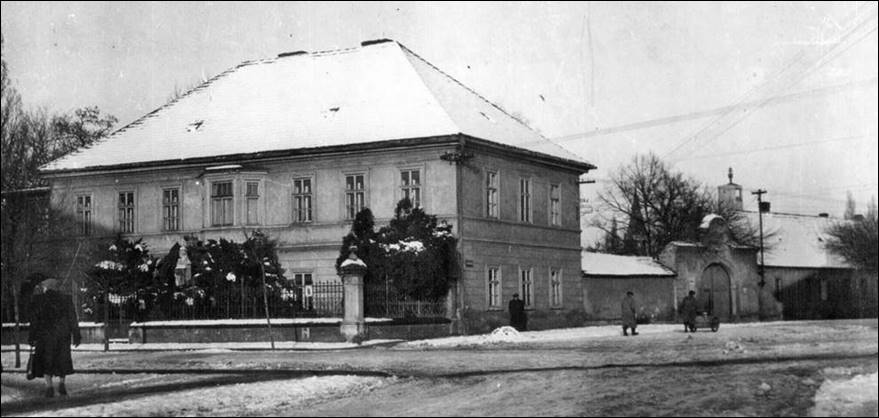
Nymburk, Boleslavská street, nr.
243, Brzorád‘s house[66]
A token was found in the field west of Slaný (Kladno District). The inscription on the coin says "Čenek Brzorad" and on the other side is the city emblem of Nymburk. So it probably comes from the time when "our" Čeněk Brzorád held the office of mayor. A 25-mm in diameter chip was found and sent by Mr. Ronald Tax. The exact purpose of the token though will yet have to be looked into. [67]
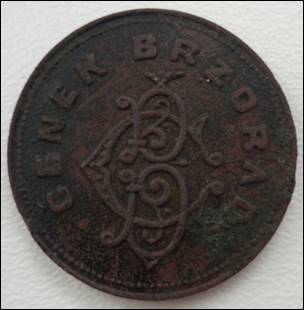
25-mm in diameter chip with ČENEK BRZORAD [68]around his initials
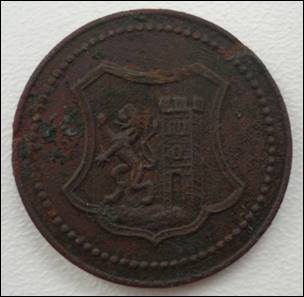
25-mm in diameter chip showing the coat of
arms of the
town of Nymburk[69]
Philip (1803-1871), an official, belonged to the circle of Božena Němcová’s acquntances in Nymburk and was the commander of the National Guard of Nymburk. He married Antonie Černá - a little later at the age 43 - and had a son, "who has earned and spent a lot of money in Prague." [70]
Čeněk (1813-1870) is unfortunately also worth mentioning, because his son Čeněk Filip (1845-1884) was mentioned by The New York Times on July 6, 1884. In Foreign Gossip and Facts, we find the following text: „The city Engineer of Prague, one M. Brzorad, who was unmarried, 41 years of age, and who lived alone, was murdered a fortnight ago by an artilleryman, aged 24, and of good family, who avowed that he had committed the crime out of jealousy. Brzorad was found lying in his own house, with his throat cut and several deep dagger stabs in his chest.“[71]

Purkmistrovský kord (Muzeum Nymburk)
The third Čeněk’s son - Antonín Brzorád (1809-1877) was also the mayor of Nymburk; the writer Božena Němcová lived in his house. This is discussed in more detail below in the chapter " Božena Němcová‘s Stay (1840-1850) at mayor Antonín Brzorád’s (1809-1877). With his wife Františka Messner he had two daughters and a son Gustav. The daughter Theresa married Gustav Klazar, Supreme Judicial Councillor in Prague; Fanny, the second daughter (+28, 2, 1937, 98 years old) married Karl Theer and their son Otokar Theer (1880-1917), a Czech poet and novelist, who used the pseudonym Otto Gulon was born in Černovice in Bukovina. He wrote books such as Under the Tree of Love, Expeditions to Me or Faethon.
Božena Němcová‘s Stay (1840-1850) at mayor Antonín Brzorád’s (1809-1877)
The writer Božena Němcová’s [72]stay in Nymbursk is described in detail by Jan Vondráček in his book from 193[73]. The author draws on detailed knowledge of the facts and memories of B. Němcová’s daughter. Let's quote this book directly:
"The Němec’s found an apartment with a large open-air kitchen on the Boleslavská road, on the ground floor of Mr. Antonín Brzorád’s house No. 243; if you came in from the courtyard, it was on the left. The house was built by the former mayor Vincenc Brzorad after the devastating fire of 1838, which destroyed much of the city. They used the construction materials from the demolished Boleslavská gateway, standing nearby. If Němcová was satisfied with her apartment, we do not know, but from the note to Konopa, where she says, "Whenever I look out of the window, I have no prospect in the landscape, only on the road," we think she wanted a more open view. There in the suburbian house in the midst of the gardens and fields, she set up a cozy home, where she spent a year and a half at work with worries, in joy and in sadness. The house of the Němecs was modest but cozy. The furniture was plain but tasteful. A simple sofa with a raised bolster, without backs and pillows, covered in green molded plush, four stuffed chairs of the same color - a part of Němcova's trousseau - a round table with one foot with a glued landscapes on the top plate under a varnish coat - the wedding gift from the bride groom to his bride and bookshelves were the most significant pieces of furniture. Němcová used to write at the round table. The flat was also furnished with a well used, fairly good piano, a library with busts of our famous men, and on the walls hung portraits of Czech writers and Němcová’s friends.
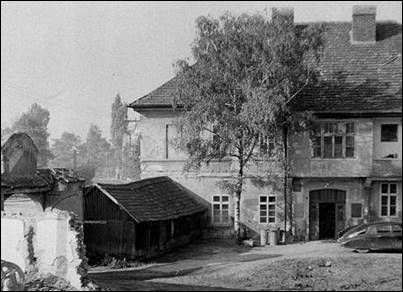
Boleslavská nr. 243, Brzorád’s house from the yard[74]
At the house there was a garden and a large yard, just like today (1913) where the children played. The house was home to poultry and there was a new world of observation and experience for children. Němcová also kept a dog Ořech and a canary in her household for the pleasure of children. Each of the Němec children had one of their own hens that they cared for. Dora had the totally black, tame little hen who walked behind her like a dog. A window full of flowers that Nemcova loved and looked after with love, looked out on the dusty Boleslavská road. The beautiful, young lady, not yet thirty, surrounded by four small, carefully raised children, of whom the oldest Hynek was a ten-year-old, the youngest Jaroslav six-year-old, ruled in this household as a queen, completely independent and free.
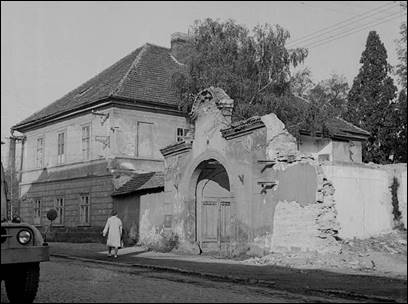
Boleslavská č. p. 243, pohled na dům s bránou z ulice Velké Valy[75]
... The relationship of Božena Němcová to her husband is still mysterious. We can say that it was not the way it should have been, but we must not judge the whole cohabitation from individual sharp outcomes; as we have numerous evidence against Němec, we find much evidence in his favour and Němcová writes about her husband once one way, the next time the other way. With increasing affection, B. Němcová clung to her cute, promising children. Love for children has replaced all of her disappointing desires and often protected her from despair. She also expresses this in her first poem To Czech Wives, “the husband does not have everything but a slender, weak woman does, just her heart and - her child."[76] She was a kind and exemplary mother, and the children adored her. She did not fuss about them, but did not spoil them either. She dressed them tastefully and guided them led to refined behavior. She did not allow them to frolic outside with the naughty youngsters and kept them at home and allowed them to invite some good male and female classmates. Here the children would read various fairy tales and books for the youth. Němcová explained, if something was not clear to them, she lectured them, played the piano for them, while the children were singing along. Thus, with her extraordinarily kind and pleasant nature she won over not only the hearts of her children but also those of strangers. Among those who would come to the Němec’s were the landlord’s children (the Brzoráds), two daughters - twins, and son Gustl (now dr. Gustav Brzorad), because they liked it more with the Němecs than at home upstairs. The boys would bring their classmates Ziebig (son of the police inspector), Kulich's boys from Bašta, Jeník Černý. Dora brought Kalinka Dlabačova, (later prof. Emler’s wife), Zdenka Havelkova (later President of the Czech Academy of Sciences’s president Josef Hlávka’s wife ) and others. That was how Němcová chased away her loneliness warming her heart on the sweet love of children when her husband was on business trips or went to the "Pelikan" inn, where he used to play cards.“[77]
Nymburk inspired Němcová to write an autobiographical novel "Coffee Society", a caricature of the germanized language of the 19th century.” There was a brief, but unusually accurate description of the spirit of the better circles of that time, where the mayor’s wife, doctor' wife, councilor’s wife, pharmacist’s wife, etc. would set the tone. (Here, perhaps, someone would have wanted specific names, but from a critical point of view, in is utterly uninteresting that in 1848), the mayor was Jan Zedrich, and after him (from 1848) Antonin Brzorad, the councilor was Gabriel, the pharmacist was Všetečka, etc. They are the types, not the reality. "[78]..." We can see their haughtiness and pride as they look upon the other plebeians, craftsmen, tradesmen, etc. upon the rabble that when they have a few groshen[79], they want to climb higher than a man who has "bildung"[80]. We hear their talk, bad German, even worse Czech and we recognize that in spite of all of their announced education, their horizons are narrow, bounded by interest in the most boring gossip.” But Němcová was not just disappointed in the people of Nymburk: " There was this closed, defamatory society of the town’s ladies who looked upon Němcová, who would shudder at her behaviour and who would judge her one-sidedly. But apart from these and many other adversaries, … there was a whole circle of our writer's sincere friends. They were the men and women mentioned in the letter to Mrs. Čelakovská: "There are Czechs here and I am happy about it ( she came there from the German Všeruby). There are also some zealous patriots and female patriots here."
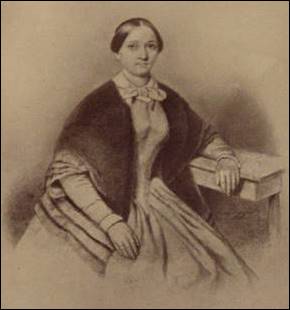
Božena Němcová in 1850 (drawing in pencil by V. Misliweček)[81]
The first of Němcová’s acquaintance was certainly her landlord Antonin Brzorad, who was later the mayor for many years. The patrician wealthy family of the Brzorads not only had many relatives in Nymburk, but also many friends people, to whom Němcová was naturally introduced. Among these, apart from Antonin’s brother, Filip Brzorad, the commander of the National Guard, there were also Antonin Brzorad’s nephews, Filip Černý and Jan Černý, known to us as a centurion of the Nymburk National Guard. So Němcová was an acquaintance not just of the Brzorads but also the Černýs family. The Brzorads were also related to the family of Všetečkas (Antonín’s grandfather's wife was Ludmila Všetečková), and the Černý family who were in a family relationship with the the Mašíns family (Jan Černý married Maria Mašínová). Kateřina, the sister of the two Černý brothers, married Jan Fleischman (No. 129), and so the circle of acquaintances spread to this family. This also explains why these well-known and affluent families belonged to Němcova's Nymburk's acquaintances.[82]
Němcová’s friends in Nymburk did not forget the interesting looks of Božena Němcová, and when poverty fell on her later on, they helped her with pleasure and willingness. The mediator was a maid Marie Votová, who, when the chips were down, wrote to Nymburk to the Brzorads, Mašins, etc., and never asked in vain. Thus much is known about the friends of Božena Němcová in Nymburk.[83]
From Vondruška's work, we will also make use of the observation of the involvement of the Nymburk Brzoráds in revolutionary events:” It is interesting that the men at the head of the Nymburk’s National Guard[84] were men who also otherwise participated in public life. The commander was Filip Brzorad, the brother of the future mayor Antonín Brzorád and the son of the deceased (1848), mayor Vincenc Brzorád. The centurion was Jan Černý, Filip’s cousin, and František Všetečka was a Lieutenant. We meet the same men, leading burghers, in the security and information committee formed according to the Prague example to watch over the order in the community in these stormy times and to inform the public of everything they needed to know and what to do. In addition to the above we read the name of Dr. Jan Dlabač (1809-1873), the most intimate Němcová’s friend in Nymburk, Antonín Brzorád, Němcová’s landlord, František Mašín the brewmaster and others, all of whom Němcová would meet. At the time, Němcová came to Nymburk. There was, apparently, a lot of old lethargy and philistinism, but also a fairly enthusiastic fervor and pure national feeling.“[85]

Bohumil Hrabal about Gustav Brzorád MD (1844-1914)
The only son of Antonin Brzorád (1809-1877), MUDr. Gustav Brzorad (1844-1914) was a Nymburk physician - small, tiny, extremely active and hardworking, a great lover of nature. He lived in his birth house in Boleslavska Street No. 243, often bringing his family and friends together at his place. Note that we can find the hospital right in front of his house. He also owned a house on the square, at the corner of today's Kostelní Street. "This house, which was burned out in 1838, was apparently inherited from his inlaws. He had it demolished and built a contemporary house no. 40 and 41. in its place. - The house has preserved its original Neo-Renaissance appearance in the direction facing Kostelní Street until today. On this side at the level of the first floor we also find the statue of St. Theresa and under it there is an interesting inscription "IN PERPETUAM UXORIS USAE MEMORIAM ANNO DOMINI MDCCCLXXXVI." Meaning, to the eternal memory of his wife AD 1886. The name of Gustav Brzorad’s wife was Theresia. [86] Baptized as Terezie Anna (19th June 1853 - August 26, 1878), the daughter of Antonín Červinka, a citizen of the town of Nymburk from the neighboring house No. 42 and Anna née Dlabačová.

St. Terezia’s statue on the corner house nr. 41 in Kostelní street.[87]
In 1860 a permanent basis was laid for the amateur theater in Nymburk, when the students, who were on vacation there, led by the „Gymnasium“ pupil of the 6th year G. Brzorad grouped around L. Rubinger ... and set up an amateur theater. ... The play Divotvorný Klobouk by V. K. Klicpera was very successful on September 3th and therefore the students played two more performances, Pašerové and Dr. Faust’s Domestic Cap. After these performances the theater was transferred from the boys' school to the U Černého Orla inn in the square, which stood in the place of today's MUDr. Antonín Brzorád‘s house. In the following text by Anna Jíchová, which was edited and adopted for his own by the writer Bohumil Hrabal[88], we read the story about the family of Gustav Brzorad MD from Nymburk:
"Behind the Boleslav Gate – at the corner of Velké Sady and Boleslavská Street - there is a large one-storey house ... with a nice balcony on the first floor. In front of the house is a neat garden with beautifully smartened up flower beds, surrounded by a fence, its rods are embedded in a low wall ... there are two barns screened by two mulberry trees and an old deep well ... Water is still weighed with a heavy steel bucket attached to a long chain, winding on a powerful shaft[89], ... Behind the house stretches a large, measuring a few korecs,[90]garden ... full of various fruit trees and bushes, gooseberries, currants and large beds of raspberries. Around the wall there are jasmine and lilac bushes ... today it is owned by Antonín Brzorád, doctor of medicine. His lady is beautiful and they have two daughters. His father was a small, tiny person ... He was a physician - a philanthropist ... in a tailcoat and an indivisible umbrella slung over his shoulder ... Everyone was „a little friend“ to him ... Once on a gloomy Sunday, our mother told us what she knew about the youth of the "doctor little friend". We could not believe that he had been young too ... Yes, he was young and certainly cheerful, my mother started ... His bride, with whom he was in love very much, was rich and of the most prominent family in the city ... He had put a lot of effort in making the bride’s parents like him. They then forced their daughter to renounce her love for a poor teacher and go to the altar with Dr. Brzorad ... Both lovers took this act of the bride’s parents with difficulty ... The young lady's beloved place was the little balcony in the front of the house. The grief was too deep for both of them ... the teacher was carrying his fate hard ... Along the fence of Brzorad's garden it smelled of lilac and jasmine, pansies and daffodils blossomed ... In the eyes of the young lady there was sadness and sorrow… Lilies of the valley and the lilac went out of bloom and in the warm summer nights the nightingale mournfully sang. … The fruits of strawberries smelled nicely ... The sadness did not leave the young lady ... Bad illness gnawed in her body and in the spirit of her sweetheart ... The windows of the little room, where the teacher stopped breathing were wide open ... death brushed with her wings the forehead of the sick man ... Then the young lady fainted heavily ... the sound of the death bell cut deep into her sensitive soul ... When the days of her life were filled, and Mrs. Brzoradova gave birth to her son, not even her husband's great love could keep his dear wife alive ...

Boleslavská street Nr. 243, Brzorád’s house with the balcony[91]
Sadness shuddered in our mother's voice ... After a short break, she told us: When you come to the cemetery, just opposite the chapel, by the first gate is a simple white memorial to Mrs. Brzorádová. There is a gilded inscription saying: Untimely, my beloved wife left me, she will be waiting for me at the gate of heaven, where our hearts will be forever united ... Underneath the verse a blank space is left, to be filled in with golden letters when her husband will be lowered into the grave... The “dear little friend”, doctor has counted exactly the day when he leaves and when the sculptor picks up a chisel to put his name on a marble slab ... He did not forget anything, our “dear little friend”, doctor even determined the last path ... I do not know if the nightingale in Brzorad’s garden sings still sou mournfully ... (From the book „Život není žádná pohádka“ written by Anna Jíchová, Cleveland, O., December 30, 1951, which was adopted by Bohumil Hrabal as his own text.) [92]
P.S. I was given this book one night at the U Zlatého Tygra inn by a young man with a note that his aunt from America sent him this book. And he is my reader and has just read the trilogy Městečko u vody (a Small Town by the Water), and „Život není žádná pohádka“ (the life is not a fairy tale) could be of interest to me because it is also about Nymburk. And when I read the book, I found that the way of seeing the town, where also the writer's time stopped, is the same as my poetic ... the author even stands above me in the sight of the detail... So first just in my thoughts and then in fact I copied the book in a shortened edition, made my textbook out of it, my abstract, my topography, by which I walk through the streets and visit the villages and places where the author's mother and herself went; And that is how I go around Nymburk and its region, like Marcel Proust, looking for and at the same time - in my thoughts - finding the lost time ... "[93]
Gustav was a member of Union of the Czech Brethren - Sion, „established in 1891 with the aim of setting up a separate reformed church and building a respectable temple of the Lord.“ At the suggestion of Sion member MUDr. Gustav Brzorad the plot Na Spálence was selected for the construction of the church and it was purchased at a favorable price from the Northwest Railway on December 16, 1895. [94]
On the death notice we read that MUDr. Gustav Brzorád died on December 29, 1914 supported with holy sacraments as a „health consultant of k. u k. State Railways and a city doctor in Nymburk. Signed below is Gustav's son MUDr. Antonín Brzorád, k. u k. chief physician of the State Railways.[95]
Antonín ‘Gruntorád‘ Brzorád MD (1876-1953)
Antonín Brzorád MD (1876-1953) was born on September 20, 1876 in Nymburk Nr. 243.
The construction of the Nymburk hospital, across the street, was completed in 1881. On January 31, 1882, the hospital was consecrated and named "The District Hospital of Crown Prince Rudolf in Nymburk" and the operation of the hospital commenced on the following day. The hospital began with twenty beds, but it was extended to fifty the next year. Medical care was provided by two doctors: dr. Brzorád and dr. Baštecký; nursing care rested on the shoulders of the merciful sisters of the Order of St. Karel Boromeus. [96]
On February 18, 1905 Dr. Antonín Brzorád married Zdeňka (1885-1966), daughter of Josef Kabát, director of the sugar factory in Velvary. In 1907, they lived in Nymburk, No. 41-42. At that time their daughter Marie was born. Elsewhere, we read that they lived in a rebuilt native home house (Nr. 243), and that Antonin remained a friend and doctor of the family of Tomáš Černý, who we will talk about later. Today's contemporaries are reminded of several generations of the name of the homeowners who hosted Božena Němcov by the name of the park, which originated from the adjacent gardens and lands and which surrounds the house today, „Park Dr. Antonína Brzoráda“ (the park of Dr. Antonín Brzorád.) Her granddaughter remembers Zdeňka: "My grandmother was a charming, marvelous lady - she had a beautiful soul, I loved her very much. Her sister Milka, married Polák, and she was the mother of the famous professor of surgery, Emerich Polák, who was the head of the surgery department at the Vinohrady hospital in Prague; he was also a dean in the Medical Faculty in Vinohrady. Interestingly, he went to his uncle in Nymburk for holidays; the contact, and the rides with him influenced his decision to become a doctor. Grandma would often go to an orphanage, which she also supported financially." [97]

Antonín Brzorád MD, a physician in Nymburk, a character in B. Hrabal’s novel and film Cutting it short, with his wife.[98]
In 1908 Antonin had house no. 252 built. (today the corner of the Palacký and Komenský Street). " The designer of the historic town house at the boundary of the historical center of the city, was the architect Osvald Polívka, who also designed the Nymburk Art Nouveau water tower and the summer villa of his father-in-law Dr. Tomáš Černý in Nymburk. In 1910, Antonin Brzorad, MD added a stucco relief of the arrival of Eliška Přemyslovna – later Elizabeth Queen of Bohemia (1292–1330) to Nymburk over the main façade made by the Prague sculptor Karel Novák. - It was the 600th anniversary of the famous event when Princess Eliška escaped on the night of 28. 5. 1310 from the intrigues of Henry of Carinthia from the Prague Castle and resorted to Nymburk, the town loyal to her father, Václav II. as well as to her. Here she spent the entire month in the former medieval house at the Black Eagle in the main square. - The partly cast and partly modeled relief depicts Elizabeth sitting on horseback in a simple dress with the company of the knights of the Lord of Vartemberk and the two maids accompanying her; at their feet is a bowing mayor. The scene is in a historically realistic concept with Art Nouveau elements. [99]

Nymbur, house Nr. 252, corner of Palackého a Komenského streets[100]
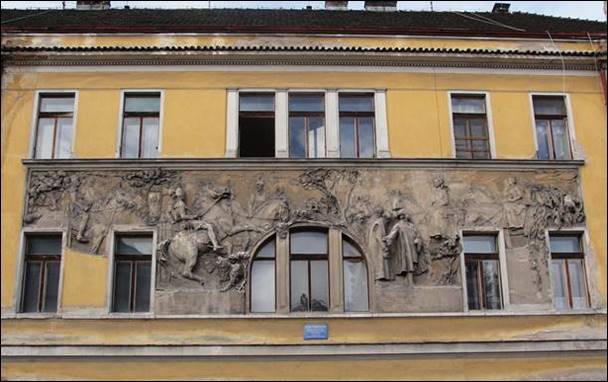
Stuco relief by Karel Novák, on house nr. 252, in 2017[101]
Antonin was also a prominent chairman of the Nymburk sports club Polaban, for which he donated land for a football field. "... The years long dream of pharmacist Polák was fulfilled on August 18, 1909. At the constitutive meeting of the Nymburk sports club in the restaurant "U Matějků "(today's Dělnický dům) binding statutes were approved and the name Polaban was kept. It had 42 members at its establishment. ... In his absence MUDr. Antonin Brzorad, who was at that time an ulan at the military exercise in Vysoké Mýto was elected a chairman with 28 votes . Time showed it was a happy choice. The famous doctor has been at the head of the club for almost three decades. He assisted in its rebirth and at the end of his term he also experienced a period of considerable boom. ... At the January (1910) general meeting, the chairman dr. Brzorád highlighted the efforts of the committee, which had managed to form a team of players in the record-breaking time, and he also appreciated the introductory game results. He also did not forget to thank the city council for assistance in choosing a new pitch Also the journalists were thanked for the popularity of Nymburk football. He was pleased to note that more and more viewers came to the gallery. ... 1911 MUDr. Brzorád was re-elected the president of the club. ... 1920 In October, a significant event occurred in Polaban's history. The chairman of the club MUDr. Antonín Brzorad gave footballers the field for their football pitch his own plot behind the gassworks. The Football Union Committee, headed by Frantisek Joch, urged members and all supporters for the rapid transformation of soft tillage field into a solid pitch. ... 1928 Dr. Brzorad was named honorary chairman of the club. 1935 Before the kick-off of the first division match with Petrin Pilsen, a festive mood prevailed on Sunday, August 18, and excited speeches were given by Mayor Fiala and MUDr. Brzorád. ... The merits of the long-time chairman of the club, MUDr. Brzorád were appreciated at his sixtieth birthday, when the playground behind the gasworks were named „Dr. Brzorád’s Stadium”. This ceremony took place during the club celebrations. ... 1939 At the July ceremonial meeting, the 30-year continuous work of the chairman MUDr. Antonín Brzorád was appreciated by presenting him a diploma and honorary union badge decorated with Czech garnets. ... 1940 Prague citizens were very warmly welcomed, Chairman of Polaban, MUDr. Brzorad recalled that it is an honor for the club in Nymburk, that a former home player Věchet plays for such a famous team. The guests responded with the compliment that they would soon be heading to Nymburk for league matches."[102]
After the outbreak of the World War I in 1914, a prison camp and infirmary was set up in the military camp in Milovice. The leading physician there was MUDr. Antonin Brzorad from Nymburk and after him MUDr. František Tichý. 18,000-20,000 prisoners were guarded in the whole facility, but after large offenses there were up to 48,000. [103]
In the town of Nymburk an association of gardeners and fruit growers was founded, which was chaired by Dr. Antonín Brzorád. The group had less than 20 members at that time, but mostly they were owners of family houses with their own gardens. He himself had dozens of fruit and ornamental trees on his estate, and for this purpose he had his own gardener, along with the families of the stableman and the driver of his personal car. The flats were along the current sidewalk in Poděbradská street from the family house. The whole garden had about 4 hectares of land, on one side to the estate of Mr. Janek and on the other side, today Smetana's Street as far as the Hussite Church. That was in 1915. [104]
Dr. Antonín Brzorád was also the chairman of the board of directors of the brewery in Nymburk in 1934-1948, where František Hrabal ("Francin"), stepfather of Bohumil Hrabal, also worked since 1919, in the years 1930-48 as its administrator.[105] Little Bohumil became fully aware of the environment of the brewery in Nymburk and brought a number of real characters to his Cutting it Short – Postřižiny novel. The fact that Dr. Gruntorád - according to the book the admirer of Hrabal's mother Maryška - was actually MUDr. Antonin Brzorad, is confirmed by his granddaughter, Jana Bernáthová: "My Grandfather is indeed Gruntorád. Mr. Hrabal asked my mum for permission to mention him in the book and, after the agreement, he changed the name of Brzorád to Gruntorád." [106]
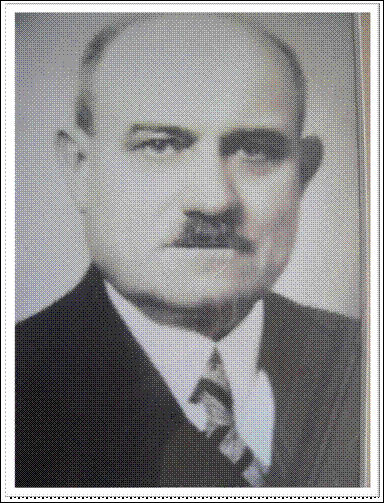
Antonín Brzorád M.D., a physician in Nymburk and a character in B. Hrabal’s novel and film Postřižiny (Cutting it short). [107]
His granddaughter remembers him as follows: "Antonim Brzorad (my grandfather) was a devoted physician, working night and day. I remember how the patients rang the bell at night at the door, the coachman Mr. Staškevič hitched a buggy with a horse and grandfather drove to a patient in the village. In winter he rode a sleigh - for me, amazing experiences, I had frequent rides with him. Every Sunday, he attended holy Mass. To the church of St. Giles he would ride in a closed carriage. He liked to go out to meet ordinary people at the Fidrmuc pub. He was a strict but kind grandfather. He would go hunting, two hunting dogs lived in his native house in Boleslavská Street. In the native house there was the so-called smart garden where even I admired the amazing flowers and trees. In addition to the beautiful garden, there was a large orchard that was looked after by Mr. Socha. I went to Nymburk regularly with my parents from Prague on Sunday for lunch, then for holidays." [108]
"In our last stop in the cemetery at St. George we mentioned the fate of some Nymburk families and their remains in connection with the removal of the cemetery. We have managed to find out that not all the remains "have disappeared irretrievably". ... the exhumed remains of Nymburk families - Červinka, Krajský, Černý, Huňků and Brzorád were also buried in the years 1967 - 9, including the remains of MUDr. Antonín Brzorád - grave No. 1618 - 1619 / IV."[109] Both Dr. Antonín Brzorád’s daughters Marie Pohorecká (1907-1984) and Jana Hanzalová (1917-1998) as well as his wife are buried in the tomb.[110]
Kateřina Černá née Brzorádová (1771-1831)
In 1771, Kateřina Černá née Brzorádová (1771-1831) was born in Nymburk. It was she who married Tomáš (II.) Michal Černý from Nymburk, who belonged to the circle of Nymburk acqaintances of Božena Němcová.[111] Their son, Jan Černý (1808-1857) was a centurion of the National Guard in Nymburk in 1848 and remained in contact with his uncle, Josef Brzorád, whom he would tease in his letters by using Czech language. He married Marie Mašínová from Nymburk, who corresponded with F. L. Rieger[112] and their son JUDr. Tomáš (III.) Černý (1840-1909), lawyer and Prague Mayor. He is presented in Jan Otto’s Encyclopedia as an "excellent Czech lawyer, co-founder of the Prague Sokol, of Zemská banka (the country’s bank), 1882-85 Prague Mayor." It is his voluminous fonds deposited in the Archives of the National Museum, which contains the genealogy material preserved for the families of Filip Brzorad of Nymburk and his son, Josef Brzorad, of Lochkov. It is not only their correspondence and copies of the baptismal letters, but also a family tree, the ancestral chronicle, a notebook from which we will later quote, a book of period observations describing 19th century society and others. The fonds is currently being processed. [113]
Josef Calasanz Brzorád (1777-1857), state councilor, owner of Lochkov estate
On the 2nd of October 1777 Josef Brzorád (1777-1857) was born as the youngest child in Nymburk, baptised as Josef Calasanz[114] by his uncle a Piarist priest Philip Sebald Wschetecžka, SchP[115], who otherwise taught at various Piarist Gymnasiums (High Schools) in Bohemia. This also explains the choice of his patron saint. Joseph Calasanz (1557-1648), a Spanish teacher and contemporary of John Amos Comenius, whom he can be compared with as a reformer of education in the first half of the 17th century. He was a very pious and educated priest who, for the care of the school, established the order of the Piarists who are still active in our country. [116]
It is not surprising that, like his brothers, Josef C. Brzorád completed his high school “gymnasium” studies at the Piarists in 1793 in Prague.[117] Thus he was there in 1792 when the Czech poet and linguist Josef Jungmann[118] studied there too. Then Josef C. Brzorád studied Philosophy (1794-6) and law (1797-1800) both in Prague, the same as his brothers Jan and Vojtěch did. He took the final examinations[119] (for" Aichbeamt ") and those for the civil service - now we would call them “state exams” - in Prague in 1801-2.
As an articled clerk he worked at the Regierung / Gubernium, a provincial government in Krakow for a year. He was then a judicial candidate to the Prague magistrate until 1804. According to Schematism in 1805 he was registered in Týnská street in Prague with his brother Jan. In 1804-1806 he was a substitute councilor to the magistrate (“Magistratsrat”) in Kutná Hora[120] and also in Mladá Boleslav in 1806-9.[121] When his father bought the manor estate of Lochkov near Prague, he gave it to him. (Vilém writes elsewhere, "Because of illness, in 1808 Josef gave up the service and retired to Lochkov".) He kept it to his death. Here he performed the judiciary power until 1839 and he personally managed the farm, until 1853, when he yielded the position of „justiciar“ to his son Vilém. In the same year he assigned his oldest son, Karel the tenant of the farm and passed the management of the farm to him.[122]

Josef Brzorád 1777-1857[123]
Correspondence 1807-1811
Else Fritschl studied part of correspondence between Joseph C. Brzorád, his father, father-in-law, his future wife, mother-in-law Delorme, and his brothers from the fonds Černý preserved in the Archives of the National Museum in Prague. Thus we learn some new details from the time of Lochkov's purchase and Josef Brzorad’s getting acquainted with Anna Delorme. The letters which Joseph wrote to his father were in Czech. The answers were often written by his brother-in-law, Tomáš Černý, in German, as well as letters from Joseph's brother Adalbert.
Their German is slightly different from the language of Anna Delorme, who probably, for lack of formal use of the language, apparently writes her lines, as they would come up in her mind. She does not use punctuation - neither comas and fullstops, nor even capital letters to divide sentences - and thus moves freely from a variety of practical themes to romantic ones and back. As for the neatness of writing, the letters from Ferdinand Delorme and his wife have the peculiarity that the letters in the words are not interconnected. Their daughter has already begun to link the letters. They all use German in their communication, Ferdinand occasionally employs a French expression.
On February 16, 1807, Adalbert Brzorád wrote to his brother Joseph after the sale of the Nymburk mill - in response to his letter - that he was surprised - did not know that it would be so easy. He hopes that his father is now freed from worries and can enjoy the peace of his age. The price was good. "Maybe someone would say it's too expensive. But the buyer was satisfied." Some of the family did not behave well towards Joseph. He is surprised - he did not know that such a thing could happen in their family - that there would be greed, avarice. Their parents were so fair and they always tried not to favour anyone and not to privilege anyone. "Tell me honestly, who was so immodest and stupid to reveal his real character on such an occasion?" As for the money from the sale - what the father does is good because Josef gets his share first - the others (5 people "interesanten") in installments. "I'm happy." Josef is supposed to take care of Adalbert's share (to invest well).
On the 9th of April 1807 Josef Brzorád writes to Tomáš Černý to Nymburk about the sale of the mill in Nymburk and the purchase of a new estate. There were more estates to be sold – He liked "Gut Loyowitz" but it was sold - a pity. But he thinks that such a thing, albeit bad, was sent to him by God. When his father goes to Prague, he should look at the estate – “Gut Tresning". "If he thinks it is worth it, I am already satisfied." He adds that at the table where he ate he heard about the auction of the “Stalsko” estate. A Saxon-based private businessman bought it at an auction for 128,000 gold. However, between the bidders there was a reprehensible (sträflich) agreement – he paid them 1000 gulden each. "It's hard to say whether this auction is valid at all!"
On the 23rd of December 1808 the beginning of the letter to Josef Brzorád from Mr. Lipkowenz is promising: "Hochedlegeboren Herr von Brzorád ..." But then we learn that Brzorád promised the seller Arioli (apparently in the course of the negotiations for the purchase of Lochkov) to deliver some pheasants. And so he received a letter from Mr Lipkowenz that the agreement was already valid and that he would have to send the pheasants, otherwise he would regret when they were bought elsewhere and the bill was presented to him for reimbursement.
Then the first letters from Delorme from Portheim’s palace showed up. They are written alternately by Maria Anna Delorme née Schell (signed either as „Delorme” or “Anna Delorme”) and Ferdinand. The first contacts between Joseph and the Delormes seem to occur regarding sending corn, salt, fruit, vegetables, etc. between Lochkov and Smichov.
In 1809 (perhaps September) the first letter goes to Lochkov and in it Anna Delorme née Schell thanks him for the vegetables and fruits, and asks for eggs. The addressing was apparently only overheard and therefore flawed: "Werther Herr von Persorád" (Honorable Mr. ...) Signed by “A. Delorme”.
A month later they are invited to Lochkov to meet Josef’s father, Filip. Anna Delorme née Schell replies that it's not easy to meet on the weekday when Ferdinand Delorme is busy, but everything has to be done to meet his father (that is, Philip). If he can, he is should send his horses - they have a problem with theirs.
January 16, 1810 Tomáš Černý writes from Nymburk to Josef Brzorad at Lochkov that Filip can not answer because he had to run somewhere else where they have a problem with water - the water was not clean.
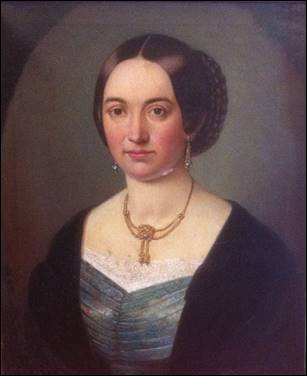
Probably Anna Brzorádová née Delorme, or her mother. [124]
January 17, 1810 Anna Delorme née Schell wrote from Smichov to Lochkov to thank him for the gift and hoped that Joseph would visit them again, and that her daughter gave her thanks for the books that Josef B sent. She would read them with pleasure.
On the other side of the letter Ferdinand Delorme wrote (he always begins - despite the contemporary social custom – his sentences in the correspondence - "Ich") and asked for Lochkov laborers to work in his garden. They would get 30 groshen per day. He would also use 2-3 “Mädgens” - girls for the factory – the girls would work in warmth and get 7-8 groshen. If there are such "Subjecte" in Lochkov, he would like them as soon as possible.
In April 1810, Ferdinand wrote to Joseph about problems with one of the workers. First, he thanked them for the butter, he invites Josef to "Suppe" (soup) - if he has nothing better to do on Sunday. The Lochkov people who came to thrash the grain had apparently arrived. "Radomický" - the Lochkov laborer went to work for the Jew in Smichow instead. "When I learned this, I went to the police. The police officers deny that he would be there. Radomicý and the Jew have done something fishy (Unrat). He returned to our place to sleep in the stable (Stall). I handed him to the police the next day to be punished. ... I am expecting you on Sunday."
In September 1810, Anna Delorme née Schell wants some grain - she has "Verlegenheit" - difficulty getting 19 (unknown kind of unit) of grain. She asked Joseph to send it or buy it in Slivenec for her. Signed "Anna Delorme".
In 1810 on St. Wenceslas day (28th September) Anna Delorme née Schell thanked him for the eggs and the hulled grain. He had offered her some young "Frischlinge" - this year's youngsters ( probably of a black-haired wildboar), but she wanted him to wait with them as she had no place for them. She was glad that he "Hofdecernamt" (department of the court office in Vienna) offered his brother the office of a mayor because thus he would be closer to Josef.
In another letter, Ferdinand asked for help with milling, and he added humorously that Joseph can sees that if one is "complaisant" friendly, everybody exploits him ...
November 27, 1810 from Smíchov to Lochkov: "I am delighted that you have offered to grind the grain. As soon as I get the promised salt, I will send it - if possible today. ... I understand what you want from your behavior, not from what you write. I guess you did not understand my daughter completely. If you have more contact, the relationship will form. From my experience I know that such “Mädgen” (Mädchen – girls) never say YES for the first time. Nanny has no experience. Perhaps if you are persistent, you will not be treated as "Morast Veilchen" (violets in mud). The snag may be that you think you are courting a rich subject. Otherwise, according to good German manners, you should approach the father, who is not rich at all, though. And the daughter is not rich either. Nor is she going to get rich from her parents. And so your wish will not be fulfilled because your wife has no money, which I can tell you straight away. Your devoted friend Delorme "
They continue to visit each other.
11th of December 1810 "Your friend Delorme" sends salt and sacks of flour to Lochkov, looking forward to the meeting - for “Suppe”.
On the 22nd of December 1810, Anna Delorme, born Schell writes to Lochkov: "It is time you said "Wörtchen" - a word, because some say you are already dead." They thanked him for good nuts and a nutcracker. The daughter would thank him when she could see him, which she hopes would be the next day. "Come early because we eat at 4 o'clock. Keep in mind that you will not be able to leave during the holidays. Thanks for the sausages, rye, peas and lentils we've got."
On the 23rd of December 1810 Ferdinand writes, "Best sit on a horse or carriage and come for a soup. I'll be home from 12, and we can talk long."
According to other letters deposited in the Černý fonds of the National Museum Archive, Anna née Delorme, later Brzorad, borrowed books from the Lochkov library before the wedding. One of the authors of the books is Ewald, the names of some books are Bagatellen, or The Journey to Paris. The letters that Anna and Josef exchanged were delivered by a wench who would carry milk from Lochkov to Smíchov. One of the letters mentions preparations for a visit of Josef's father, Filip Brzorád from Nymburk. When Anna wanted to write a letter to her future father-in-law Filip Brzorad in Nymburk, she wrote a careful draft.
Also Josef made a draft first. There is a particularly interesting one of his two versions of a very smooth-tongued letter in which he attempts to introduce himself to Therese Weisenberger, Anna Delorme’s older sister, then married to the rich trader Kašpar Weisenberger in Vienna. We do not know its exact dating, nor do we know which of the versions was eventually sent. However, her forthcoming response is dated in Vienna on 16 April 1811 and it arrived in Lochkov on 21 April 1811. It took 5 days. In the German concept we read the sentences in the sense:
"Life is short for long compliments, so I put them away and introduce myself without their help. ... when I tell you how happy I am that I found my life mate. Now my wishes will be fulfilled ... It is the blessing of the generous Father of all that I may be related to you. So I wish that this bond was not just for the civil law, but that it was true friendship and affection. I will try to do all that is in my power. But until I have the opportunity to prove that what I have said is a fact, I ask for Your favor. ... Your most humble servant...“
What follows is the most interesting description about how to pronounce the name "Brzorád". Let us emphasize that - not only for the genealogists - this is a rather rare finding. From this more than 200-year-old text we can not only learn the facts and the form of written language. This time, the sound of a word that nobody could record for us at the time, can be heard:
„After I have introduced myself to You, I would like to ask you to recommend me to your husband as someone who seeks his friendship. I have heard that it is very difficult for him to pronounce my non-Czech[125] (nicht böhmischen) name. I have no choice, and to make it easier for him, I will mention this peculiarity of the Czech language, in which it is not unusual that consonants R and L are used instead of vowels, of which my name is an example. I therefore kindly ask your spouse to take the first two letters of my surname "Br" as one syllable - a bit - like the habit of a coach controlling a horse, while slowing down a wild steed.[126] And then he should let the next "Z" sound like the French Ç up to the next "O". I think the correct pronunciation of my name will no longer be a problem.”
The original is: “Nachdem ich mich auf diese Art bei Ihnen eingeführt habe, bitte ich nun auch, mich bei Ihrem schätzbaren Gemahl auf das Beste zu empfehlen und als einen Mann vorzustellen, dem daran gelegen ist, sich seine Freundschaft zu erwerben. Da ich vernommen ,daß es ihm schwerfallen soll, meinen nicht böhmischen Namen auszusprechen, so kann ich nicht umhin, zu seiner Erleichterung die Eigenheit der böhmischen Sprache hier berühren, in welcher es nicht ungewöhn lich ist, daß der Mitlaute r und 1 die Stelle der Selbstlaute vertreten wovon sogleich mein Zuname ein Beispiel abgeben kann. Ich bitte daher den Herrn Gemahl , die ersten zwei Buchstaben meines Zunamens Br als eine Silbe auszusprechen versuchen zu wollen - ungefähr - wie die Pferdebändiger in Gewohnheit haben ,um ihre mutigen Rösser in Ruhe zuerhalten und dann das darauffolgende z wie das französische Ç zu dem o klingen zu lassen. Ich bin verführet, daß es ihm nicht halb so viel Mühe verursachen wird, diesen Namen ganz korrekt zu lesen.”[127]
On the 11th of June 1811 "Josef Brzorád, the owner of the Lochkov estate", at the age of 34 married the sixteen-year-old Anne Delorme, a Catholic in the Smíchov church. The witnesses were his brother Jan Brzorád J.D. and brother-in-law Kaspar Weissenberger, businessman. From the voluminous correspondence of the engaged couple, we exempt the letter of the 8th June 1811 from Lochkov as an example. In the seals of Joseph's letters "JB" stands in as his coat of arms on the background of various agricultural tools. In part of the book called Familie Delorme, you can find a letter from the fiancée "Nanny" of the same date as well as her picture. „Brzorád” - as he signed - uses the addressing "Liebste Nina".
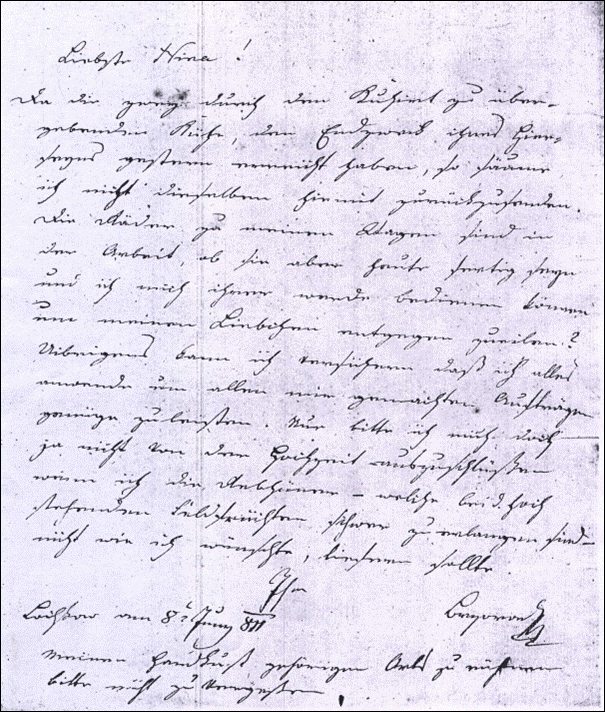
Dopis Josef Brzorád’s letter to Anna Delorme of 8th June 1811[128]
On March 28, 1812, a daughter Philipine Brzorad was born in Smíchov in house nr. 80, baptised at St. Philip and Jacob. The Godparents were Anna with Ferdinand Delorme and Caspar with Teresia Weisenberger. After the death of Philipine’s mother, it was she who cared for her siblings and later as a spinster for their children.
In 1813 Karel Brzorád (1813-1871) was born in nr. 80 in Smíchov and baptised as Carl, Ferdinand, Johann, Caspar. The Godparents were “Ferdinand Delorme, Kaufmann”, „Johann Brzorád, J.u.D“ and „Caspar Wewissenberger, Kaufmann.“ Karl was the successor of the family in Lochkov and his family was very numerous.
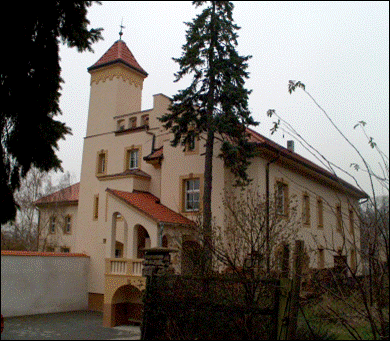
Lochkov’s castle from the back, photo by JS in 2002
In 1814, Josef Brzorád became the owner of the Lochkov allodial estate, and in Schematismus he is also referred to as "Justiziär".[129] The Justiziär was a lawyer qualified in political sciences, who himself was in charge of dealing with heavier lawsuits. For this position, the directors of estates would chose a Prague lawyer or shared a lawyer with another lord.[130] As for the farm, we already know that Joseph's father bought a coal mine and two meadows in Smíchov due to lack of wood and land.[131] We find them in a cadastre maps dating back to 1840 on what is now an island called Císřská Louka on the Vltava River directly against Vyšehrad. In the 19th century, then the house No. 1 in the yard was rebuilt into a modest mansion. The building of a rectangular ground plan with a turret, a balcony in the front and a short wing had its own chapel. In the 1840s Lochkov had 49 houses with 485 inhabitants[132] and a farm of 277ha. [133] More about the Lochkov vineyard, the harvest or the garden can be found in the memories of Anna Brzoradová, which we keep as a whole in a separate section.
In 1814, Vilém Brzorád was born (1814-1898). Later, he was a provincial lawyer and administered Jinonice estate where he also died and was buried. More about him in a separate section further below.
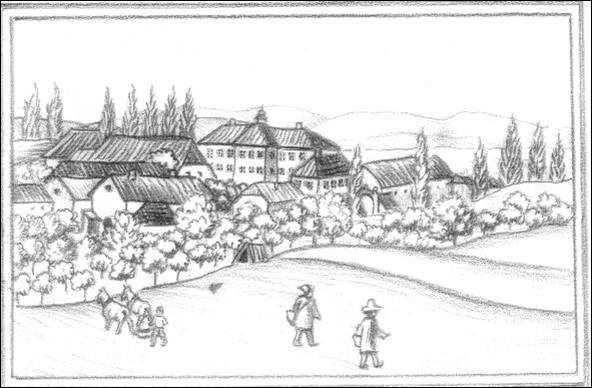
Lochkov – A blurred acquarelle by A. Erben cca 1850 copied in pencil by E. Fritschl
Meteorologische Beobachtungen
In 1816 Josef Brzorád begins to record meteorological observations, which he performed with great care at Lochkov for 40 years until 1856. In the year 1868, his son Vilém, then an attorney in Litomyšl handed these files, entitled „Guth Lochkow Meteorologische Beobachtungen vom/Im Jahr 1825 von J. C. Brzorád“, for the collection of Prague university Library into the hands of a family friend, k. k. librarian PhDr. Ignatius Hanuš.[134] In three well arranged tables there is a figure in columns with headings saying Baromether, Thermomether, Wind, (+ 1 unreadable) for each day of the month. Later Hygromether was added. His son, Vilém, enclosed a text “Správa” to the file, in which he introduces the personality of Josef Calasanz Brzorád to the librarian and writes about his relationship to sciences:
"His love to his homeland was warm, also to freedom, to knowledge, and especially to the findings of the arts and crafts. He was interested in the phenomena linked to astronomy as well as winds, to the extent that as a student he fostered an interest in bird catching. He recorded not only the number of caught birds, but using his own signs he recorded the weather at the moment of catching. From 1797, he also used signs for making notes of the winds up until 1811, when he got married. Then he had to overcome the difficulties connected with starting a household and farm facilities - he certainly had a lot to do for the past frequent changes of the owners of the neglected estate, and also for the repayment of the assumed debt. Then with a well-ordered household and necessary quiet in 1816 he began to write down three times a day in the course of 41 years of windy events with a caution so steady that if there was any obstacle – a trip etc. - to do it personally - he would instruct somebody to write down the recordings in question, which he would then copy in his own hand.
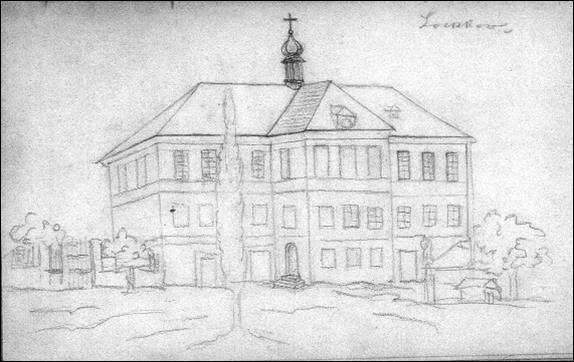
Lochkov - Skizzenbuch Anton Erben (archiv Else Fritschl)
Apparently he was also interested in astronomy and he was thinking about what he was doing with such zeal. That can be documented by the fact that he could set up set up a pressure meter, a thermometer and even the sundial, which he had set up many times. He would use the former during his trips to the mountains to measure their heights. I attach two sheets filled with his notes about astronomy and meteorology etc. ... "[135]
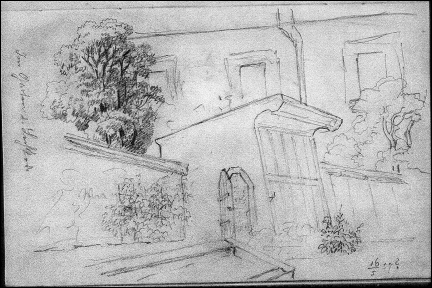
Im Garten von Lochkov 16.5.1857 Skizzenbuch Anton Erbens (archiv Else Fritschl)
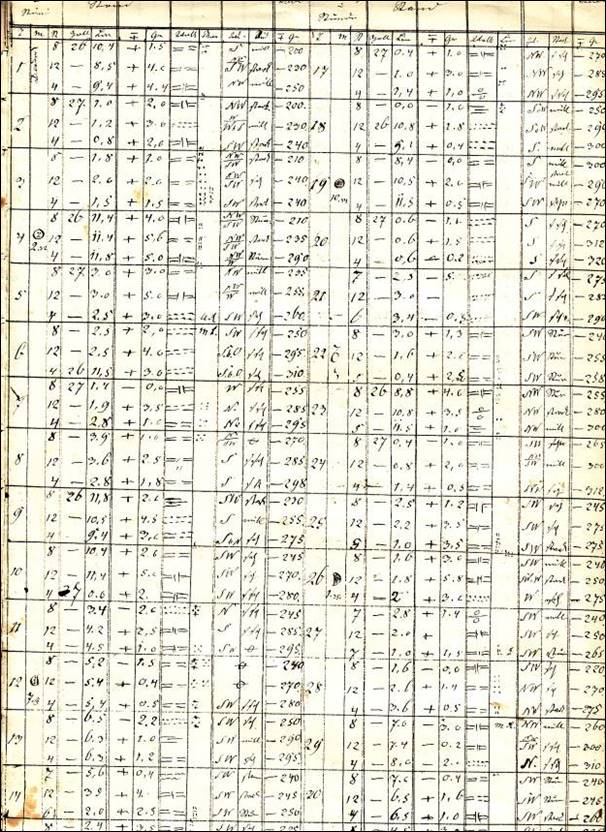
Guth Lochkow Meteorologische Beobachtungen vom/Im Jahr 1825 von J. C. Brzorad
On 6 March 1816 Luise / Ludovica Maria Theresia Brzorad was born in Lochkov, whose tombstone is still found in the wall of Slivenec Church. She died on 29 April 1817. The godparents were: "Ludowika Delorme, Hofmeisterin bei der Königin von Denmark, Ferdinand Delorme, Fabrikant von Smichow, Anna + Joseph ?” and “Theresia Weisenberger gebohren Delorme".
On 7th of May 1816 a widower Ferdinand Delorme, 60 years of age (religion given was “reformiert”) married 26 year old Theresia, daughter of “Franz Pichel Stadtrath” from Prague.
On 27th July 1818, Marie Anna Theresia Brzoradova (1818-1888) was born in Lochkov nr. 1, who later married k.u.k. engineer Karel Hauptmann. In the baptism register we read that her Grandmother Marie Anna Delorme née Schell was born in Prague nr. 151 and the godparents were Ferdinand Delorme and “Theresia Delorme, Fabrikantin vom Smichov”.
On 31st January 1820, Eduard Brzorad (1820-1898) was born in Lochkov, a future lawyer and notary in Deutschbrod, who married Marie Edle von Krziwanek (1834-1898), and thus joined the Brzoráds to the von Herites family. We dedicate a whole chapter to him later on. The godparents were Ferdinand Delome, Theresia Delorme and Theresie Weissenberger geb. Delorme.
On 26th September 1821 Ferdinand Ludovicus Brzorad (1821-1863) was born on Lochkov No. 1. He remained single and was an “adjutant” (assistent court official) of the provincial court. The godfathers were “Ferdinad Delorme, Kaufman zu Prag, Theresia Delorme, Kauferin, and Ludwik Nidaj / Nicolai, Studiosus.”[136]
On 16th April 1823, Josef Cal. Rudolf Ferd. Brzorád (1823-1890), the last son was born in Lochkov. Later he became a very wealthy owner of a farm and a coal mine in Hungary. His godparents were Ferdinand Delorme, Kaufman, Theresia Delorme, Kauferin” and sister "Philipine Brzorad, Gutsbesitzers Tochter".[137]
The magazine of the patriotic museum society “Časopis společnosti vlastenského musea” from 1827 - first year running – lists “Mr. Josef Brzorád the Lord at Lochkov” in the list of its subscribers.[138]
On June 14, 1828, Ludovica Josepha Ludomila Philippina was born in Lochkov No. 1 to Josef and Anna Brzorad. Sadly she died shortly on March the 5th, 1829.
On 12th December 1833, the last child, Anna Maria Philippina, Theresia Brzoradová (1833-1865), was born in Lochkov. Later she married the school inspector Anton Erben (1835-1905). Her godparents were siblings Karl, Philipina, Maria and Vilém, “Jurist im erst. Jahr”.[139]
The report about the Czech museum “Zpráva o českém muzeu” from 1837 mentions on page 231 that Mr. Brzorád, the Lord at Lochkov sent some kind of a lamb “potwotneho beranka” for the animal collections. [140]
The Danish princess visiting Lochkov
In June 1838, the Brzoráds / Delormes were visited at Lochkov by a princess and after 1839 Queen Karolina Amalia von Schleswig-Holstein-Sonderburg-Augustenburg (1776-1881), a charge but also a friend of Louise Delolme. Augusta Brzoradova (1851-1940) remembers this visit in 1935 newspaper article: "Between Chuchle and Radotin the steep bank of the Vltava River is broken by a side valley. One edge forms the round peak of a mountain, behind which lies the village and estate of Lochkov. This hill is called Karolinen Berg.[141] Why it is called so is known in Kopenhagen rather than in Prague. ... How hearty was the friendly relationship between the princess, the later Danish queen Amalia and her court lady and friend Louise Delorme we can see from the fact she visited the Delormes home in Braunschweig and Lochkov. (It is no surprise that Amalia wanted to meet Louise’s Cousin, Anna Brzorad née Delorme – with whom Louise had been in such intense correspondence contact.) That was in July 1838. She was wondering how the hill from which she was enjoying the beautiful view of the Vltava River valley was called. She was told it has no name. So the name could be Karolinenberg - Karoline's Mountain, the princess decided. The princess could afford something like this. Especially such a good princess. On the occasion of her visit the first children's care institution was founded following the example of Koppenhagen. It must have been a wonderful fate that next to the princess there was standing the grandmother of Augusta Brzoradova (1881-1916), who cared for the very "Kindergarten" in Vinohrady her entire life.“ [142](The article is displayed in full in the section on Karl Brzorád further below)

The Danish Queen Karoline Amalie von Schleswig-Holstein-Sonderburg-Augustenburg (1776-1881)[143]
Stammbuch für Anna Brzorád
15th of June 1841 "Joseph Brzorad Vater" wrote into his eight-year-old daughter Anna’s scrapbook[144]: „Liebe Gott über Alles und den Nächsten wie Dich Selbst. Dann wirst Du beten und arbeiten, der Tugend folgen, und das Laster fliehen und so Dein Glück hier und Jenseits begründen.“ - Love God above all and your neighbor as yourself. Then you will pray and work, follow virtue, escape unrighteousness, and so your happiness here and forever establish.
Mother "Anna Brzorad geb. Delorme" wrote about five days later: „Blühe auf wie das Veilchen im Moose, verborgen, doch edel und rein, und lass der üppigen Rose den Stolz bewundert zu sein.“ - Bloom like violets in moss, hidden, yet noble and pure. And leave the pride of admiration to the lush rose.
Stammbuch für Anna Brzorád (later Erben), Else Fritchl’s archive
All the siblings and their wives gradually contributed to the scrapbook. Merry Sister Anna was the darling of all.
On June 15, 1841, the brother "Vilím Brzorád" wrote copied 101st sonet from The Daughter of Sláva by Kollár[145] and added the folk wisdom: "Short speech and a nice word, will make people do a lot; and if you remember this, you will live happily." Vilím’s wife Antoinette, added to the enclosed flower: "Je vous donne ces penses – pour que vous a moi pensez There also „alte Tante Therese Weißenberger“ joined.
Brother Eduard wrote to his sister on September 30, 1841: „Ringe nicht nach eiteln Kränzen, zu oft sind sie des Zufalls Spiel; Nein, still zu schaffen, nicht zu glänzen sey Deines Lebens schönstes Ziel.“
27. 2. 1842 Sister Philippine wrote: "„So sanft, so geduldig, so folgsam wie dieß Lämmchen, möchtest Du werden, meine liebe Schwester! gewiß die Liebe Gottes und allen guten Menschen wäre dann Dein reicher Lohn. Dieß der Wunsch Deiner Dich innig liebenden Schwester.“
Also the old Uncle Caspar Weißenberger showed his humour, when he wrote on 14. 4. 1843: „Darf ich Liebe Nanny darüber keinen Vorwurf machen, daß du dich nicht darauf erinnerst schon im Jahr 833 bei mir in Mogyoros gewesen zu sein, so behalte dagegen in deinem freundlichen Andenken, daß ich 10 Jahre späther bey dir in Lochkov war, …“ It was in 1833 that Anna was born.
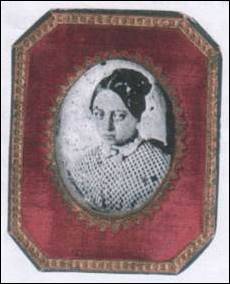
Anna Erben née Brzorád, Daguerreotype par Monsieur Le Pescheur 24. 5. 1849[146]
The painter Thorald Læssøe at Lochkov.
In 1842, Lochkov was visited by the Danish painter Thorald Læssøe (1816-1878). He was the son of Margarete Juliane Signe née Abrahamson, a prominent and literally active hostess of art circles in Copenhagen. She was known to Louise Delolme. Thorald Laessoe studied at Kunstakademie in Kopenhagen and painted landscapes and architecture. He was driven to Prague for his studies and he visited Lochkov because of his acquaintance with Louise Delolme. He received a friendly reception here, which brought him closer to Louise, even more than his illness or his sensitive, melancholy creature. He also painted a view of Lochkov for Louise Delolme on a folder, which he had made himself, for Louise to hang it over the writing desk. [147]
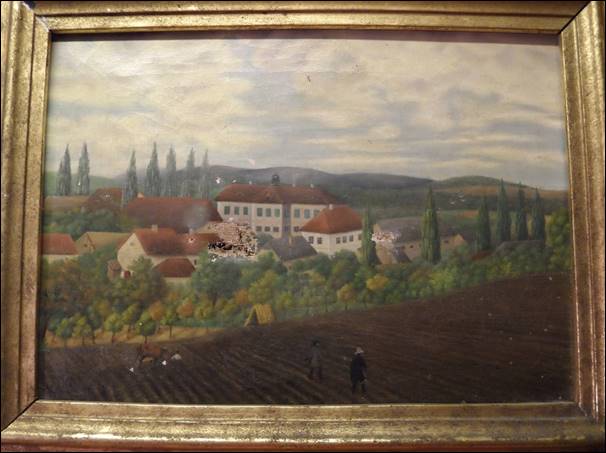
Thorald Laessoe (1816-1878): Lochkov 1842, oilpainting, 28x20cm. (Dr. Robert Mayr’s private archiv,) [148]
In 1844 Thorald Læssøe drove to Italy via Austria. So he stopped again at Lochkov and brought greetings and presents from Louise Delolme, as the most precious one - the picture of the Danish royal couple. When he returned to Copenhagen from Italy after five years, he renewed his relationship with his old friend. [149]
The next entry in Anna’s scrapbook is from 13th of April 1844 and it is from Louise Delolme written in Copenhagen:
„Zu schnell entflieht der Schönheit Glanz, verwandelt sich in Nacht,
flicht Geistesanmuth nicht den Kranz, der dann auch lieblich macht,
wenn Lilien und Rosen fliehn, und Falten Wang und Stirn umziehn.
Elise von der Seile
Daß wahre, im christlichen Glauben wurzelnde, und also auch mit Herzens Demuth gepaarte Geistesanmuth, so wie jegliche weibliche Tugend Dein Theil werden möge, ist meine theure Anna, der herzliche Wunsch Deiner Dich innig liebenden Louisi Delolme.“
In 1845-8 Joseph's son Wilhelm Brzorad was the administrator and legal official "Verwalter und Justiziaer" in Lochkov.[150]
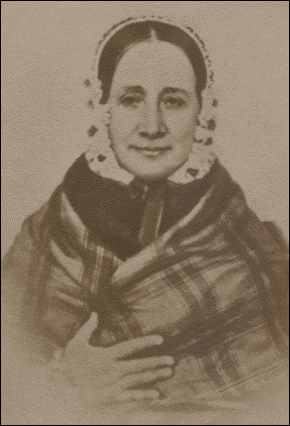
Anna Brzorádová born Delorme 1795-1846 (archive of J. Brzorád)
In 1846, Anna Brzoradova born Delorme died at her fifty years of age. Her granddaughter, Selma Mayr preserved her Aunt Philippine’s memory: "When the grandmother died, the Jews from the village asked (die Juden aus dem Dorfe sich die Gunst erbeten) to carry the coffin from the castle to Slivenec where the family grave was. Naturally, I imagined it very festive: the old, long-bearded Jews, as were Abraham and Isaak in the Bible."[151] The 21-year-old daughter of Philippine took over the position of the housewife.
The list of members of the patronage of the Economic Society in Prague in the 1840s contains an unfilled statement, on the reverse of which is handwritten "Joseph Brzorad, Gutsbesitzer in Lochkov". Joseph, however, is nowhere listed as a member, unlike his son Charles.[152]
The period 1846-1857 is also covered by the memories of the granddaughter - Anna Brzoradová, which are translated in a separate section.
In 1850, Professor MUDr. Jan Helcelet (1812-1876) writes to his friend, the philosopher Jan Ignác Hanuš (1812-1869) - both national revivalist, participants of revolutionary year 1848 and friends of Božena Němcová - P.S.1 "Write when you will go to the Brzoráds and when you will return". The editor's note to the text says that "these are the sons of Josef Brzorad, the owner of the Lochkov estate near Radotín, Wilhelm and Karl, with whom Hanuš was friends."[153] Let us be reminded that the events of 1848 were actively attended by Josef's brother, the Prague attorney JUDr. Jan Brzorád, a member of the National Committee, and also that in 1848-1850 Božena Němcová lived in Josef's nephew Antonín Brzorád’s Nymburk house.
The belles-lettres magazine Lumír published in Prague in 1851 published an "extract from the Fourth Statement of Voluntary Contributions to Building the Czech National Theater", which on page 813 states: "... - Mr. Josef Brzorad, owner of Lochkov Farm, 100 zl."
In 1853, Josef Brzorád gave the position the Lochkov estate legal official over to the son JUDr. Vilém Brzorád and the farm administration to his son Charles as a tenant (he rented it). [154]
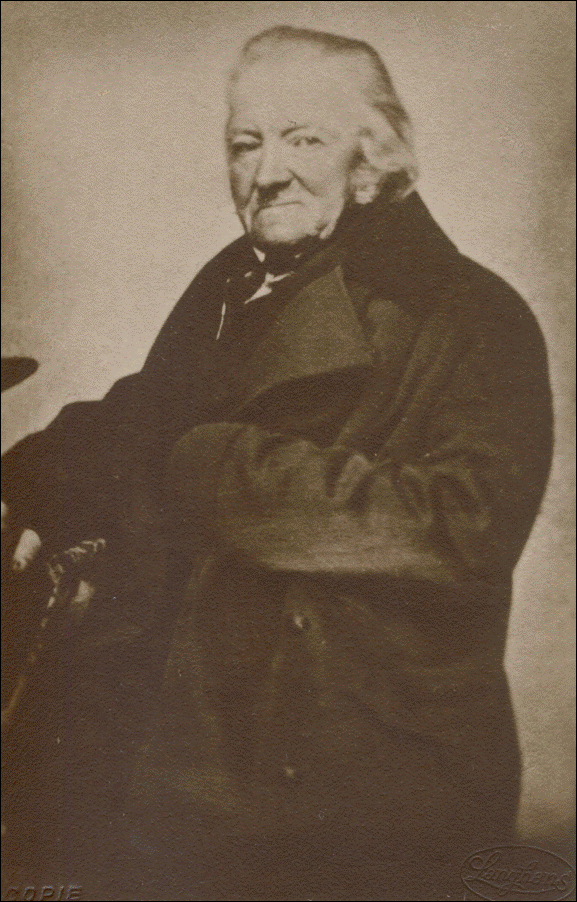
Josef Brzorád (1777-1857) , foto Langhans, archiv J. Brzorád
On 20th of June 1857 Josef Brzorad dies. His granddaughter Anna remembers the sick, coughing grandfather they were not allowed to kiss any more. "He had an eye cancer, poor thing. When the dead man lay on his bed, we had to kneel and pray and kiss his hand. He was displayed in a large hall, where only a wallpaper door was opened, laid in a chapel that was in the annex of the castle, and where there was room only for the altar, priests, servers, and the great "Todte-Denkbilder," with candles thick as the arms which were burning in the day, and where the mass was read for the dead. Anna Delorme and two little aunts Luises, who were buried in Slivenec."[155]
On the monument, which was built in the Slivenec cemetery, we can read the inscription "Hier ruhen im Frieden unsere theuern Eltern Anna Brzorad geb. Delorme geb. Day 9. June 1795 gestures. Day 12. April 1876 Josef Calasanz Brzorad geb. 2. Oktober 1777 gestures. Day 20. June 1857 Herren des Gutes Lochkov. " The monument uses the full name of the patron saint, Saint Joseph Calasanz - Joseph Calasanz (1557-1648). Although in around year 2000 the tombstones were dismantled, as the last monument in the graveyard, it was later repaired by the parish, the plates with inscriptions placed back into the main tombstone with God's eye and an aspersorium and it was erected in the cemetary near the wall. (Situation in 2017.)
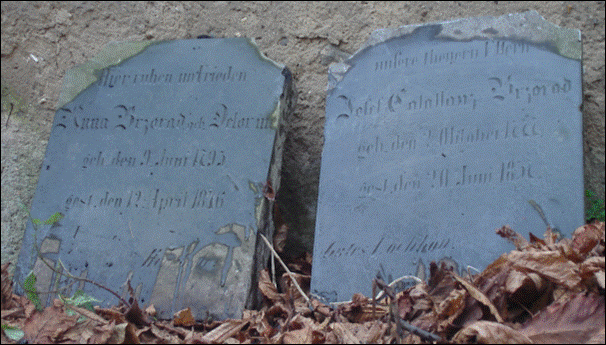
The plates with the tombstone inscriptions in 2008. Photo JS
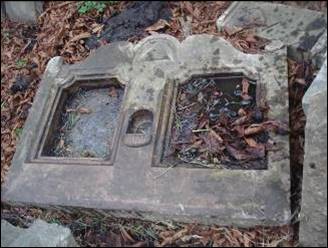
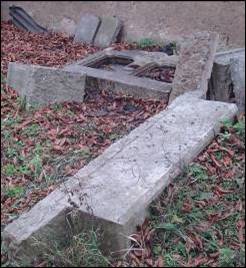
The main tombstone and the basement of the Brzorads grave in Slivenec cemetary in 2008. Photo JS
His son William (1814-1898) remembers his father as follows: "He was a good and grateful son, a kind brother, husband and father. From his youth, diligent in the sciences, especially in favor of the natural sciences, he kept a diary (whose six books I own), made notes of meteorological observations (which I handed over to the University Library in Prague), he wrote to his father in Czech language, kept every letter his father and brother Vojtěch (before his departure from Bohemia) left in Nymburk. I have more than one hundred of them in Jinonice near Prague. He was a philanthropist - "Menschenfreund", but economical as the owner of the estate, yet the real father of the poor, the helper in need, so the priest Brož at his funeral remarked that there was no one in the neighborhood who would not love him or not honour him. - He was a good educator in terms of psychological and physical education, pious, but with Hussite tolerance and the desire for freedom "von hussitischer Toleranz und Freiheitsliebe" (?), uncompromising where he was convinced of his truth. - As a book lover he left a spectacular library, so each of his eight children got a lot of them, he also left a collection of minerals.[156]
Elsewhere[157] Vilem wrote about his father: "His behavior was silent, taciturn, and strict and he was a philanthropist to the extent that - although as an administrator and legal official he was forced from time to time to reprimand those subordinate to him, yes, even to punish some of them there was no one who would not love him sincerely, or trust him as a benign father. ... He raised and provided for 8 children: 5 sons and 3 daughters so that it was only up to them to take a position in or outside the country completely adequate to their status.
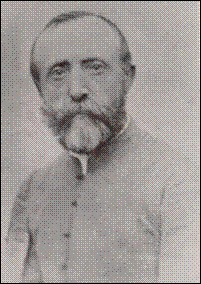
Vilém Brzorád (1814-1888), archiv J. Brzorád
As a curiosity of the time I allow myself to add: his parents were pure Czechs, and their sons especially wrote – especially to their grandfather - only in Czech. School education, but also the manners usual in the country where he lived, caused that he got used to use German language in family and when dealing with friends in both speaking and writing. Our father never lost warm love for his country and his mother tongue and was a personal admirer of nationalists, and a close friend in the family of Martin Pelcl (one of his granddaughters is my wife). When his sister’s son Jan Černý (father of Tomáš Černý JD) knowing his love for the mother tongue wrote him in Czech – my father considered this to be daring, to address an older relative in a different language to the one he is used to. Even his children were raised exclusively in Czech and I remember that I was somewhat tormented in the family for my imperfect knowledge of Czech language. After all, he liked to buy Czech books and he would have become a co-founder of the Matice Česká publishing house[158], if he had not sign me as such, which was following the unforgettable Josef Jungmann's advice so that the benefit from the investment could be used for the longer time in the family.
His thoughtfulness was excellent, which is why the documents and letters the first dated from 1773 have been preserved by the family. He kept a journal about all the things that happened to him. From this and from the letters could be created interesting pictures, no less than those recently published from the journal by Dr. Held announced by Bohemia."[159]
Josef Brzorad's extensive correspondence with his father is preserved and kept today by the National Museum Archive. The diary is not there, though.
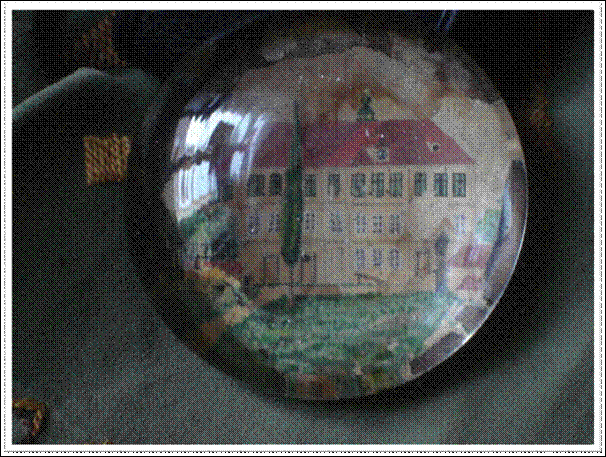
The Lochkov glass paperweight standing on the preserved desk of Anton Erben in Graz. Pictures date back to 1850. (Photo JS)
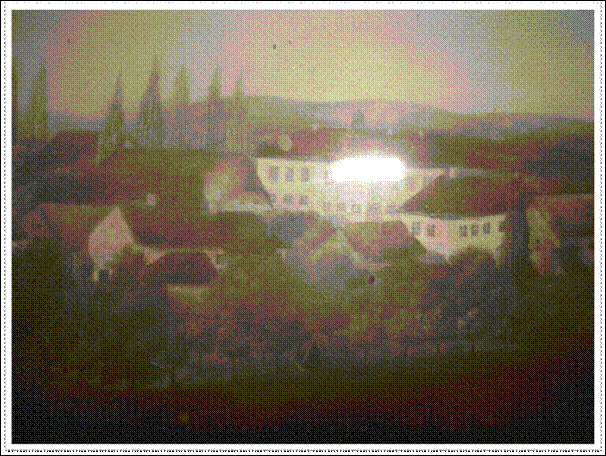
The Lochkov watercolor picture standing on the preserved desk of Anton Erben in Graz. Pictures date back to 1850. (Photo JS)
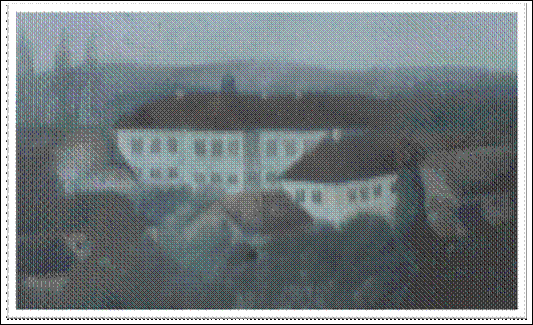
The Lochkov watercolor picture standing on the preserved desk of Anton Erben in Graz. Pictures date back to 1850 – close up without flash. (Photo JS)
From the diary of Tomáš Černý JD (1840-1909), a lawyer in Prague and the nephew of Josef Brzorád.
Farewell to Josef Brzorad at Lochkov. On Tuesday, June 23, 1857. „In my Father's house are many mansions; I go to prepare a place for you.“[160]
I was painfully touched by the news I received of a death notice on Sunday . My dear Lochkov Uncle, Josef Brzorad, passed away on Saturday at seven o'clock in the morning. His miserable state, when I saw him last, foretold the fact that he would die shortly. I was surprised, however, by the sudden news. How I wish I'd seen him one more time before he died. It was my immediate intention to go to the funeral, and I was encouraged by Uncle Plaček in that. I was anticipating yesterday and today who would arrive from Nymburk. Yesterday evening auntie Adleta[161] with Miss Brzoradova, with Jeníček Dlabačovský.[162]
This morning we set out together at 7 o'clock in a fiakr[163]. The day was beautiful, sweltering, a lot of dust. The journey was passing quickly; we arrived via Slivenec to Lochkov at about 9 am. The funeral was to take place at 10 am. Both our aunties came down to meet us, both in sadness. Anna first. She had a beautiful face today; the silent struggle fought on her pale-faced cheeks with brave sufferings: sad was the look, my heart was fluttering. We went upstairs. Uncles William and Karel received us, both filled with pain, but of stable minds. Also two from Chlum were there with the aunts. The other brothers also came slowly. Eduard, Rudolf, Ferdinand; the priests came too.
With Uncle William, we went upstairs to the room where the uncle was lying. Candles were burning around the coffin. The wind blew through the open windows. We uncovered the lid. The body lay, his hands on the cross, clad in a black shroud, his head tilted backwards, one eye blindfolded, the other one rolled back, his mouth open. The smell of the body was weak although it was the fourth day. The poor thing lay dead surrounded by the grieving family; And yet I did not feel even a little sorrow, only a serious mourning. Never, never before I had ever felt so clearly the immortality of the human soul. Here the body lay before me: could the soul also die? - Impossible.
Recently my uncle reportedly suffered very much with his eye; but it was somewhat better at the end; the doctor thought he would last until the autumn. On Saturday morning, when he woke up from sleep he was asking for milk. Then when he coughed, Charles asked him if he wanted tea. Give me, that was the answer. Charles went to tell Philippina; Anna came to ask her father if he wants milk. Give me, he said. He took a glass to his mouth and having started to drink, his head suddenly dropped – the thread of life was broken.
At about 10 am the priests went up and prayed at the coffin. The room was full of people, so Jeníček and I barely got some room in the room. After that, the coffin was taken down and the procession began – it was a sad look! The sons with tears in their eyes carried the coffin with their father, after them the landowners from the neighborhood, retired people, workers paid in kind; then again the sons carried the coffin into the Slivenec Church. The priest ascended to the ambo and held the burial speech. It was miserable, but it could not but proclaim the praise of the deceased.
Born in Nymburk in 1777 on October 12th, he was due to come to his eightieth year. Having studied law he joined the civil service in Mladá Boleslav, Kutná Hora, Krakow. For his illness he gave that up and represented his father in the Lochkov farm; After a year it passed into his hands in 1808. Here for half a century he spent his godly life, dedicated to the sciences and to the welfare of his subjects; the special object of his care was the school and the poor. Surrounded by an exemplary family he lived to see high age, he deceased in the Lord.
That is the core of the speech. After the requiem mass, the coffin was buried at the door of the church, next to the wife of the immortalized. There were so many people in the small cemetery that I could not come to the grave. - The sons lowered their father into the grave themselves, they threw the first shovels of the earth on his body, after the sons the daughter, then the granddaughters, then we were the last to pay homage to our beloved patriarch. Everyone wept, everyone was drowned in tears, both the family and the people, "and will God give him an everlasting joy?" said an old man next to me, the words which tore sobs out of my breasts. After the funeral, one more Mass was read., then we sat in the carriages and went to Lochkov.
We had lunch at our uncle Karel’s; 25 sitting at the table; and none of uncles’s children among the people. I talked to Jeníček, because there was no one else to talk to. Little did they paid attention to us; who would ask otherwise; Hauptmann sat in the second room with a teacher /who seems a bit vulgar to me/ with the cousins. Only Emma walked past several times, today I respected her even more seeing her honest pain at the funeral, and tears in her eyes.
When we got up from the table about half past three, I asked Lotti for her mother in German, and because she did not let go of her ironic smile, I used it with all the coldness as well. Having entered the room we missed Jenicek Černý.[164] We went out to look for him and I gladly used the opportunity to look around Lochkov for the last time. Because, I'm not going to come here so soon anymore, it is almost certain. With my uncle gone who liked to see me here, and the aunts would not stay here anyway. Uncle Charles's family is already distant to us. I went with Jeníček along the slope of that wooded boulder bending into the pretty valley, we went along the vineyard, and last time I sent my eyes on the nightingale’s grove. The sun was drawing toward the distant hills, and the calm landscape commanded a wonderful view. Aunt Aletta and Miss Brzoradova left us in the meantime.
We were awaited by Karl's carriage, also carrying the aunts from Chlum. We said good bye to all the Lochkov good souls in the garden, and having alighted we were speeding to Prague. The councilor Jakub made the fast horses hurry up. Filip’s Aunt was talkative more than usual, and so we had a good time on our way, especially when the sudden rain made us even more cheerful ... Sad I set out, slightly cheerful I returned ...[165]
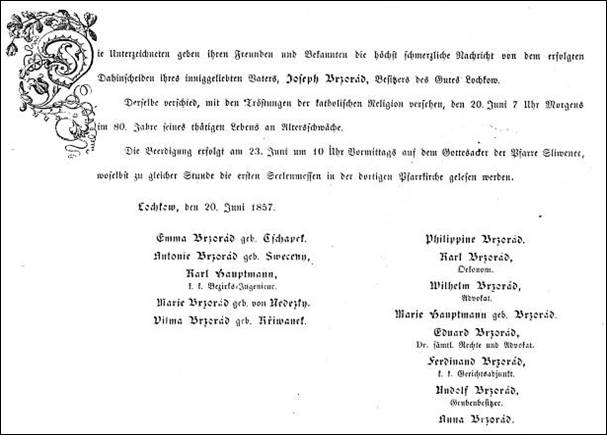
The death notice of Josef Brzorád[166]
Josef Brzorád and his wife Anna’s children who lived to the adult age were: Philipine (1812-1886), Karel (1813-1871), Vilém (1814-1898), Marie (1818-1888), Ferdinand (1821-1863), Rudolf (1823-1890) and Anna (1833-1865).
Philippine Brzorádová (1812-1886)
Philippine Brzorád was born on 28. 3. 1812 in Smíchov Nr. 80, and baptised at St. Philip and Jakob as Philipine Anna Theresia. The Godparents were Anna with Ferdinand Delorme and Caspar with Theresia Weisenberger.
A festive poem recited in the name of the schoolchildren in Lochkov was preserved in neat handwriting. The teacher, who probably wrote the lyrics apparently anticipated the knighting of the Brzoráds.
“Poem on the day of the First of May, on the name’s day, for the Noble and High-minded Damsel Filipine, Lady of Brzoráds. Humbly recited in the Name of Lochkov’s School Youth.[167]
1.Welcome the glorious day of May
the spring window into the world,
in which the groves blossom
and all the flowers bloom.
The trees are turning green,
The birds sing sweet
The mountains and hills rejoice
All creation becomes refreshed.
2. And also we rejoice,
Thanking God,
That he let us live to see the day,
singing him praise,
for all the gifts and grace
let the name given us from heaven
be extolled thousandfold.
3. The cause of joy
on the feast of Philip the Saint
which she celebrates devoutedly
and after whom she has her name
At the baptism endowed
is the gorgeous little flower,
no fail in virtues and manners
the noble lady little Filipine.
4. With whom as with the first gift
the most noble parents
were from the grace Divine
pleased the most.
With them also we rejoice,
with our manorial lords,
towards us most benign,
gracious at all times.
5. Hence with all deference
Both the small and big
we wish in meekness
good health ever lasting
happy living
good luck and delight
for the noble Filipine
we request without end.
6. Lord, through the gift of all graces
confirm our judgement
so that our manorial lords
get awarded threefold.
That they always rejoice
With their kind darlings
Here in this world and in eternity
that they reunite in heaven happily.”
Filipine remained an unmarried spinster. After the death of her mother in 1846 Filipine had to fill in in the place of the Mother; to take care of the house, farm and siblings.[168] At that time Philipine was 34, Karl 33 and had already married Emma Tschapek, Wilhelm 32 had married Antonie Svěcený, Marie 28 had married engineer Hauptmann, Eduard 26 did not marry until 1852, Ferdinand 24 remained single, Rudolf 23 had already been in Hungary but Anna was only 13.
After the sale of Lochkov in 1862 Filipine lost her home and lived at her married sisters’s, Anna and then Marie. After Anna died in 1865 Filipine took care of her children: Antonie was 4 years old, Anselma 2 and Wilhelm 1. The Aunt’s help was welcomed in all households full of children. „Tante Filipi“ is often mentioned in the memories by her niece Anna Brzorád, which are given further below in one piece in a separate section.[169] Also Selma Mayr, who was brought up by her, wrote about her: ‚In my memories she is of a small, puny figure with brown hair and large blue eyes, a laced black little bonnet, crinoline, graceful – on the sides laced up shoes. When she and my father[170] went to the theatre, or to the concert she wore a nice silk blouse, a velvet ribbon with a jewel made of genuine pearls on her forehead and a cashmere scarf folded into three corners with long fringing on its edges, which I liked particularly.
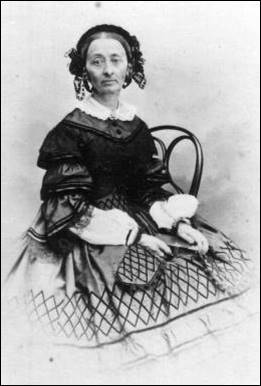
Filipine Brzorád (1812-1886) in 1862, archiv J. Brzorád
When it got dark, we begged: “Bitte, Tante , erzähle von Lochkov und wie Du klein warst” – Please, Aunt, tell about Lochkov and when you were small. Here a lot out of these stories remain in my memories coloured vividly by the childish fantasy. As the Queen of Denmark visited Lochkov, as the horse in front of the carriage shied and bolted and Aunt fell out of the carriage and fell with her head on the rock – the white horse with its mane fluttering, Grandma[171] was holding fast, the Aunt flying at a high speed into the ditch, the coachman fell off and was running after the carriage to pick up the reins, which were being dragged on the ground, the people working on the fields running to help; it was all so gripping as a fairy tale, an so I recollect all so vividly and colorfully.’ [172]
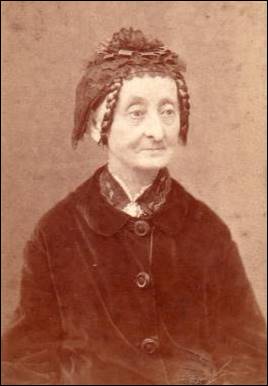
Filipine Brzorádov (1812-1886), archiv J. Brzorád
„Tante Philipi“ died in Prague on 4th of November 1886 after a few weeks of an illness of pneumonia. Her niece Selma Mayer, „She looked after and worked for others for her whole life. Humble, quiet, content with a little. Of a tireless diligence, fervid faith in God, religious values, kind and rare character.“ [173] Philipine was an important person and for her role of a housewife, which she coped with after the death of her mother, she belonged to the histories of many relatives.
Karl
Brzorád (1813-1871), the owner of the Lochkov estate
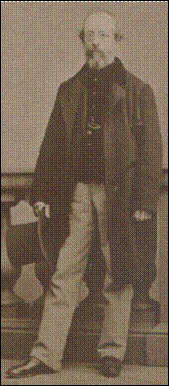
Karl Brzorád (1813-1871), archive of Jiří
Brzorád
Karl Brzorád was born in Smíchov in
house nr. 80 in 1813. He was the successor of the family in Lochkov
and his family was very large. Baptised
as Karl Ferdinand Johann Caspar he married Emma Tschapek
(1814-1875) and then tenanted a farm nearby in Dobříč.
In 1845 he is listed as a member of the pomological society as Herr Carl Brzorad Pächter zu Dobritsch auf dem Gut St.Ivan.[174]
From 1849
at the latest he is a member of the Patriotic Economic Society as a tenant of Dobříč[175],
after that he became a tenant of Lochkov farm – at
his father’s; later on he took over the farm from his
father and then sold it in 1860-1862.
This allod[176]
estate (230,44 ha) with a mansion, yard, limestone quarries, lime works and a
brick plant was bought in 1862 by a large Jewish landowner from Smíchov, Karel Kirschner, a provincial deputy
in 1866.[177]
The Schematismus
for 1881 states for Lochkov an overall land area of
over 230 hectares and an assessed value from 1861 at 152 000 gulden. On
Karl and Anna Kirschner’s farm in 1881 there can be found marble of all colors, outstanding hydraulic lime, and red pot clay in
high yield. Regarding the industry there is (also in Schematismus
for 1870) listed a brewery with a kiln for the production of 96 hectoliters, rented to Prague’s Klatscher
& Löwy, a brick plant and lime works.
On the 17th of March 1862 Karl Brzorad’s
household is registered in Prague 1275/II. Then they leave for the estate Kleneč pod Řípem, near Roudnice, where Karl is a tenant in 1863. After his death
on the 17th of February 1871 Kleneč was sold. On the 12th of June 1872 the household is
registered with the police in Prague 315/III. „There was very little money“, his daughter Anna writes, „and after the death of
the mother on the 5th of April in Salzburg it was gone“.[178]
Through his wife Emma and her German
speaking family Karl’s family was related to the family of Ernst Rudolf
(1783-1860, from 1856 von Wartburg) K.K. Hofburg-inspector
/ Prager Burghauptmann. His son Josef „Pepi“ Rudolf
von Wartburg, was the recipient of a war medal, a medal for civil service and
the medal for armed deed - Medaille für die bewaffnete
Macht[179]. Later the regional governor in Salzburg
is mentioned in the memories of Anna Brzorad, where
she wrote, that when they moved from Dobříč, there
was a hunt in Lochkov and the Aunts and “Pepi Rudolf, später v. Wartburg“ were sitting at the table.The
Tschapeks family had 16 children and Karl’s wife Emma
was the youngest. Her oldest sister Lotti married
Andreas Schnell. The Tschapeks and the Schnells were two of Prague’s wealthy merchant families. Andreas Schnell’s
older sister Marie was
Ernst Rudolf von Wartburg’s wife.[180]
Only 11 of Karl’s children lived to be adults.
But even the daughters received a careful upbringing and education – German of
course – by governesses and resident teachers in this formerly wealthy family.
Mostly they became
teachers in German kindergartens, or in families. Here we can see
connection with the Delolmes family, where the
daughters were distinguished governesses. After all, the visit by the Danish
princess to Prague in 1838, as we state elsewhere, lead to the establishment of
the first care giving institution for children in Prague, following the Danish
example.
Karl had eight daughters and three sons: 1.
Emma (1839-1911), 2. Lotti (+1931), 3. Karl (*1842),
4. Pepi (*1843/4), 5. Thekla
„Etelka“ (1845-1903),
6. Anna (1847-1934), 7. Jaro (*1848), 8. Klara (1850-1924),
9. Zdenka (1850-1924), 10. Gusti
(1851-1940) a 11. Ferdi (1855-1930).
1. Emmanuela „Emma“ Cichra (1839-1911), „Kindergätnerin“ v Praze,
after the sale of Lochkov she stays with Anna and Zdenka in Prague in 44/II. In Národní
Listy a daily from 1868 we read: The children’s little garden founded in Smíchov by Miss E. Brzorádová
will seemingly enjoy a great success, as conscious[181] families, seeing the benefits of
such an institution, even before its opening enroll their
children, boys as well as girls. The manageress Miss E. Brzorádová
wrote a leaflet, in which she explained the purpose and the point of this
children’s little garden in a very clear way. On Saturday the 13th of June the
Czech department was opened in a glorious way, by a lecture by our revered
authoress Mrs. Žofie Podlipská
at 4 p.m.“ [182]
Later Emma married a secretary to the Prague’s
municipality Cichra. Their daughter Marie married a
railway clerk Rüttig. Their grandsons were Helmut and
Giessbert, who was a professor in Göttingen and
Heidelberg.
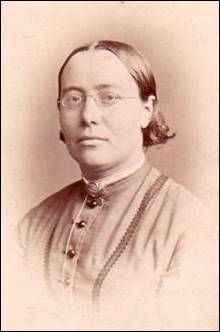
Emma Cichra roz. Brzorád
(1839-1911)
2. Lotti Brzorad (+1931), Kindergärtnerin
in Salzburg, then in Prague with Gusti
a Ferdi in Pštrossova street nr. 25.
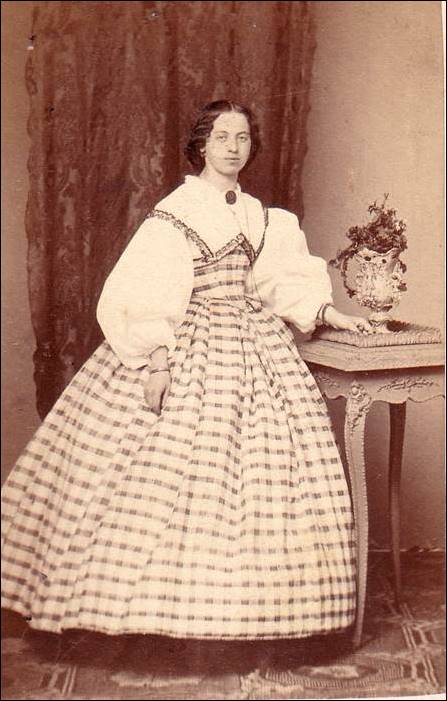
Lotti Brzorád (+1931), archiv Jiřího Brzoráda
3. Karl Brzorád
(*1842) was a senior railway clerk. He had 6 children and lived in Prague in Smíchov, later in Vinohrady. His
children were 1. Emma (*1875), a kindergarten nurse, who married Mr. Cingria(?) (+1922) (they had 4 children, their daughter
married Treves, a writer in Munich); 2. Karoline (1878-1918), a teacher in Vinohrady, Prague; 3. Karl (1879- cca
1937), a secretary in Schiltigheim by Strassburg in France, oo
Henriette; 4. Josef (*1881) financial clerk in Plzeň;
5. Jaromir (*1884), injured as a first lieutenant, later a major, a director of
the tax authority in Vienna, who married Hildegarda
née Bříza; 6. Mariane
(*1886), a secondary school teacher of German or Mathematics at the German
teachers training school in Prague. She married D/Trinkhauser,
a professor in Innsbruck.[183]
4. Josef (Pepi) Brzorád (1843/44-1916/7) the head engineer in Rotschild’s company in Waidhofen.
With his wife Kathi he had 4 sons: 1.
Rudi (Rudolf); 2. Karl, a railway clerk and a manufacturer in Vienna, he had
three sons and changed his name to ‘Burghart‘; 3. Ferdinand; 4. Jaromir,
changed his name into ‘Burghard.[184]
5. Thekla „Etelka“ Erben (1845-1903), at her Uncle Vilem’s in Michalovice at first, then at her Uncle Rudolf’s in Mogyoros and then she married the widowed husband of her
Aunt Anna born Brzoradova (1833-1865), a school
inspector Anton Erben. His children, he had had with Etelka’s Aunt Anna had known her as a cousin Thekla. One of them, Selma Mayr remembers, “Once a cousin Thekla arrived, the daughter of mother’s oldest brother;
she had a zither with her and played songs on it in the evening. … In August
1870 our father brought a new mother to us, that is the cousin Thekla, who had already visited us. It struck me as
strange, that we were supposed to call her just „Mama“,
as before we had simply only called her Thekla.“[185] Thekla
and Anton Erbenem had a daughter Anna
(1871-1946), who married a regional governor in Völkermarkt
and Klagenfurt JUDr. Wilhelm Klebel.
The Klebels had three children. Elisabeth, Ernst the
mineralogy professor in Salzburg and Wilhelm / Willi who had 8 children. This
family is well branched out in Austria today.
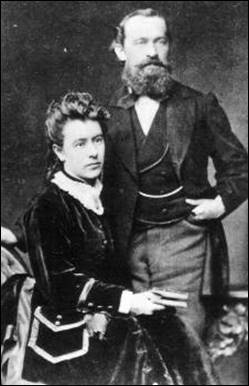
Thekla Erben née Brzorádová (1845-1903) with her husband Anton Erben
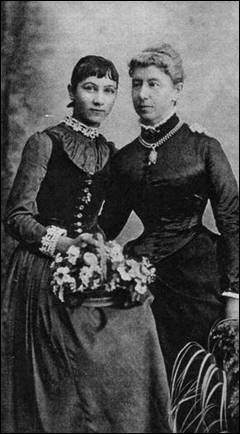
Thekla
(1845-1903) and her daughter Anna (1871-1946) cca
1890[186]
6. Anna Brzorád
(1847-1934) a language teacher and governess with the noble ladies in Salzburg.
She left the extensive narrative “Errinerungen an Lochkov und Dobříč”, describing
Karl Brzorád’s family’s life in Dobříči,
and also later in Lochkov, where she depicted the
last years of her Grandfather – Josef Brzorád, the
sale of Lochkov, leaving for Kleneč
and mentions also the fates of her siblings. We include the whole text further
below after all of her siblings have been listed.
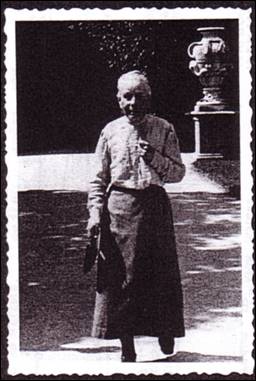
Anna Brzorád (1847-1934), foto 1925[187]
7. Jaromír Brzorad
(*1848), chief brewer in Posen, then in Rybinsk in
Russia, then in Prague at the Schnells’ (U Schnellů).[188] He married Helena Rovinska, and later on her sister. They had 4 children: 1.
daughter Anja, a teacher in Upper Austria, Salzburg,
whose husband was called Weng; 2. Jaro(slav); 3. Vladislav / Wladi, who
worked for an electrical company in Prague[189]; 4. Helene oo
Wiklič in Serbia, they had 2 children.
8. Klara Schleussig
(1850-1924), a teacher in Vienna married a headteacher Schleussig
in Vienna. Their daughter Klára was a nun in Vienna,
their son Kamil was also a teacher and married a teacher Margareta (Kreta). They had four children: Ingeborg, Irmgarth, Kreta and Volkmar, who crashed in 1937 as a flying instructor.
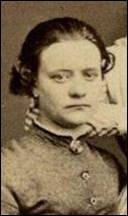
Klara Schleussig roz. Brzorádová (1850-1924), roku
1868, archiv Jiří Brzorád[190]
9. Zdenka
(1850-1924), a graphic artist, xylographer in Leipzig, then in Munich.[191]In
the dictionary of Czechoslovak artists by Prokop Toman we read: „Brzorádová Zdeňka *17. 10. 1849
in Dobříši(sic!). A graphic artist, student of
Otto Roth in Leipzig; she was active in Munich. She especially made wood
engraving of Defreggr, E. K. Liška
(„Děvče z lidu“ Zl. Praha, II, 501) and other.“ The text accompanying the engraving of the drawing „Děvče z lidu“ in Zlatá Praha magazine from 1885 says, „The engraving was
done – for the special recommendation by our famous landscapist master Julius Mařák – for „Zlatá Praha“ by a
chisel of a Czech native, Miss Zdenka Brzorádová in Munich.“[192]
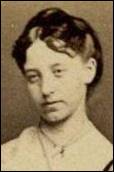
Zdenka Brzorádová (1850-1924) in 1868, archiv
Jiří Brzorád[193]
10. Ferdinandine „Ferdi“ (1855-1930), a teacher in Krems,
Vienna, later she lived in Prague, in 1925 together with Lotti and Gusti in Pštrossova street nr. 35, II.-1507.

Ferdinandine „Ferdi“ Brzorádová (1855-1930), roku
1868, archiv Jiří Brzorád[194]
11. Auguste „Gusti“ Brzorádová
(1851-1940), a retoucher in Eckert’s photography atelier,
from 1873 she works as a retoucher in Salzburg for 2
years and then for a year in Munich. 1877-1878 she was a governess in the noble
family of the Strachwitzs in Mamling,
Upper Austria and when her charge died, she stayed in the family as the Countess’
companion for some time; 1881-1916 she was the director of the German
kindergarten in Vinohrady in Prague. She lived
in Pštrossova street nr. 25 and in 1935 she
shared some of her family Lochkov memories about Lochkov with a Prague’s paper in an article “Frau Brzorad erzählt.”
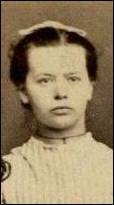
Auguste „Gusti“ Brzorádová (1851-1940), roku
1868, archiv Jiří Brzorád[195]
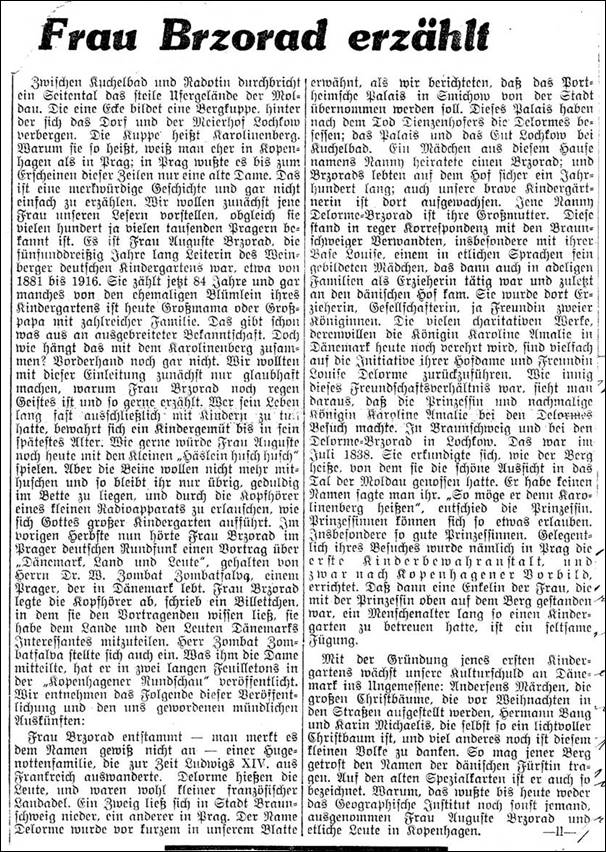
In the
article, however, Augusta does not mention her relationship with the
distinguished painter Josef Tulka,[196]the painter of the lunettes in the
National Theatre in Prague. In a biographical book[197] about him a chapter about his
relationship to Augusta Brorádová can be found:
Tulka
the painter and Augusta Brzorádová (1873-1879)
During his studies at the academy of fine arts in
Prague Tulka had to struggle to survive, because he did not get any support
from his home. Apart from the sources, I have already mentioned, he found
satisfactory earnings in the photographic company of H. Eckert in Újezd in Prague’s Lesser Quarter. There he retouched and colored photos for him. There he also met a very young lady
Augusta Brzorádová, a daughter from a once wealthy
family, related to the Brzoráds of Deutschbrod (Německý Brod, today Havlíčkův Brod) and
those of Nymburk; Otakar
Theer the poet’s mother Františka
née Brzorádová was a cousin of a second degree[198]. Augusta, born on the 24th August 1851 in Dobříč,
Smíchov region, was a daughter of Karl Brzorád, owner of an alod manor
farm estate in Lochkov by Radotín
(once a seat of Václav
Michna of Vacínov) and Emanuela, born Čapková (Tschapek); they were a Germanized family. In the year 1862
the Brzoráds sold Lochkov
and moved to Kleneč under the Říp
hill (near Roudnice nad
Labem), where they bought a farm “poplužní dvůr”. After the death of the father the family became
quite poor. Only Augusta with her two younger sisters remained without
provision out of twelve children mostly provided for by working in state or
private services. Having found refuge at her mother’s sister, who married a
Prague Lesser Quarter merchant Schnell, she would go to Eckert’s atelier, where
she met Tulka. He taught her to retouch photographs; She then earned her living
that way. In 1873 she and her mother went to her older sister to Salzburg,
where she stayed for two years, occupying herself with retouching and the next
year she was employed as a retoucher in Munich.
In
the years 1877-1878 she was a governess in the noble family of the Strachwitzs in Mamling[199] in Upper Austria. When her charge died, she stayed as the Countess’s
companion for some time.
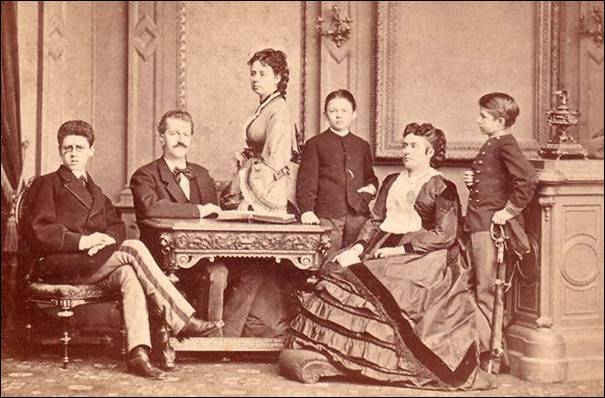
Tante Gusti Brzorád (1851-1940)
probably with the Count Strachwitz family, archiv J. Brzorád
Then
she returned to Prague and having taken a course she was a nanny in a German
kindergarten in Královské Vinohrady
(today a quarter of Prague) for 35 years. Today she enjoys a modest pension
from the institution of social care. Her cousin, Albertine Miksch,
a daughter of a doctor in Brandýs nad
Labem, being taken into Aunt Schnell’s own family, became after her death an
heiress of a decent estate, which she then left to Augusta Brzorádová.
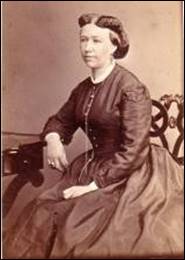
Miksch, archiv J. Brzorád
From
the contacts in Eckert’s atelier a love affair developed between dreamy Tulka
and peaceful, plain-hearted Augusta. It lasted until Tulka’s disappearance. A
bulky sheaf of Tulka’s letters from 1873-9 reflects the pure love of both young
people.[200] Augusta Brzorádová keeps them as a precious
and dear memory of a beloved man, whom she, with a child’s naivety, believes
that he still lives and that he might even come back. It is interesting, that
Augusta, who in a wealthy family with governesses and resident teachers got the
careful upbringing and education – of course in German, only wrote to Tulka in
German, whereas Tulka, although his command of German was perfect, wrote her in
Czech exclusively. In one letter he says explicitly: »Forgive me, for I only
write to you in Czech. I like you in a Czech way. Your golden dear heart will
be more tolerant than the Czech and German nations.«
Rarely he added a German note, but he did so rather to clarify the meaning of a
Czech expression or saying, which she would not understand. If he wanted to
express exceptional cordiality, he addressed her, »Milá
Mařenko« (Dear little Mary).”[201]
After Tulka finished the cycle of the lunets for the National Theatre in Prague he abandoned
himself to skepticism and lack of confidence in his
talents; he burnt most of his painting sketches and retired to a monastery in
an unknown place in Italy. After his disappearance, Augusta could not manage to
get in contact with him any more.
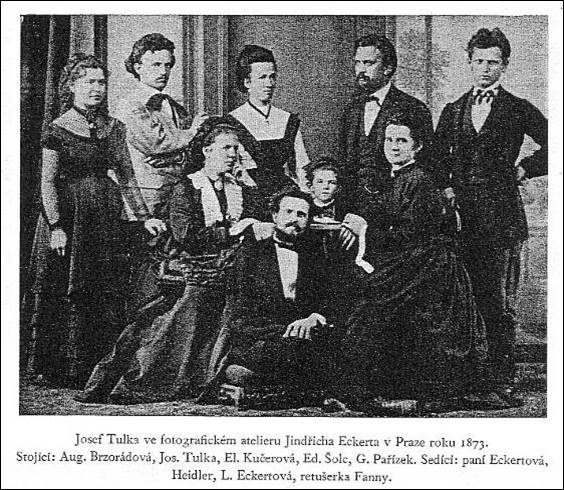
Jindřich Eckert’s atelier in Prague in 1873. Augusta Brzorádová
and Tulka standing as the first and second from the left.
The Memories of Dobříč and Lochkov by Prague
Written by Anna Brzorád, 1909[202]
Dobříč belonged to Mr. Berger, the owner of St. Ivan, who was very rich. My father rented it from him and I can remember the yard, the residential building and the garden on the left very well.
Tachlowitz and Hořelitz[203] were very close and the cheerful Pater (Father) Fabat used to come to play tarok with my father. In Hořelitz was Pater Š/Čiška who taught me to read when I was four. When there was a baptism, which occurred eleven times in Dobříč, the dean[204]came too. He was big and stout and had a so called “club foot” and so he had a special, heightened, big shoe, which I would always examine very carefully. Also his umbrella was exceptionally big. Because the baptisms took place at home at that time, the celebration was very important for the other kids. The mother was replaced by Kathi Skalitzky and we kids loved her. She taught us the prayer „Anděl zdrašce (Schutzengel)“ to our guardian angel. On the Sunday after the birth there was a baptism. The priests were invited and Kathi prepared a big, celebratory meal. Before that, though, the white small dressing table was covered with a white scarf of damask; a black iron cross was placed in the middle (Lotti); the branched candlesticks on the right and on the left (Zdenka), bread and holy water. The newly baptized had a little white bed, a small dress with the pattern of a dove, a nice, white tulle cover and white ribbons, which were given as a present by Grandma „Anna Brzorád Delorme“. It was kept with great respect and later it served as a baptism dress for little Anna (Annerl) Klebel, Tekla (Thekla) Erben - Brzorad’s daughter. It was later sent to brother Karl for his firstborn Emma Brzorad.
At the baptism each child present was given one wax candle in their hand, decorated with flowers and gold. (um als Lichtlpaten zi dieben)
It is interesting that I do not have many memories of my older siblings. Just once I saw the first, small anteroom, where mother had a small table with sewing equipment by the window. She was sitting at the window, crying, her tears running down her cheeks. Then Emma, Lotti, Carl and Pepi were punished hard. I was standing and staring stiffly. – Then I saw them (the siblings) at the table for learning (Lehrtisch). Horliwitz seemed to be, I think, a friendly teacher, who sharpened a pencil for me and gave me a sheet of paper I doodled on. Anyway, they all started to study very soon, and so we played only towards evenings.
Jaro, who is one year younger than me and who could run at 9 months – as my father was informed in a letter from my Aunt Anna – was my first companion for games. We had Scottish flannel dresses with wide belts and an “Achselträger”.
I saw him crawling while I was running, or he was sitting on the freshly cleaned floor and scratching out the sand and dust he was – eating it.
Emma and Lotti were threading pearls or beads (Schmelz). The other room was both a dining room and a living room. Then mother’s little table for sewing things stood there (in diesem Rau?). My parent’s bedroom was on the left. On the right there was the „yellow room“ and I remember this in two moments. My father came early and woke me up: „Anna, get up, you have got two little sisters“. The surprise. – The second memory of the „yellow room“ is when all 11 children had measles.
The bathing of the two small creatures was the best entertainment for us. Pouring water with a bit of milk. Klára was fat – Zdenka skinny and very lively; we called her “frog” as a joke. I remember these baptisms clearly. Mr. Turecký, our neighbour, was Zdenka’s Godfather, and Grandpa was Klára’s. The Godmother was probably Aunt Philippine, as she stood as such to all with the exception of Gustis and Ferdis. Grandfather gifted a 10 gulden coin – Aunt Philippine one ducat. Zdenka got a silver case with a cup and a cutlery.
I will never forget my first jump either. I climbed up to the stool and jumped – I fell on my nose, which bled and I bawled.
Our house was next to a garden, in which my ability to reason was awakened. I was intrigued by the view of the trees. The day before, my mother’s friend, Dr. Kotonč’s wife was telling something about “planting the teeth“. And seeing now, that trees are „planted“ too, the fact that the teeths are planted too astonished me.
Frequent “Einquartierung” - providing accommodation for soldiers would bring a change for us, work for mother and expense for my father. The huge laundry kettle served, after proper cleaning, for boiling dumplings. The fact, that the horses were accommodated here too, also required supplies of hay. One soldier was not satisfied and asked for more hay. Failing to fulfill his wish caused a big surprise at their departure. It was little Gustis’s baptism – the guests were driving into the yard through the gate and at that moment flames spurted from the heap of hay placed under the high poplar tree. Great horror! I was watching the fire fighting from the window. Little sister Gustis’s Godmother was Aunt Lotti.
When another little sister came we were clueless as to what name to give her. At that time we had a young governess from Geneva, Louise Buache. She wrote several names on pieces of paper: Irene, Imene, and finally the name after the English queen Victoria was chosen. I cried then, because I liked the afore mentioned names better.
I remember the arrival of Louise Buache very well too. Dark blue, flowery pattern dress, black velvet short jacket, short hair (after typhoid[205]), and a peacock’s feather at the back of her head as the ending of the hairstyle. Big almond shaped brown eyes, which made a very good impression on us, big nose. Eighteen years. Before her arrival to our house she was a general’s daughter’s companion, whom she called Malinka. As a big reward she gave us two beautiful books – „Contes de Perrault“ (Mr. Perrault’s tales). They were printed in roman letters. One evening I got a book about the bad Owen to read, while Emma, Lotti, Aunt Anna and Pater Ciška were studying French. The book had no pictures so I was just looking at the words and all of a sudden I could see the meaning – the bad Owen kicked up dust „der Schlimme Owen hatte Staub aufgewirbelt“. I looked up and everybody’s eyes were fixed on me – it was my first French reading and understanding. From then I was delighted to read fairy tales from the mentioned book: „Blaubart“ - Knight Bluebeard, „Dornröschen” Sleeping Beauty, etc.
And then the relocation came. Father gave up the Dobříč tenure to be a lease holder at my Grandpa’s in Lochkov. Luise Buache with Tekla and Anna went to Lochkov earlier that day. But it was winter and I was rather cold when we came to Grandpa to the castle and Aunt Philippine gave us „Bouillon“, as she said to Luise. Although I had spoken French and could understand, this word was new to me and I remembered it well.

Lochkov, Das untere Haus 16. 5. 1857 in Tagebuch Anton Erben
The same day there was a big hunt in Lochkov. Luise and I went back to our house, we washed, combed and freshened up and went back for meal in the evening. But Tekla and I were seated at the children’s table. Grandpa, two Aunts, Louise Buache, Pepi Rudolf (later von Wartburg), Wachtel, etc. and the administrator (?) sat at the large table.
Grandpa was a dignified, serious man, who had a writing desk (counter) for work standing up in his room in the corner at the window. When he snapped the lid, figs and dates for the grandchildren appeared. He had an air pump. Sometimes a sparrow came under the bell glass, the air was pumped away and yet, in the last moment, the bird survived.[206] There was a little devil in a glass, who had to dance for us. Saint Anthony, whom we had to kiss, gave us bites, because it was electrified. On the New Year and other holidays we had to learn, or recite German or French (for Aunt Philippine) poems, or congratulations. Mostly we got a fit of deep anxiety that our minds would go blind. Mommy did not wish this torture. – For the village children Grandpa had books, notebooks and pens, which they got for free. The beggars got an apple instead of a kreuzer. The children were not allowed to come begging. When Grandpa was ill, there was real awe in us, instead of the reverential one because coughing and sneezing were reprimanded by Aunt Philippine. We were not allowed to kiss him anymore. Then he had cancer in his eye and died at 80 years of age. When he was lying dead in his bed, we had to kneel and pray and kiss his hand. He was put on display on the bier in the big hall, where a wallpaper door was opened to get to the chapel, which was in the projection of the mansion, and where there was room just for an altar, a priest, servers and a big „Todte-Denkbilder“ with candles thick as an arm, which were burning on the day, when a mass for the deceased was read. Anna Delorme and two little Aunts Luises, who are buried in Slivenec.
In this very hall I had seen my Grandpa playing chess with Dr. Horst. Also dancing master Link was at our place during holidays and we had dancing lessons from 10 to 12 with this gentle, short man. Nevertheless, only Aunt Anna was adult, Emma and Lotti were under age, Tekla and Anna were children. That did not hinder us from dancing mazurka “grosse Mazur”, “Alliance”, “Menuet” and all the modern dances. At the end there was a ball “zu dem Spirk”, Hauptmann and various other young gentlemen came. Tekla in pink, Anna in blue were dancing with elegance; finally I sat down, tired on a sofa – kindly turning down all the dancers and fell asleep. In the morning to my embarrassment I was lying in my bed, to which I was carried by somebody and my clothes were taken off without my knowing about it. “What will my big dancers say?” I thought and went to the breakfast ashamed. Nobody said anything – that the small lady dancer fell asleep.
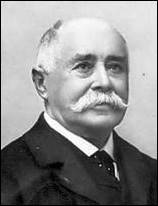
Link – dancing master in Prague I, Krocinova Street
At that time Grandpa was still alive; later he was put on the bier in that hall. I was trying to cry so hard but I failed to do so. And when I pulled out a handkerchief a number of rose petals fell out of my pocket, which was very embarrassing. As long as Grandpa lived we were not allowed to enter the castle garden and when we were, we were not allowed to pick anything.
However, there was a small garden in front of our house, in which my mother had chestnut trees planted into a circle. These grew fast and we could have these for snack to our utmost delight. Sometimes for dinner. Yes, that was fun. There was singing, laughing and joking. On the right and on the left of the chestnut trees circle was a lawn and in its centre was a flowerbed of moon roses (Monatsrosen). In one corner of the garden was a gazebo with honeysuckle, in another corner jasmine and lilac along the fence, a smell over a smell. On a high wall leading to the big garden, there were pear trees held up and cut, of extraordinary size, called “French pears” – they had to be left to ripen in winter and they were the juiciest fruit.
While we were studying upstairs from 8 to 12 and from 2 to 6, mother and the older sisters, the dressmaker Mrs. Urban (Mr. Hauptmann’s widow) or Adolfine Franiek or Albertine Mikschel were in the gazebo diligently sewing new dresses and underclothes, or with the same diligence they were mending the worn out or damaged things.
Sometimes, to mother’s delight, someone would read aloud. The family had a subscription at the Schalek’s in Prague and so several German and French translations for various ages were delivered to stockpile. So in the evenings whilst knitting the stockings we would have a good read: Christoph Schmid translated into French, Rose de Tannenbourg, Henri d'Eichenfels, Lesoufus de Paque.
When Tekla and I grew up, we were entrusted with various duties at which we took turns after 8 days:
1. At the milking time to knit and check the sale of the milk from 5 to 6 in the morning, 11 – 12 at noon and from 6 to 7 in the evening.
2. At the time of the harvest we took turns at the barn door and knitting or crocheting we would check the brothers bringing wagons from the fields.
3. Measuring out the oats for horses.
4. To be present in the distillery, when the worker in charge measured out the nice-smelling alcohol from the barrels.
5. To pick the currant, sort it and help with preserving it. To supervise the preparation of plum jam.
6. In winter to help feather pluck.
When the last was finished the maidservants and cowmaids (Kuhmägde – milkmaids?) were rewarded with coffee, bread and “Buchten” – cake with filling.
After the harvest there was wonderful harvest home celebration “Erntefest”, which we as children were expecting happily.
The last sheaves and bundles were decorated with colourful ribbons and loaded onto wagons. Men and women smartened up festively were coming into the freshly clean swept yard, came into the house and after a short address they handed a bunch of flowers to my father, brothers and mother. We girls were given wreaths of flowers from our garden and ears of grain from the fields. Afterwards one went back to the yard, where mother gave out bread, Buchten (cake with filling) and coffee. Also a barrel of beer was put at one’s disposal. A barrel organ played and harvesters and children danced around a decorated sheaf. When the mood was rising everybody went to the pub.
Another pleasant duty of ours was picking green pea pods. What we liked even more was the poppy harvest. Mother with all the daughters cut the poppy heads, which were later dried in the loft on canvas, called “Blacht”. Then we sat cheerfully in a circle and poured the poppy seeds from the poppy heads and sometimes also into our stomachs, then into large wooden containers.
A vineyard was in Lochkov too! What a pleasure! The grape harvest! Each child got a knife called “kudlička” with a red or yellow handle. My mother, the governess, the house teacher and the children with the maids, all went to a quarter of an hour distant hillside and there one was pruning diligently and eating. The rest went to a barrel like bucket, which was transported into father’s cellar in the yard. I have never seen the next procedures. After some time, however, we got sweet must to drink and later at the feasts and holidays there was slightly tart, but genuine wine on the table. These various feasts are also a ray of light in my memories. The Christmas Eve, at the same time the name day of my mother Emanuela, the New Year, my mother’s birthday! With so many children and caring good parents it could not have been otherwise than that a happy bliss ruled these days. Ignoring some minor incidental mistakes, for which one would otherwise be admonished, it was complete harmony and peace of minds.
In the morning, after Christmas Eve I woke up with a blissful feeling. Is it possible? All the thinkable wishes fulfilled! Immaculate cleanliness of the body, clothes, rooms, pleasant warmth, festive meal and the blissful feelings of the loving parents. There were guests all the time, because there were enough aunts, and male and female cousins. Also the day before the feast Albertine Dr. Kontonč’s wife from Dobříč would help my mother prepare a delicious festive meal „Kirchweih“ and small cakes to be baked in the oven.
When we grew up a bit, the 12th sister came. My father would call her „vejškrabek“[207] jokingly. We all wanted to own her and adopt her. Aunt Therese Weissenberger – Delorme, my Grandmother’s sister, was her Godmother and Ferdl got a rose christening gown. Aunt was a beautiful old lady in a grey silk dress and with snow-white hair. When Leni coiffured it, it flowed as a topcoat all around. I saw this only once and it remains unforgettable for me. In dumb shyness I was watching the old lady, to whom Leni said, ”Such a big girl and she climbs the trees!” I was deeply embarrassed to hear that. I was the perpetrator, because in the cavity of the high plumb tree there was a nest of a shrike whose young attracted me and scared me. With their wide open yellow beaks they were demanding their fodder. Teacher Mazans was passing by and learned about that despicable deed. Emma, who was then 15 years old, went with the great-aunt to Mogyoros where she read the whole collection of letters from my parents and Emma, which gave short but detailed reports about Dobříč and Lochkov.
My sister Emma and Luise Buache were keen on riding for some time and so father bought a pair of pony horses, which would work in the week and Sundays they had a horse blanket fastened with a belt. All the children including the governess, uncle Hauptmann and friends would ride in turns slowly along the path in our large garden.
At that time plenty of visitors came from Zbraslav: Marie and Clementine, our family doctor’s daughters. The older married a rich Drchota, the younger married von Stransky; both widowed. – Familie Dlabač: the beautiful Gabriele and Fanni. In the end father sold the small horses, because the coachman Stefan knocked out an eye of one of them in anger. (…das Aug ausgeschlagen hatte.)
Swinging was also one of our favourite pastimes. Witanowsky, who was our dear helper with anything, fastened a thick rope on two tall trees and instead of the seat there was a blanket folded more times and then it started. Each child swung 20 – 40 times, Tekla and Anna flew highest. Witanowsky had a go too. That was fun! Many danced with a barrel organ on Saturdays and Sundays, Witanowsky and Heinrich Franiek and Thecla and Anna etc.
When the mown grass was piled up in a heap we would jump across it in the evening with the moonshine above.
Before 1859 there was a beautiful comet[208] to see and the villagers saw it as the danger of the outbreak of the war, which happened to come. We admired this constellation every night during our walks into the “Nachtigallental” Nightingale Valley or when walking somebody from Zbraslav to Radotín. An ever widening tail coming from a large, burning star, as we said. Across the whole sky! It was awesome. On other evenings we often saw beautiful northern lights (aurora borealis), the whole horizon was as if in one glittering fire.
When Tekla, Lotti and Emma came of age, they took part in dance parties in Zbraslav. After the Italian war around 1860[209] soldiers came to Zbraslav and “officer’s dancing parties” were held. Tekla was very popular, but still very young. Once I was there too but I was only 13. Tecla is 1 ½ year older. First lieutenant Ventour and lieutenant Weismann and others were once invited to our place too. The former one was later often at our place, as you know.
In the time 1860 – 1862 Lochkov was sold and our resettlement to Kleneč by Roudnice nad Labem came.[210] There we were brought low[211] at first, as the saying goes, but then we got used to it. However, during a few years we parted in all directions: Emma: Institut Vogel in Prague, Thecla: a governess at the Meissels by Prague[212], later to uncle Rudolf in Mogyiorosz. Anna Institut Vogel and in year 1868 to the Steinbrechers[213] in Moravská Třebová. Clara and Zdenka to Leipzig.
On the 18th of February 1870 my father died and Kleneč was sold. There was very little money left. With the death of my mother in 1875 - we have run out of it. [214]
14th March 1908[215]
The Lochkov yard made a long, wide rectangle. Behind the small residential house of the head brewer, a lumber yard and the mansion[216] was Grandpa’s vegetable garden, which lay a bit lower. The mansion was adjoined by the castle garden, which ran up to the yard and it was equipped by an iron grille. The shorter side of the rectangle was fenced by a barn, a wine cellar, a shed for various coaches and sledges and then again by a barn. - At the corner, by which the long side begins, opposite the castle garden, was a huge entrance gate (leading to the linden avenue, Chuchle and Prague). The watchdog was at the entrance and the residential house of the head thresher Adámek, who lived in the same place with his wife and children. Next to that there was a large distillery factory. Next to that was a huge pile of rubble, or soil and then a large iron gate, which led to the big garden. (A whole field of fruit trees, a gardener’s house and our, children’s little garden.) Next to the gate there was a long cow house and then a high wall which separated the large garden from ours – children’s one. – The shorter side was bordered by our residential house, its back to the street leading to Slivenec, its front to the small garden.
Our house adjoined a large entrance gate too; leaning against small houses on the right and on the left. A coachman Knížek lived on the right with his family, on the left a coachman Salaba with his family. Besides was a big stable for horses. The inner area of the yard was divided by two small walls, which had passage entries in its centre, on the right and on the left. Thus there was a narrow path behind our little garden, which lead to the cow house, in front of which was a fixture - the pile of dung and liquid manure fenced by a little wall. The same was in front of the stables. There was a turret-like pigeon house in front of the right wall, a little room inside, pigeon-holes along the wall, which served as nests for the pigeons; behind this pigeon-house were a large shed, and a woodshed, in which were hay wagons, ploughs and harrows. That is why the farm yard looked all the time so tidy. Also on Sundays and holidays the whole yard was swept clean. On the other sides of the walls were large lawns[217] in the upper part; very rare old lime trees, chestnut trees, poplar trees and mulberries. Mother used to keep silkworm moths for some time, which interested me a lot too. She hoped there would be some profit from this but nobody bought the spun silk from her. Also she earned just a mere profit from the surplus of honey and fruits.
At the upper gate behind the barn, a road led through the field and the vineyard, through the Nightingale valley, Lahovska, Radotin and Zbraslav.
Because we would learn and work from 8 to 12 and from 2 to 6, we enjoyed doubly the walks in this direction. As small children we frolicked and ran and I always imagined I was a horse. When older we hurried to the places where violets bloomed. Later we would knit eagerly whilst walking, singing and laughing.
When the first governess was at our house, Luise Buache from Geneva, she would teach, sew, and knit a lot and played on the piano at the Harausch’s. Then a young governor came, a theologian Witanovsky, who was very favourite with us and in his spare time he prepared a puppet theatre, with which he and we gave a performance.
In summer we played „Reifen“ - hoops with him and family Eminger, Marie, Hedwig, Emanuela and Josef and other friends and older siblings. Thecla and Anna with Witanowsky were the most skilled with that. In winter, when cousin Adalbert was here, and other relatives, we played various games: Cat and Mouse, Jakoberl wo bist du? Wie? Wann? Wo? Warum?, Verstecken (Hide and seek), Plumpsack geht um[218], Sekretär, Theaterzettel, etc. On warm winter evenings the dinner was brought into the “Gartel” and then we sang like crazy. It was always very cheerful. Emma and Lotti dignified. Tekla had already played the piano and Albert and Gustav Leroun and Andres Mikschl listened. Anna was a long child and ran about.[219]
The younger children were in the other room. So the 6 of us or the four older ones with the friends were together and made up adventurous ideas with daggers and pistols and gave each other names such as Albert - Mohican, Carl – Coda Brska, Pepi – Ledestrumpf, Thecla – Beldemonir, Anna – Brutto Demonio. For Emma and Lotti this was too childish.
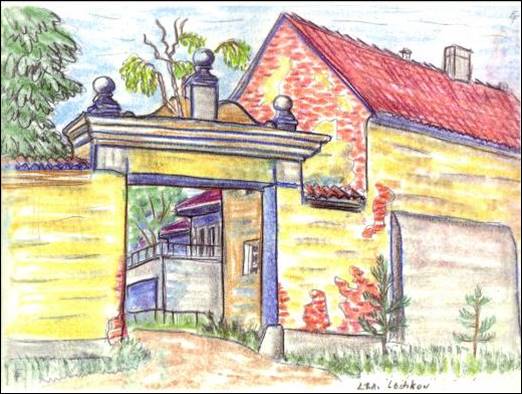
Obrázek 53 Brána na lochkovský dvůr, Else Fritschl 2005
Kleneč
The year 1867 brought changes for all of us. The parents with three siblings stayed at the farm (Lotti , Gusti, Ferdi). Clara and Zdenka left for Leipzig. The other 9 siblings, however, tried to earn living on their own. Tekla left for Mogyoros, Anna to Moravia and Emma went to a kindergarten.
I was a governess at a factory owner’s in a country town – Moravská Třebová. Two young ladies were entrusted to me, one 7 and the other 12 years old. Their two brothers attended my lessons partly too. …[220] Then I took a job in Vienna and it was at my student’s cousin’s. I stayed there for 10 months.
1873 was the exhibition year. Then I fell ill because of the Viennese air, water and people. In May I left for my sister’s, who was married in Salzburg. In October I went to France and England and in 1880 I arrived in Salzburg for a visit and to recover, by no means with the intention to stay, but to go to Vienna. But my sister Tekla yearned for me to stay and try giving lessons, which actually had not been my intention at all. That turned out well and apart from many burgher children of all estates among my female students I included Archduchess von Toska, Duchess von Arenberg, and her 17 years old daughter Maria Salva and Princess von Croy.
For the states exams I prepared:
Annerl Erben, French, English
Hilde Wessely, Generals daughter, French
Fanny Würthle, photographer’s daughter, French
Maria Swoboda, notary Rosmanit’s niece, English
Lambert Gruber, specialised teacher, French
Lisa Neumöller, French
Anna Brzorad 1847-1934
Typed by Elisabeth Klebel, November 1965
The following statement is also in Aunt Anna’s handwriting:
Lochkov for 152.800 fl sold
-38.000 fl
_______
114.800 fl father got and 7 siblings
Therefore each 16.400 fl and father as a compensation
16.400 fl and
21.600
________
38.000 fl.
And despite all the effort “ging Alles zu Grunde” all came to naught.
Pepi Warthburg said, that his father was persuading mine through all legal means not to take over Lochkov; to stay in Dobříč, where the lease was cheap and the soil fertile. But my father carried out Grandpa’s will to ill luck for him and you. He was a hard worker; he had the work and the others got the money without work.
Three times he was supposed to cultivate neglected fields: Dobříč, Lochkov, Kleneč.[221]
He should have stayed on the first farm or after Grandpa’s death to take the position in the sugar factory, because he was a pioneer - as Pepi Wartburgh put it. He was the first to have beet used for sugar and had it planted for that purpose. (Words by Pepi Rudolf v. Wartburg, 1908)[222]
Vilém Brzorád JD (1814-1898), advocate and owner of a brick factory
Vilém Brzorád JD (1814-1898) was born on 16th December 1814 in Smichov Nr. 51, baptized as Vilém Ferdinand Brzorád; the Godfathers were “Ferdinand Delorm, Kaufman” and Adalbert Wilhelm Brzorád. According to the obituary, the country’s advocate (in Rakovník, Litomyšl and České Budějovicen) and a member of various patriotic corporations, a man of a genuine character and extraordinary merits. Although according to the old custom of those times the language spoken in the family was German only, Vilém was from his earliest age a determined Czech.[223] It is his memories that this text draws on in several places.[224] He married Antonie, the daughter of Jan Svěcený, the magistrate councillor in Jindřichův Hradec, later the mayor of Pelhřimov and finally the city councillor in Prague, but also the granddaughter of a distinguished historian and linguist F. M. Pelcl / Pelzel (1734-1801). In a genealogical book about Pelcl we also learn more about Vilém Brzorád and his family.[225]
Vilém was without doubt one of the oldest members of the Czech Museum Society[226], he was amongst the contributors of the National Theatre[227], he was a friend of national revivalists such as Jan Helcelet M.D. (1812-1876) and a philosopher J. I. Hanuš (1812-1869)[228]. Vilém wrote in memories of his father: “He liked to buy Czech books and would have become a cofounder of Matice Česká[229], if he had not had registered me as such, which happened on the advice of the memorable Josef Jungman, so that the benefit of the cost invested could be used longer in the family.” [230]
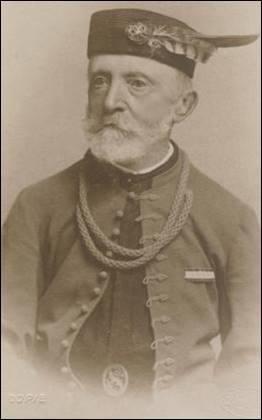
Vilém Brzorád JD (1814-1898)
In years 1845–1848 Vilém administered his father’s dominion and performed there also the office of a justiciary. [231] Having studied law, he became an advocate and settled in Litomyšl, where due to his outstanding social and patriotic qualities he found himself at the forefront of public life. He became the first chairman of Sokol, a member of the town council (elected e.g. 1865) and the director of the saving bank. He performed meritorious public deeds during the Prussian invasion in 1866. Although cholera plagued the town of Litomyšl and the spirit of the toughest were sinking, Vilém Brzorád remained firmly in his post and managed a good many charitable things.[232] (In 1870 as an advocate he contributed two gulden in favour of the widow and a 13-year-old daughter of the deceased painter Alois Bubák. [233])
After years, when two of his sons entered the service of the Schwarzenbergs, he settled in Písek, later in České Budějovice, where for the excellent qualities of his character he soon became respected and popular. He actively supported all the patriotic undertakings here, but he was never at the forefront due to his innate modesty. [234]
Vilém’s wife Antonie died in České Budějovice on July 30, 1884. The remains of the deceased were transferred from "Pěkná Vyhlídka" (Rudolfovská třída) to the local cathedral and after the end of the church ceremonies, they were stored in the Old Town cemetery, to the private tomb for eternal rest. The brothers of the deceased were František Svěcený JD, k. u k. chief financial councillor and Bedřich Svěcený, k. u. k. gubernial councillor.[235] In Rudolfovská třída, on the right is the Czech economic school (in 1892). When the Czechs won a majority in the regional economic-forestry association in 1885, the new committee immediately prepared to set up the Czech Economic School. (The chairman of the committee was Vilém Brzorad junior.[236]) For this purpose, the curatorium purchased the farmstead “Na pěkné vyhlídce” and converted it for use as a school. (First class opened in 1886) .... Further on the left is Brzorad's extensive brickworks.[237] In 1886, the company "Vilém Brzorád st.", owned by Vilém Brzorád senior, the owner of the brickworks in Budějovice, was registered at the Commercial Court in Budějovice. In the same year dr. Vilém Brzorád, a lawyer in Budějovice, gave up his advocacy and was removed from the list of attorneys. [238]
His last years he spent in Jinonice by Prague at his son’s, Mr. Vilém Brzorád, an inspector and administrator of several manor farm estates. (According to the meeting of the Committee of the Czech Museum in 1891, Mr. Vilém Brzorád of Jinonic has increased the museum collection of manuscripts, documents and coins. [239]) Until the last moment, the deceased kept his mind fresh, in full bodily condition. In the evening before his death he was dealing with an important letter. He died on March 25, 1898. His departure will be regretted by all who knew him, to whom he was an adviser or a friend. Honor be to his memory. [240] He had two sons Adalbert (1843-1926) and Vilém(1853-1913),.
Adalbert Brzorád (1843-1926), worked as a forest councillor with prince Schwarzenberg in Hluboká near České Budějovice and as the director of the Vimperk estate. We read about him: " In the eighties of the 19th century, in the field, A. Brzorad walked through at least a part of the Golden Trail[241] (a trade road in Bohemian Forest in 11. - 17. century in German called Goldener Steig) and briefly documented in writing what remained of the road. This forest surveyor from Hluboká nad Vltavou, upon the initiative of his employer, Prince Adolf Josef of Schwarzenberg, preserved the description of the remnants of the Golden Trail in the section from the border to Horská Kvilda for the future. "[242] On the 6th. of May 1878 Adalbert married Miss. Vilémina Hoffenthal (28 years old), the daughter of Ladislav Hoffenthal, the chief administrator of the Hluboká estate and his wife Vilémina née Kučera of Postoloprty. In 1914, according to a Schwarzneberg’s architect’s plan a villa in Písek, Rokycanova Street, was built for the administrator of the Vimperk estate, Mr. Adalbert Brzorád. It was for sale in 2017 for 13 million crowns. [243] The only daughter Pavla married in 1909 the revenue director Adalbert Stohr[244] from Munich, a land owner in Postoloprty. They had two sons Adalbert and Pavel. [245]
Vilém Brzorád jr. (1853-1913), the second son of Vilém, was born on 1st of April 1853 in Pardubice and became the chief director of the estates of Prince Paar, the Count Mansdorff-Pouilly and the Count Kinsky, a tenant of Prince Schwarzenberg’s Jinonice estate, a member of the board of directors in Pozemková Banka etc. His wife was Marie née Brych. According to his obituary „he was a well-known farming operative and expert. From his life experience, we can briefly point out that he graduated from, the Halle University of Economics, in his time, a most prominent institution with an excellent reputation. For his knowledge and practical insight into managing and administering the manor estates he gained a highly praised reputation among the landowners' circles, so that with time the management and inspection of many estates ended up in his hands. Because of his hearty nature and great economic knowledge, he was generally honored and respected, and the economic circles lose in him their prominent operative. Honor to his memory.“ [246]
As an example of his activities, let us mention he was a delegate to the agricultural council for the political district of České Budějovice as the tenant of the Princ’s farmstead of Světlík, elected in 1884, [247] or that he, as the chairman of the economic and forestry association in 1888, pushed through a holding cattle exhibition, at which he also received the prize for his cow. Here he also made a speech both in Czech and later also in German. [248]
An interesting add: "Simple Economic Accounting. Written by Vilem Brzorad, a farm tenant in Svetlik. In České Budějovice 1890. Self published. Mr. Brzorad, as an in-depth practitioner who does not lack making progress in the economic field, has undertaken the task of compiling an accounting scheme that has proven to be successful for many years. The task has been achieved and it is presented by a published booklet, which can be recommended to any progress loving economist.“[249]
And finally a mention of an Easter trip to Palestine and Egypt with Čeněk Šulc et co. travel agency on the steamship Thalia, which sails from Trieste and which will be carrying the Czech colony of 30 members, among which there are chief director Vilém Brzorád with his wife, architect Ant. Wiehl, and an architect Mr. M. Blecha with his daughter, arch. Mr. O. Nekvasil., Přemysl Šámal JD or Josef Šupich JD. [250]
Vilém Brzorad died in Jinonice on December 12, 1913. He had sons Vilém (1887-1962) and Jan (1883-1970).
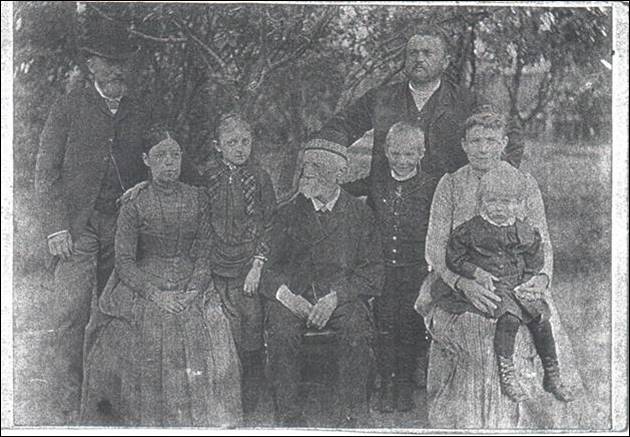
Vilém Brzorád (1814-1898) with his sons, daughters in law and grandchildren. [251]
(From the left,
Vojtěch (1843-1926) standing in a hat, next to him
Vilemína his wife sitting, next to her probably their daughter Pavla; Vilém Brzorád (1814-1898) in a cap sitting
in the middle, next to him the
elder of his grandsons, Jan (1883-1970),
behind him Vilém (1853-1913) and on the right his wife Marie sitting, Vilém
(1887-1962, or Marie (1890-1898) on her lap.)
Vilem
Brzorád
(1887-1962), an academic painter, lived in Prague in Smíchov
and remained single.
Painting by Vilém Brzorád (1887-1962), cut out [252]
Jan Brzorád JD (1883-1970), a landowner in Michalovice near Mladá Boleslav, as chairman of the landowners' union, did not escape the communist prison and his family were subjected to other persecutions. We learn more about Jan Brzorád JD (1883-1970) from the letter written by his daughter-in-law Jitka: “My father-in-law Jan Brzorad JD (1883-1970) was certainly a leading national economy figure during pre-war Czechoslovakia, and in terms of his professional skills, he probably remained such in the period of German occupation. Apparently, he was also recognized by the then bosses, as apart from the law at the Charles University in Prague he also studied Natural Sciences at the German University of Halle, and thus he mastered their language, perfectly.
Family hardships occurred after the emigration of his son Vilém and with the arrival of the "rule of the people", when he was gradually deprived of property at his estate Michalovice by Mladá Boleslav. He was finally deprived of the right to use the Prague apartment on the Pařížská Street (in the operation of “moving the millionaires”) and moved to a wooden cabin he had bought in time in Káraný by Toušeň. Meanwhile his youngest son Jiří (1929) had to end his studies of medicine at the Charles University and was called to military PTP units.[253]
My father-in-law went on long walks in local pine forests, where he found anti-Communist flyers, which he unfortunately collected and kept in the book of Hubert Slouka "Pohledy do nebe" (Looks into the sky). They were later found by Stb officers[254] during a house search.
Meetings of old men from the Masarykova Akademie Práce that unrealistically counted on the early fall of the “afterfebruary”[255] regime and talked about "what if". ... Along with the secret correspondence to his a son in emigration - through the Danish Embassy - and the reaction of the repressive forces were not long in coming. In the autumn of 1954 Jan Brzorád was arrested and together, for example, with brothers Čapeks’ brother-in-law, Dr. Josef Palivec (2nd husband of Helena Čapková) and an industrialist Otakar Kruliš-Randa, in 1955 sentenced for espionage (letters to son abroad), sabotage (the leaflets) and treason (meetings of experts) for 10 years in prison, loss of all property and civil rights and a fine of 100,000. If the fine is not paid, the sentence is increased by one year. The loss of all assets excluded it, so the punishment was increased. The loss of civil rights, however, also meant the suspension of his retirement pension. Since his wife, who was never employed, lived from the pension too, she became totally without funds, supported only by her own children. She was later assigned a 100.- CZK monthly allowance !!!
To serve his sentence Jan Brzorád was first transported to Mírov, a horror arousing red-painted castle in the middle of the Moravian forests near Mohelnice, today the jail for the heaviest criminals. The company he had was excellent: the poet Jan Zahradníček, Zdenek Rotrekl, or the afore mentioned co-defendants. The visit, which was rarely allowed, was racking on the nerves of the visitor and the visited. The feeling, when the entrance gate closed behind us with a bang, was freezing. The visiting room had a dividing line of wire glass and touch was excluded. It was painted with a merry roller in pastel colors and decorated with amateur pictures of still-life food (apparently the painters – jailbirds - capturing their dreams on canvas). Although then my father in law was 72 years old, he spent there - and then in Leopoldov five years - with the custody in Prague for almost six years. Even in the terrible conditions of the medieval castle, the old gentlemen did not abandon affairs of the intellect but held "seminars" in their expert fields. Or they improved each other’s foreign languages while peeling the onions or assembled the clothes pegs from their component parts. At their age admirable! Unexpectedly Jan Brzorád was transferred to prison in the Leopoldov fortress in Slovakia. The Theresian brick fortress – the spitting image of the Small Fortress in Terezin, painfully reflecting human cruelty. Besides, it was more isolated, and only a large number of ravens surrounded it in the bare white fields. Alfred Hitchcock would be delighted by the look ... The waiting room for visitors was not in the camp itself, but in a small house halfway between the town and the prison. As if we were waiting for the bus to arrive, except that there was a little burning stove. The permission to proceed with the next walk behind the adjoining barrier was given by the guards on the telephone – each time everyone believed it was for him. For older people with difficulty walking, the time of the "Way of the Cross" suffering to the gate and later back. After the "lucky ones" had left, the waiting room fell back into lethargic helplessness. Then, in the desertion of the snowy plowed fields with the flocks of black birds, surely many of us felt the association of the "Castle" by Franz Kafka ...
Having returned, all were exhausted, and the only plus was the mutual "seeing for ourselves" that we were all still alive, albeit as if in a bad dream. Havel's "Letters of Olga," where he demanded packages of Swiss chocolate or other "specialties" would seem to us like letters from a spa, not from the communist jail ... We were not even allowed to leave a mere knitted warm sweater from second hand unravelled wool for the old man in the castle or later in the fortress.
After the amnesty of 1960, my father-in-law returned from Slovakia by train with a briefcase of his belongings, shocked by the change, the most prominent in fashion. "Most women wore trousers, some even colorfully checked and men? Colorful sweaters - even red! Like clowns!" Unfortunately, more changes waited for him, even though the August end of "Spring 1968" did not surprise him too much - he had anticipated it! He was concerned about mankind, "technical progress is getting disproportionately ahead of the mental and especially moral stagnation." We see the consequences more clearly, but he foresaw them almost half a century ago. He was really an extraordinary personality who would have great reservations about our world today. …
… Below I quote the "Album representantů všech oborů veřejného života československého" (The album of the representatives of all fields of the Czechoslovak public life") published in 1927 [256]: Brzorád Jan, JD, Chairman of the Economic Cooperative of Landowners and Tenants, Michalovice, born in 1883. He studied law at the Charles University in Prague and Agricultural Sciences at the University of Halle an der Saale. He took over the lease of the Jinonice farmstead near Prague, after his father. After the coup d'état, until the end of the reform, he was the central director of the estates of the former Princes of the Paar. He is now the owner of the Michalovice estate near Mladá Boleslav. He is a member of the Masaryk Academy of Labor, a member of the Central Committee of Agricultural Unity, a member of the Board of Directors of Prague Credit Bank, public company Breitfeld, Daněk and Co., Kolín Chemical Factory, etc. [257]"[258]
Dr. Jan Brzorad, the director of the Paar estate in Jinonice, was a founding member of the Czech Astronomical Society[259]; there are nice portrait photographs of him available on Langhans online archive.[260]
„As an interesting rarity, in my collection of stamps I have a postcard addressed to my father-in-law from Princess Paar, which has in place of the postal stamp "Ex offo"- free of charge inscribed in her own hand. The Paar family was then the owner of the postal horses and so did not pay postage.“ [261]
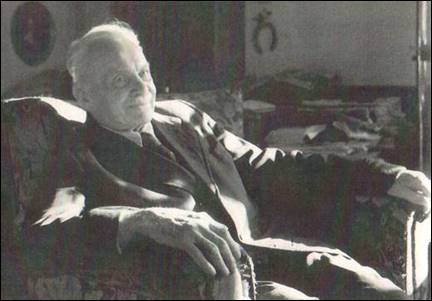
Jan Brzorád JD (1883-1970) cca in year 1961 [262]
The Archbishop of Prague, Dominik Duka writes, "There remains a question that has not been fully discussed yet: who is sitting on the horseback of Ardo as St. Wenceslas ...? During my visit to the Prague school in Kladska Street, I also met its director, Mrs. Kateřina Vávrová. We talked about a lot of things and also about Myslbek’s monument. "You know that my grandfather, col. Jan Brzorad, is sitting on the horse?" the director said. "I will send you his photo." It's not his face, but the figure may belong to him, Jan Brzorad, born in Světlík near České Budějovice in 1883. ... ".[263] The family story that Jan Brzorad modeled for sculptor Myslbek was also confirmed by his son Jiří Brzorád (1929-2016).
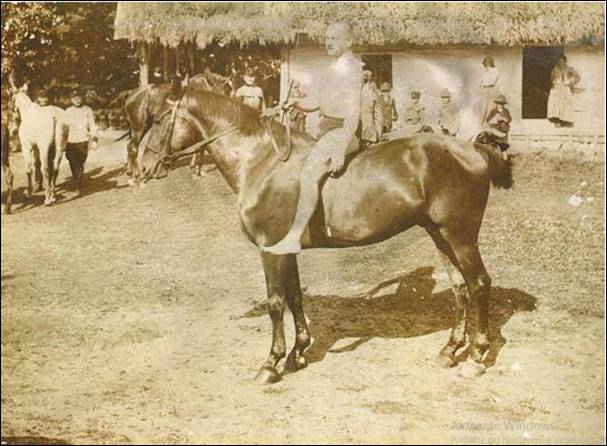
Jan Brzorád JD (1883-1970) on the horse Ardo[264]
The children of Jan Brzorád JD (1883-1970), were: Vilém (1911-1995), Jan (1917-1990), Jiří (1929-2016) and Eliška (1927-1999).
Vilém Brzorád JD (1911-1995)[265], a lawyer, politician, an economist, who, after a secondary school (Gymnasium) studied at the Business Academy in Vienna and Law at the Charles University. In 1948 he served as a Secretary to the Foreign Trade Minister Hubert Ripka. He remained outside the borders, lived in the USA, and was on the editorial board of the Svědectví magazine.
Vilém Brzorád (*1911)[266]
When he applied for US citizenship in New York in 1954, he signed the registration card in his hand as "William John Brzorad Delorme," and the name was typed as "Delorme William John Brzorad (Vilém Jan Brzorád)", residing at 83-10 35th Avenue, Jackson Heights, NY.[267]
In 1959-1993 Vilém was engaged in the Committee for A Free Europe; on October 28, 1995 Václav Havel awarded him with the Order of Tomas Garrigue Masaryk III. Class in memoriam. He was the author of Economic Works: The Economy of Czechoslovakia and a second book, Czechoslovakia. His wife Olga was the daughter of the writer Zdeněk Němeček, their daughter is Nina Brzorad-Pourfarrokh (* 1954) a distinguished ballet dancer, the son Jan Brzorad (1959) has a son Karel (* 1992).
From the letter
from Jitka Brzoradova we learn more about
Vilém: “My brother-in-law Vilém Brzorád JD (March 17,
1911 - June 1, 1995) was opening
a new air line to Africa at the end of
February 1948 as a Secretary
of Foreign Trade Minister. During the flight,
he was informed of the coup
in the homeland and emigrated at a stopover in Rome. As far as I know,
he was one of the first
emigrants in 1948 and was briefly staying with our local
Ambassador Schwarzenberg. In exile he was very fond of Paul Tigrid, who was also
the godfather of William's children.
Even in the difficult beginning of emigration, they earned a living
together as cleaners. With Pavel Tigrid, his wife Ivana
(and their dog), we have had several Thanksgiving celebrations at Vilek's wife
Olga’s
(née Němeček),
who lives permanently after "November" in the family house of the Němeček’s in Rataje nad Sázavou.
It is also a “base”
for the
there living daughter Nina or the son John when he comes with his two sons from
the US where they live permanently.
After the "November" (1989 JS), Vilem felt uneasy about returning to Czechoslovakia because he (according to the family rumors) had been in absentia in the process with Dr. Milada Horáková sentenced (even perhaps to a capital sentence?) which was still effective. That is why his half-, but loving siblings Eliška (Iška) and Jiří, set off to Munich, where he was waiting in the apartment of another friend from the "Opus bonum" - Richard Belcredi. The apartment was fully available for them, and I know that Iška was astonished at the "security" cameras, which were quite unusual at that time. Only when accompanied by his siblings did he cross the border, which he had last crossed more than 41 years before in opposite direction ... He was a known exile activist, but he was not able to assert himself after "November 89". Either for his age or for “weak elbows” (i.e. not being pushy)," so I think his merits were not appreciated enough, even though he was awarded the Order of TGM III. in memoriam by the president.
In the USA, they lived with Olga in a family home on Long Island, along with the widowed Mrs. Němeček (she was not much older than her son-in-law Vilém). There Vilém died suddenly at the age of 84. The urn of ashes was placed in a family tomb at the cemetery in Jinonice at the ceremony lead by the Břevnov monastery Archabbot Jan Anastas Opasek and the mourning speech was given by Pavel Tigrid. The burial was attended by a representative of the presidential office, who also laid a wreath in the tricolor colors on the grave. Vilem can also be found in the publication of Josef Tomeš et al. "The Czech Biographical Dictionary of the XXth Century" - p.149. Published by Ladislav Horáček - Paseka in 1999.” [268]
Jan Brzorad (1917-1990) was an agricultural engineer and married Irene Thorand. His son Jan (1944 *) married Daniela Fisherová, they have a son Jan (*1974).
Eliška née Brzorádová (1927-1999) first married Michal Kuthan (1926-1976); they had a son Michal. The second husband was the distinguished Czech doctor Prof. MUDr. Jaroslav Padovec (1908-1982). Their daughter is the above mentioned school director, Kateřina Vávrová, the wife of Ing. Petr Vávra.
Jiří Brzorád (1929-2016), joined the PTP [269] instead of continuing his studies of medicine . His origin certainly continued to be non beneficial during the socialist era. He is the owner of the family archive, from which he provided plenty of photographs and documents with great kindness. He also helped with the translation of Aunt Anna's memoirs. He had two daughters. After we have read the 200 years old instruction on how to pronounce the – for the nonnative speaker difficult – name Brzorád, it is necessary to add a kind memory of Jiří Brzorád (1929-2016) longtime distinguished operative in an X-ray department who specialized also in mammography screening.[270] Numerous lady-patients would nickname him then “Dr. Prsorád”.[271] His wife Jitka adds that this funny nickname was also used by most of his colleagues. In her letter she also writes:
“My husband participated in the research of the remains of our sovereigns, beginning with St. Wenceslas. He had the honor of being selected for cooperation by such a prominent specialist as Prof. MUDr. Et RNDr. h.c. Emanuel Vlček, DrSc. In his hands he even held the skull of St. Wenceslas, which the professor had brought for screening by then a new way of display - using Xerox machine. My husband was trained by the producer company as one of the first for its optimum use, which also proved successful with relics of long before deceased patients. The problem of keeping this precious relic fixed in space for screening was solved by hanging it in a mesh bag, so called "síťovka”. How undignified - but effective.
At the successful exhibition "Charles IV,” at Prague Castle my husband had so-called “blue chamber” available. It was a small room, fully utilized to install the Xerox blue images displaying examined skeletal remains of the sovereign. My husband was also the first to see and also was able “read” the image of the remains and so he was also the first to recognize the apparent cause of his death – fracture of the neck of the hip joint. That used to result in embolus of blood clots in the bloodstream and frequent death.
The research of the skeletal remains of Ladislaus the Posthumous (son of Albert of Habsburg and Elizabeth of Luxembourg) had an additional purification effect for George of Poděbrady, since the year 1452 the provincial administrator. When the sovereign died very suddenly in 1457 and it was not quite clear how, George of Poděbrady was suspected of having done away with the king, especially when he became the king himself in 1458. Such an ugly stain on his shield was still in existence until the 20th century, when the skeletal remains of Ladislav Pohrobek were taken under the inexorable look of modern instruments and the progress of diagnostics. It turned out that the young man suffered from a rapid form of malignant hematopoietic disease, to which he had succumbed at that time. Thus, the memory of George of Poděbrady was cleared of the shadow of the suspicion of the regicide.
An interesting - even bizarre thing was the survey and documentation of the remains of the so-called. "Dwarf of the Kuks", a poor relative of Count Spork. She was affected by a growth disorder, and this nobleman provided her with a home at his court in Kuks. There was no problem with the transport of her remains - she fitted into a banana box ...
When the Tycho Brahe grave was opened, there was a coincidence that is sometimes called "to be in the right time at the right place". In the burial robes of this astronomer a tiny rectangle at the edge was missing. At that moment, my husband realized that we had the same "little thing" at home in the showcase. It was in a tube whose cork stopper was covered with wax and the relic was marked "Roucho Tycha de Brahe" (Tycho Brahe’s robe.). My father-in-law (JUDr Jan Brzorad) received it from his Danish friend, who was the husband of the former wife of astronomer Ladislav Pračka, who was present (apparently in the first half of the 20th century) at the opening of the Tycho de Brahe’s tomb in the Tyne Church in Prague. In an unguarded moment, he yielded to a once-in-a-life moment - and “sacrilegiously” cut off the cloth. After so many years, by a coincidence (or the decision of God?), the two pieces of fabric got together, as my husband brought and donated the test tube with the cloth to the museum workers. At first they did not even want to believe the story. But when they filled the hole with the piece of cloth, the color and the size of the segment fitted perfectly like a jigsaw puzzle. Unbelievable ?? But it happened!!
In the days of "normalization"[272], I experienced a comic event myself. After a long and intensive negotiations, our state managed to negotiate (unfortunately I cannot remember at what kind of opportunity) the borrowing of King John of Bohemia’s remains from his home country. They were probably fearful of their return! One day the frightened postwoman came to deliver the registered letter from - Office of the President of the Republic (then Husak)! It was no longer a time when we were waiting impatiently from this place for a positive response to the plea for pardon for the father-in-law Jan Brzorád JD, who was sentenced to 12 years for high treason at 71 years and jailed in Mírov and Leopoldov prison. But the positive answer had never come - is that it now, then? Post bellum auxilium – After death the doctor? No. It was an invitation for a member of the delegation who had the task to welcome the sovereign, albeit deceased long time ago, at a ceremony at the airport in Ruzyne with all the tribute to a ruler. As far as I know, the remains were transported in a specially crafted box that was wrapped in a replica of his royal standard. So participation in this ceremony was a real honor.
My husband received probably the last homage in his life on 7th of.April 1998. At that time, he was the only participant without academic education and a title among those present such as doc. Jaroslava Moserová MD Dr. Sc., or prof. Oldřich Čech, Dr. Sc., awarded at the 650th anniversary of the founding of the UK with the "Medaile za zásluhy o čs. zdravotnictví" (Medal of Merit for the Czechoslovak Health). He was also chosen to speak on behalf of all there a speech of thanks, which he considered to be an important recognition of his almost 40 years of professional work in the health service. The Communist regime did not allow him more between 1949 and 1989. How symbolic for our "lost" generation of non-members of the Czechoslovak Socialist Youth Movement and non-party people.”[273]
Apparently, thanks in particular to Vilém’s family branch of the Brzoráds, in 2009 the city of Prague named the street in the area of Prague 5 Jinonice “Brzorádových” = the Brzoráds’ street.[274]
Marie Hauptmannová née Brzorádová (1818-1888)
Marie Anna Theresia Brzoradova (1818-1888) was born in Lochkov in 1818. In 1843, she married Ing. Karl Hauptmann (1801-1870), Chief Engineer of District and Road Construction Supervisor in Brandýs nad Labem, where they met. They lived in Klatovy. Eventually, when Marie Hauptmann was widowed, Tante Philippine lived at her place.

Marie Hauptmannová née Brzorádová in 1864[275]
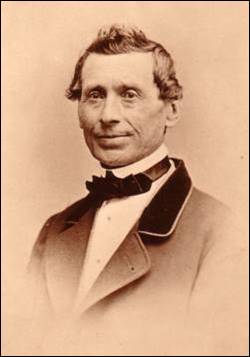
Ing. Karel Hauptmann[276]
Ing. Karel Hauptmann was the son of Dr. František Hauptmann (1772-1860), a physician in Zásmuky and Štěkeň and Ignácie Ulrychová, the daughter of Antonín Ulrych from Častolovice and Johanna born Hertzig von Herzfeld (1774-1821). Ignatia had 12 children and when she died, MUDr. František Hauptmann married Johanna (1796-1843), the daughter of the mayor of Hradec Králové František Reyt von Baumgarten (1765-1805) (Rayt / Reytt / Reith von B.). Ing. Karel Hauptmann's grandfather was Dr. Frantisek Haubtmann (+1799), a manorial doctor in Opočno.

Marie Hauptmannová née Brzorádová in 1869 [277]
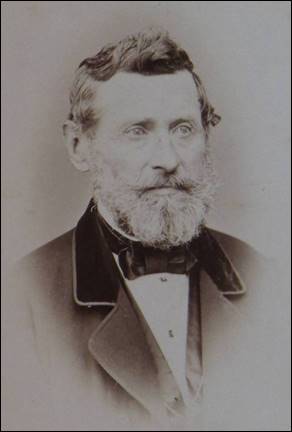
Ing. Karel Hauptmann in 1869 [278]
Marie Hauptmannová née Brzoradova had 9 children:
Marie (1844-1897) married Karel Goppold in 1874 (1841-1919), from 1911 with the von Nordenegg predicate and coat of arms, retired as k. u. k. captain and had 4 daughters and two sons Karl (*1881), k. u. k. lieutenant and Rudolf (*1886), a private clerk.
Anna (1845 - 1937) died single.
Karl (1847-1882) was a lawyer in Březnice and died single.
Josef (1849-1923) forester at Count Kinsky, from the beginning of the 20th century, the owner of a small factory for the production of soups and later also of confectionery in Prague at Královské Vinohrady in Prague, father of Rudolf and Otokar Hauptmann (1897-1974), genealogist of the Hauptmanns. At Josef's baptism in Brandýs nad Labem, in 1849, the godfather Josef Brzorad (* 1777), the owner of Lochkov with his daughter Filipine were present.
Rudolf (1852-1855) and František (1854-1856).
Otilie (* 1856), a teacher in Vienna who traveled a lot.
Filip (* 1858), "substitute professor", then professor at the Prague grammar school in Smíchov. His widowed wife, Marie née Schmaus (1875-1967) provided a poem for the wedding anniversary of Ferdinand and Marie Delorme, which we can read in Familie Delorme chapter. Filip was active in the Sokol movement with Tyrš and had two sons: Zdeněk, who worked as a union captain of a canoe club and Ing. Ladislav H., longtime secretary of FINA, International Federation of Amateur Swimming. He was at many Olympic games and was also the founder of ČPK (Czech Swimming Club).
Eduard (1860-1925) was a professor of ceramics in Bechyne and had 4 children.
Vilém (1861-1912), Chief Financial Controller of Uherské Hradiště, also in the brewery in Slavkov. [279]
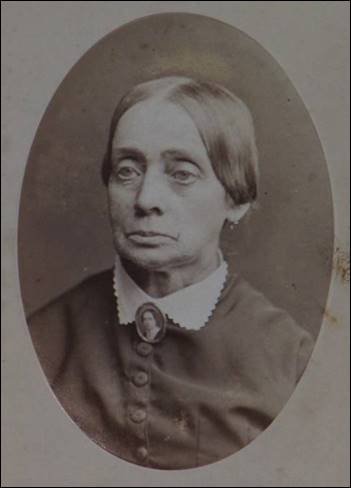
Marie Hauptmannová née Brzorádová r. 1880[280]
(Notice the brooch with the miniature portrait of Anna Erben née Brzorád (1833-1865))
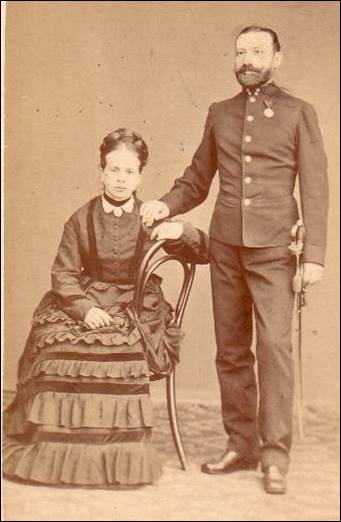
Marie née Hauptmann and Gopold von Nordegg[281]
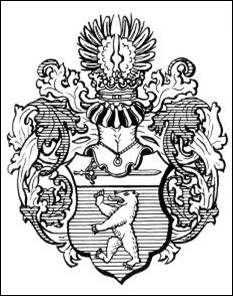
Gopold z Nordeggu, erb[282]
Ferdinand Brzorád (1821-1863), deputy judge to the country court in Prague
Ferdinand Brzorád (1821-1863), baptized as „Ferdinand Ludovicus“ was a deputy judge „adjutant“ to the Czech country court. According to an address book of 1859 he lived in Karlovo Square in Prague nr. 552. He stayed single and died no later than in 1863.
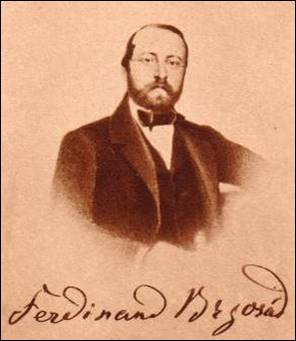
Ferdinand Brzorád (1822-1863)
Rudolf J. Brzorád (1823-1890), owner of the estate and a mine in Hungary
In 1823 in Lochkov was born the last son, Rudolf J. Brzorad (1823-1890), baptized as Josef Rudolf Ferdinand, the owner of the farm and mine in Hungary, and according to the death notice also a titulary high court judge of the Graner district administration "Titulär Oberstuhlrichter des Graner Comitates". Rudolf "Röszi" J. Brzorad later married Vilma von Nedetzky (who is a character of the famous Hungarian writer Mikszáth Kálmán in the book A gavallérok) and moved to Hungary, Mogyorós - today Mogyorósbánya (mogyoró - hazel, banya - mine). It was a coal mine, and we know that Rudolf's Aunt, Anna Brzorádová’s sister lived in Mogyorosz. Her name was Therese née Delorme, and she became the wife and later widow to Caspar Weissenberger, who opened the mine in Mogyoros in 1810 and by steamers on the Danube River successfully supplied Buda and Pest. [283] Caspar was the director of the Northern Hungarian Mining Company Tokod from 1812 to 1838 as a renter of the Hungarian religious fund’s estates in Mogyoros, then in 1838-1853 as a renter of the Esztergom estates in Szarkas. There, in the years 1853 - 1869, Rudolf Brzorad was also mentioned as the director. [284]
In the typescript by his grandson, Kornell Brzorad[285], we read that Rudolf (Rezsö) came to Hungary as a young man and that he had received a large sum of money from his father. For this money he bought two estates, where he opened two mines, Mogyorós and Pusztaszarkás - now Szarkáspuszta. Coal was transported by wagons to the Danube and then by boat to Pest. There was a port called Brzorad.[286]
In the middle of the 19th century, Rezső Brzorad, the village's judge and largest owner opened a quarry on the outskirts of the village Mogyorósbanya and built a castle in 1862 on the edge of the village. [287] „An unusual, singular look is the chateau in Mogyorósbánya (district of Komárom). On each side of the main gate there is a stone slab, one says Weissenberger and 1829 and the other one on the other side the name Brzorad Rezső and 1864. This can be interpreted as the restoration of the former building by Rezső Brzorad in 1864.“ [288] In 1910 the castle was owned by Borbála Schelzenlechner. [289]
Rudolf J. Brzorad was an active director of the mine because in 1863 - he advertised an offer of employment at his mine and the applicants were to contact "an Herrn J. R. Brzozad, Steinkohlenbergwerkbesitzer zu Mogyorós im Graner Comitate. "
Rudolf's mother advised him to rent a mill on the mill stones in Sarospatak where Kornel was the arbiter. „In the 1870s (probably in 1873) ... the factory was rented by the coal mine owner Brzorád J. Rezső of the Mogyorósi coal mine. From the price list published in 1873 it can be concluded that the mines and the factory were run by the method of Charles Láezay Szabó. The stones were made not only for the production of high-quality flour, but also for the needs of the chemical industry, and used for milling corn and rye and for milling cement, paint, bone and clay. The tenant maintained the good reputation of the Sárospatak millstones, expanded his presence in the country and expanded abroad [...], orders grew. He later settled in Sárospatak. (where he first changed his name to Brozorád, then later changed to Bozorády. The members of the family and their descendants became the miners and the leaders of the factory. (A család tagjai és utódai lettek a bányák és a gyár vezetői.)“[290]
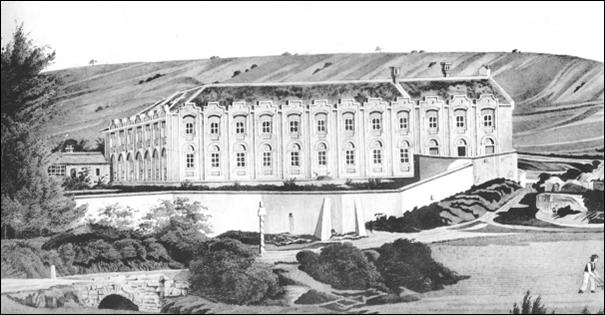
„Wohnhaus des Brzoráds“, Mogyorós, Hungary – the castle in the estate which belonged to Rudolf Brzorád’s family.[291]
With his experience with the Danube River steamship, he gave advice in the press and in Prague on how to implement this transport on the Vltava River: "The idea was put forward by J. Rudolf Brzorad, from Maggyoro by Nyerges Ujfalu. His suggestions, which are now widely known (July 19, 1846), were based on the calculation of profitability of the Danube steamship Danube.
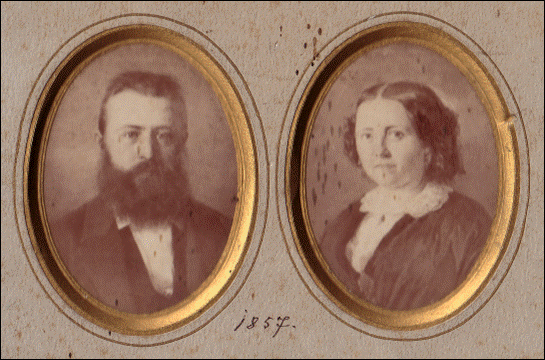
Rudolf Brzorád and Vilma née Nedetzky[292]
The capital needed would be at least 20,000 gulden, 18 of which would be for a fifty horsepower ship, and two would be required to build docks in Prague, Chuchle and Zbraslav. Brzorád estimated the expense to 13150 gulden per year, so two thousands more would have to be earned; only in that way would the entrepreneurs have achieved a four per cent interest of the money invested. Brzorad’s proposal came true after 11 years with the Mecsery steamship; unfortunately the vessel got stuck in the first experimental ride. (28.7.1846) and on the second one it was shipwracked by Vraňany (13.8.1857). It will not be possible to go to Štěchovice this way, no further than to Zbraslav. Further upstream the steamer machine can not manage the rapidity of tho flow." [293]
Rudolf Brzorád, photo Langhans[294]
Selma Mayr remembers Rudolf's family: "Uncle Rudolf, a great, impressive, with a nice long beard; he was very wealthy, he would come from Paris with his wife and daughter; once he came with his son Rudolf, but he was much older than us. We drove two carriages to Maria Plain."[295] Rudolf Brzorad died in 1890 and was buried in a church cemetery in Mogyorós. On the death notice we read "Rudolf J. Brzorad Gutsbesitzer und Titulär Oberstuhlrichter des Graner Comitates".
Julius "Gyula" Bezerédi (1858-1925)[296]
Rudolf’s son, Julius "Gyula" (1858-1925) was a sculptor and a great Hungarian patriot and adopted the already existing Hungarian name Bezerédi. His statues of James Watt and George Stephenson adorn the eastern railway station in Budapest; he is also known for his memorial to the Hungarian poet Kálmán Tóth (1831 - 1891), the revolutionary from 1848.
The second son of Rudolf, Ferdinand, a one-year volunteer, shot himself to death.
Rudolf‘s daughter, Vilma married Nicolaus Vutskits (Vukčič) von Mártonfalva, an official in Fiume in Hungary.
The other daughter, Anna, also married a nobleman, Paul von Potoczky, a police officer in Budapest.
Rudolf‘s third son, Rudolf Brzorad, took over the estate - the mine in Mogyorosz. He was the director of a millstone factory and married widow Adelheid (Etelka) von Komjathy, with whom he had four children: 1. Mary (*cca1886), who married pastor Baksy, their son was the director in Saros Patak, and grandson was a pastor; 2. Prezsö JD (*cca1889), police captain; 3. Vilma (*cca1891) and 4. Kornél (*cca 1896).
Kornél (*cca1896) was also a great patriot and participated as a volunteer soldier in the "Recapture of Slovakia"[297] and began to use another, already existing, Hungarian name of Bozorody. He married twice. First he married Török Mária and they had daughter Hermine. Then he married Illona Kiss and they had Illona and Zoltan Kornell. Zoltán Kornél Bozorád, the Lutheran evangelical pastor at a home for children and retired people in Nyíregyháza, is the father of András Bozorády, who mediated the story of the whole branch and lives today in Hungary with his descendants.
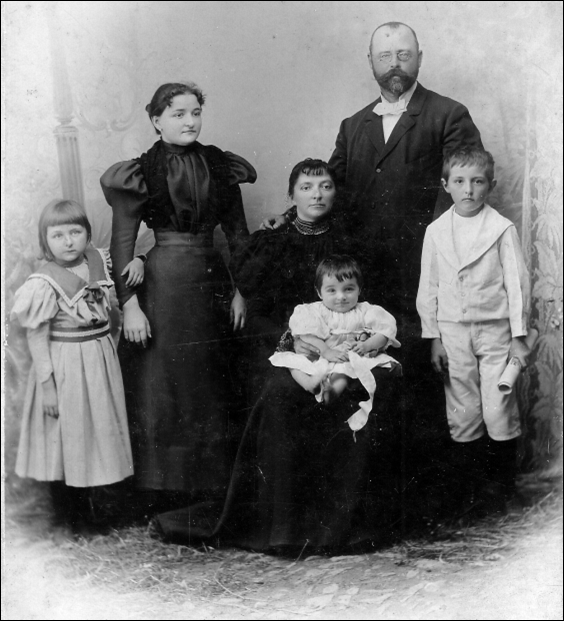
Rudolf and Etelka (née von Komjáthy) , Marie 13, Reszö 8 l., Vilma 6 l., Kornél 1 1/2 , Sáros Patak 16.12.1897, archiv J. Brzorád
Szarkáspuszta Castle, Brzorar / Bezeredi - Zoltai kastély in Mogyorosbanya built by Rudolf Brzodád (on the bricks in the ruins it is still possible to read the RB - perhaps the initials of the builder) passed into the hands of the Zoltai family in the first ¼ of the 20th century. It was confiscated in 1945, managed then by the agricultural cooperative. Illona Bozorády writes: "... I also visited Mogyorósbánya when I was 11-12 years old in 1954-55. Our father took me and my older brother there to see where our grandfather was born. In Mogyorósbánya, with respect to the fresh air and the big manor house, the state had planned to establish a pulmonary sanatorium, the equipment had already been delivered. The family was delighted that the manor would be used for a noble purpose, then collectivization came, and they needed space for the cooperative offices and stables. In the beautiful, wood-paneled knight's hall we saw the horses; our father was very saddened that the horses were standing there in the manure There were still older people alive who knew our family and respected it or used to be our employees in the past. My father led his children to see the dwellings of their ancestors. In a knight's hall with oak paneling, the horses were tied to the iron circles that were fastened to the paneling. My father was terrified that the animals were in the manure. Later on there was a school and then a cultural house. Then, when I went there with my son, there was nothing of the palace in 1987[298], in the surrounding buildings people showed that their stairs of pink marble are from that very mansion." [299]

The remains of Brzorád Castle in Mogyorozs, Bajót-Szarkáspuszta: Bezerédi kastély[300]
Anna Erben née Brzorád (1833-1865), friend of Kateřina Fügner
In 1833, Anna Brzoradova (1833-1865) was born on Lochkov, the last child of Josef and Anna. We have already read from her Stammbuch (a scrapbook) further above, so we know that as the youngest sibling she was "Liebling aller Schwägerinnen" - the darling of all sisters-in-law.[301] We can also read about Anna in the diary and correspondence of her future husband. [302] No later than 1857, Anna was courted by Anton Erben (1835-1905), the teacher in Rakovník. His father, Wilhelm Josef Erben (1797-1854), was a successful manager of the Harrachov glassworks Nový Svět (New World), as well as the brother of his mother Marie Anna Erben née Pohl (1795-1837). [303] Wilhelm's father, Anton K. Erben (1764-1814), was the administrator of the Harrach’s estate of Šluknov, which fell victim to a horde of unorganized Napoleonic soldiers after the Battle of Leipzig ( autumn of 1813). Anton K. Erben chose not to defend the Count's property by force, and for failure to protect the property entrusted to him, he was so full of remorse that he committed suicide. Count Harrach supported the widow and the son who could get acquainted with the latest contemporary glassmaking technologies.[304]
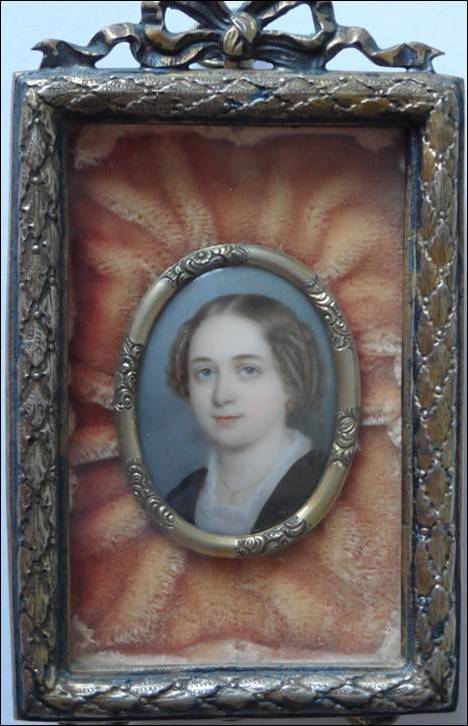
Anna Brzorád later Erben (1833-1865), miniature portrait on a brooch in frame [305]
(private archive of Dr. Robert Mayr)
According to notes in Antonin Erben's diary for 1857
"... on 29th March there was an invitation to Lochkov.
5th April Palm Sunday 5 o'clock departure from Rakovnik. Beautiful spring weather. Wilhelm, Kopetzsky, Jedlicka. Noon arrival - Anna by the window - friendly reception - warm atmosphere - the old gentleman attended lunch. Then in the garden - before we had seen birds and small orange trees. In their garden a small round table - a tree - a heart-shaped flower bed - the Carolinenberg - the Slavičí (Nightingale) Valley - a vineyard. In every room a bouquet of violets was given. After „caffee“ - singing. Jedlička sings Müttelein. Invitation to come back for the holidays. Fast Farewell - Evening to Prague - overnight Zlatý Anděl – at 5 stagecoach back.
3rd of May, a letter from Lochkov came, which contained the remorse, why did I not come on the holidays. ... "
10th of May, 1857, early at Mrs. Brzorad’s, who was somewhat unwell; most sad news from Lochkov, the death of the old gentleman is expected in the next two weeks. ...
14th, Mrs. B. calls me, shows me a letter from Anna in the garden, in which she disclosed her displeasure, why do I not want to come to Lochkov, that she wants my father to know me, the way she knows me, so he could close his eyes calmed about her future happiness. It was decided to go to Lochkov, all the difficulties were overcome. Now I'm sure she loves me.
15th I spoke early about the way with Mrs. B.
16th ½ 1 hour with post coach to Prague, where I arrived early ½ 6; there were no rooms except for Archduke Stephan[306], where I lay down, had breakfast, drank a glass of wine and at 9 am in a cab[307] to Chuchle. Went through the garden and took the holloway up until the lime trees appear; the whole region is in the most beautiful decoration, with a pulsing heart I was approaching and coming in. Anna ran to me from the second room, welcoming me kindly as well as Phillipine and the father. Joyful surprise is painted on her face. I'm ushered into the room where I talk to the father for a long time until his illness requires me to take my leave, but then the conversation continues. Meanwhile, with Anne alone in the first room. At the table with the two ladies alone, after the meal Karl came; we went for a walk, but to the regret of both of us accompanied by the whole family, with 9 children, a governess, and Mrs. Eminger. The bunch of blue lobelia picked by myself will last long, forget me nots picked, at Lahovka the most beautiful view of Zbraslav; on the way back with Anna and Karl lead from the heath (der Heid?) down the steep slope. The wreath is connected at the vineyard, it was a success. Her gaze is charming, indescribable. I'm talking about leaving, she's rejecting. After coffee I draw the lower house; coffee and go with Wilhelm to the garden, right in the small garden. Forget me nots are in the most beautiful bloom. On a small table I find several verses, her expressed wishes, hopes and aspirations. She tries to hide some, but just seemingly only to gain even more attention. Wilhelm tried to be helpful. We go further to the fig house, while he looks at the figs with the gardener, she asks standing by the greenhouse when I come again, and regrets that not until the holidays. This is the beginning of my request and confession. The words flow heavily from the heart. She is silent, looks at me remarkably, silent again with her head bowed. Then half-avoiding words begin, a pause, and finally, in another tone, I should not think about her, she is too old. [308] Long silence. Invitation to stay there. In the room with the father; during which Anna calls Wilhelm and Karl too, telling them what happened. Dinner. Anna brings me something to read.
17th Pleasantly slept; in the morning Wilh. read Humboldt's letters. Breakfast, farewell; from her father really kind and encouraging. I went to Prague with Hofmeister. - arrived at ½ 9; immediately ordered the fiacre and at 11 o'clock went away with Sophia and Hanns. In Slaný with Kopetzký parents. Evening in Rakovnik. ...
21th hit by fortune, Thursday, holiday, at the Brzorad’s[309] talked about the similarities between Sofia and Anna; talked a bit about Lochkov; on the occasion of going there, I get the idea of writing to Anna. And I carry it out. ...
5th of June on Friday. In the garden at B. - Letter was accepted, she declares that she can not answer this letter, because she can not even show her father such a crazy letter. So if I want an answer, I have to write another more serious letter. The opinion of the Father, the Sister, and Ferdinand is good. However, it does not seem so with the wife and daughters of Charles; which Anna does not like. I should come to Lochkov when I want to. ...
13th At B. with Kopetzky at the table, at the dessert talked about Lochkov and Anna.
14th The afternoon at the shooting range ... Wednesday, at Mrs. B. A letter was sent to the old man. It was sent on Thursday after receiving full approval.
19th on Friday, Mr. B. said when we went to swim, what good news he had about his father's health. ...
21st Vilém informs that his father died. ...
26th called to F. B. She informs me that the letter has been well received by the brothers, that certain answer has not been given; still depends on a closer acquaintance. Anna would arrive with Philippine. I should believe after so many signs, especially the letter before the second visit, that she really loves me; and yet the proceedings are so formal here as if I were to win her love from the beginning. I made a resolution to lead the talk to it.
2nd July, I was told that they had learned that Anna would arrive the next day. In the evening at Hainz, an excellent beer, in the best humor at 12 o'clock home.
3rd Early morning at Mrs. B., the letter came ... Anna will go to Prague for about eight days to the Lignerisch’s; everything will be done to get her here as soon as possible. Impatient expectations.
15th Anna arrives. ...
4th April 1858 I travel with Mr. Brzorad via Pürglitz - Neuhütte to Lodenitz.
5th at Lochkov, where Anna also arrives. After the meal, we were in the castle in the upper room, in the library, in the chapel, in the garden and outside. Evening in the company to Prague where I went to see Don Juan and a few days later at Egmont. "[310]
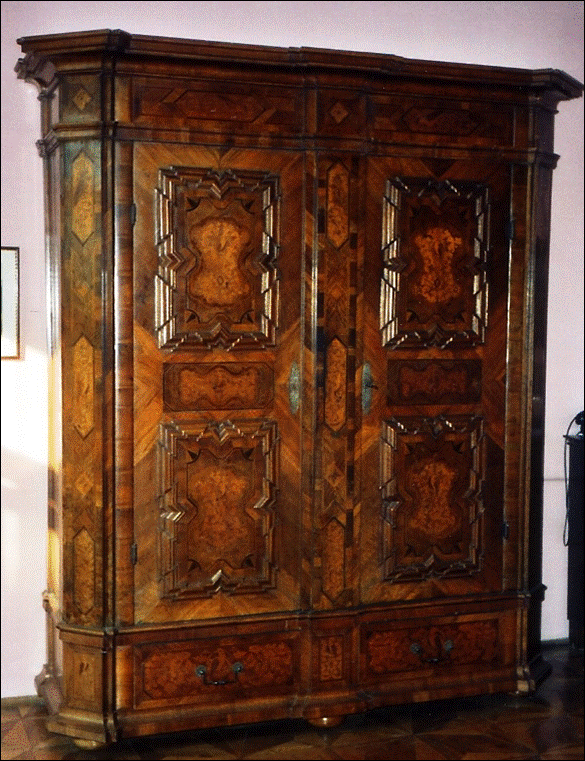
Lochkov’s wardrobe, Anna got it as a wedding gift, brought it to Loket, then moved to Salzburg, Innsbruck and Graz, where it is now a property of her descendant, Else Fritschl.
The mention in the diary, but especially the book by Irena Štěpánová "Renáta Tyršová", reveals also the confidential friendship of Anna Brzorad (later Erben) from Lochkov and Kateřina Fügner (1834 - 1906). She was the daughter of the economic councilor to Princess Dittrichstein and an owner of an estate in Zbuzany, Josef Turecký (+1865), but mainly the wife of Heinrich (later Jindřich) Fügner (1822-1865), Prague financier, "Freigeist"[311] and co-founder of Sokol. Štěpánová draws in her work from a German correspondence, which is deposited at the National Museum. [312]
"Yesterday I was in the theater. They gave Lucia (Lucie of Lammermoor, opera S. Cammaran, libretto by W. Scott) ... and I enjoyed it very well, but I was hoping to see "somebody", but I was very wrong. I saw only his brother. My eyes wandered in vain across the ground floor, "says Kateřina Turecká, 18, a friend of Anna Brzoradová. The letter is written sometime in the winter of 1852, naturally in German, as the whole of this correspondence. At that time, Katherine had known Fügner for several years.
"See the happiest creature in the world in me. H. loves me truly and sincerely, because he himself told me. ... Yesterday's ball was the most beautiful day of my life. I would not give it for anything in the world. He danced with me a cotillion, and he confessed his love to me at soupé. At that moment I think I would have renounced of all the treasures of the world to have the bliss once again, " she writes to her friend Anna on Jan. 15, 1853.
On July 31, 1854, Renáta was born. The first and only child of the Fügners. "I am fulfilling the pleasant Catherine's order and I can tell you with great pleasure that Catherine, the mother of a healthy daughter, is in a pink mood and sends her hearty regards to you," writes the newly-begotten father to Anna Brzoradova.
One of the letters shows that not only Anton Erben was a suitor of Anna Brzorad, but there was also a brewer. The Fügners both advise Anna to prefer this man, and leave the uncertainty of the teacher's status.[313]
"She makes us happy, she's just what we want her to be," writes Catherine to Anna Brzorad, about her seven-year-old daughter.
The year 1862 was also significant for Renáta by the fact that she first went abroad with her parents, of course to Italy. ... "Renáta rolled her eyes when she saw the sea for the first time and sailed on it," Mrs. Fügner informs her girlfriend Anna.[314]
Anna, eventually married the later school inspector Anton Erben (1835-1905) at Easter in 1860 and followed him to Loket with a beautiful wardrobe which was a Lochkov's dowry. Their children were Antonie (1861-1932), a teacher; Anselma (1863-1946), the writer of "Erinnerungen an Tante Philippine" whose husband was the director of the Library Dr. Ludwig Mayr; and Wilhelm (1864-1933) later PhDr. – history profesor in Graz, the writer of the biographical study "Louise Delolme, die Erzieherin Zweier Königinen von Dänemark" (Wien, 1897). Wilhelm‘s daughter Marie (1894-1983) married Robert Schwinner (1878-1953), a university professor of geology and gephysics in Graz. By courtesy of their daughter, Else Fritschl née Schwinner (1930 *), the genealogy work of Wilhelm Brzorad JD, Dr. Wilhelm Mayr as well as hers was at our disposal.
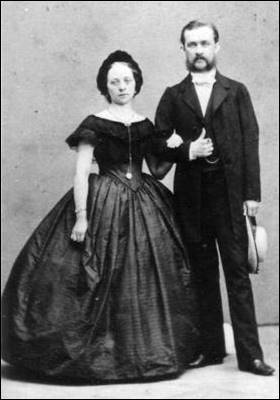
Anna Erben née Brzorád and Anton Erben
Anna Erben (1833-1865) died at the age of 32, and Anton Erben married the daughter of his brother-in-law Karl - Thekla Brzorad. Many descendants of Anna live there in Austria today.
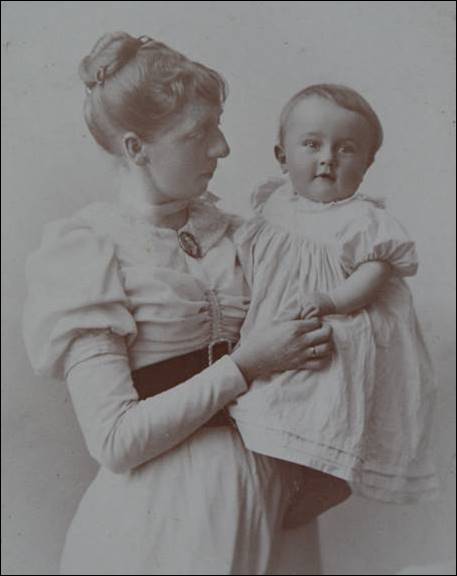
Anselma Mayr née Erben (1863-1946) with her son Wolfram (*1894) in her arms.[315]
Eduard Ferdinand Brzorád JD (1820-1898)
Eduard Ferdinand Brzorád JD (1820-1898) was born on 31st January 1820 in Lochkov. He was baptized Eduard Ferdinand as his Godfather was his Grandfather Ferdinand Delorme (the Godmother was his Aunt Therese Weissenberger).
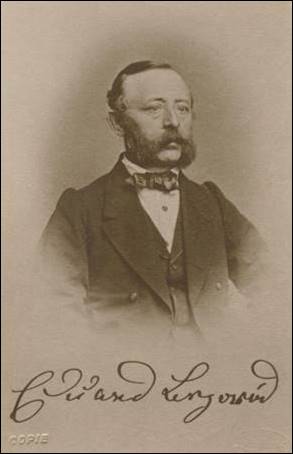
Eduard F. Brzorad JD (1820-1898)[316]
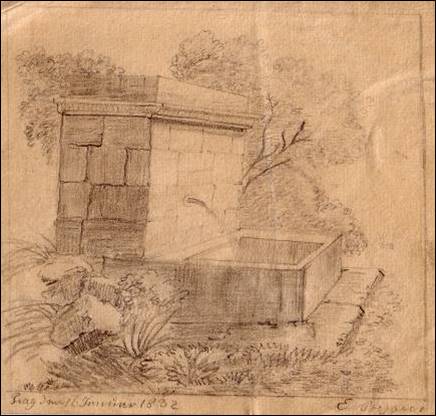
Prag 16 Januar 1832, E. Brzorad, Frána’s archive
At the time of his studies, when he was 18 he copied the following „Spruch“ in his neat handwriting in Lochkov on 11th of August 1838:
Wilst du kühn das Schicksals trotz besiegen
Musst du an die Gegenwart dich schmiegen
Wie an seinem Mutter Brust das Kind.
Musst die Freud an ihren Schwingen haschen,
Bienen gleich von jeden Blume naschen,
Fliehn jede ah‘ ihr Duft verrint.
If you want to win boldly in spite of fate
You have to embrace the presence
As a baby does with her mother's breasts.
You have to catch the joy on your wings,
the bees enjoy sweets from every plant,
Every one flees when the fragrance’s gone. [317]
Eduard Brzorád is remembered by his niece Selma as a short, gentle man with blue eyes.
Eduard started to study law in Prague, where in his first year in 1837 he was a schoolmate of František Ladislav Rieger, who graduated in 1841.[318] Eduard finished his studies in Vienna.
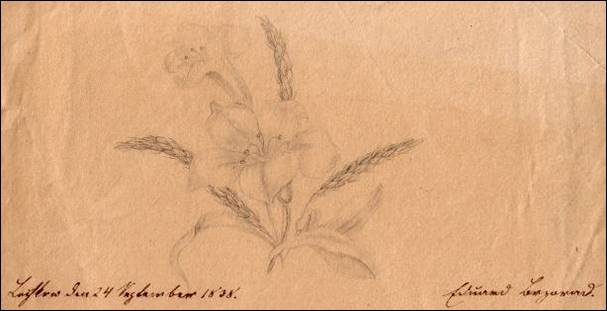
The drawing in pencil by Eduard Brzorad, Lochkov 24th September 1838[319]
When Eduard studied law at the Viennese university he lived at his Godmother’s – Aunt Therese in Herrengasse nr. 26[320]. He became a Doctor of Laws and obtained the diploma on the 3rd of June 1843. The document (parchment paper 40x57cm, a seal in a wooden box ø8cm with the text SAPIENTIAE STUDIT VIENNENSIS) published in the name of "Eduardus Brzorad, Bohemus Lochkovensis", which declares him Doctor in Jure, was issued by „Universitas Vindobonensis“.

Eduard Brzorád’s graduation diploma from the Viennese university[321]
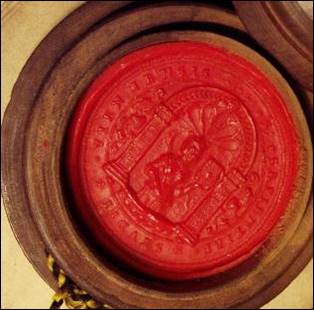
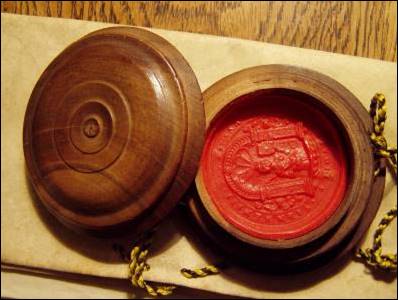
The close-up of the diploma seal of Eduard Brzorad from the University of Vienna.
In the 1847 edition of the journal Des Juristen einer Zeitschrift vorzüglich für die Praxis des gesammten österreichischen Rechtes, Dr. Eduard Brzorad contributed by an article Ueber die Gemeinschaftlichkeit der Beweismittel im Österreichischen Civilprocesse (On the Communality of Evidence in the Austrian Civil Hearing) Eduard Brzorad. (Inhalt des 1. Heftes. I. Abhandlungen. Ueber die Gemeinschaftlichkeit der Beweismittel im Österreichischen Civilprocesse. Vom Hrn. Dr. Eduard Brzorad.) [322]
Probably during his law studies in Prague, Eduard became friends with Joseph Alexander (Baron from 1854) Helfert (1820-1910), who was born in the same year as Eduard. [323] From Helfert's memories we know that in 1848 he corresponded from Krakow "with his friend Eduard Brzorad" (1820-1898), "Jur. Dr. in Prague".[324] He mentions their common friend and classmate Joseph Peter[325] and described Eduard as "a quiet, thoughtful man - ein ruhig überlegender Man." [326] He also quotes from a letter in which Eduard Brzorad writes about his visit to Helfert's sister Marie. [327]
Josef Alexander Helfert was a prominent lawyer, historian, deputy, and ministry official - in 1860 he practically directed the Ministry of Education. He took an active part in the events of 1848 in Prague. [328]
His political and world views were influenced by the strong piety of his parents and also by his persona experience with the coexistence of Czechs and Germans in Bohemia. He supported the federalization of Austria. He rejected the Austro-Hungarian settlement in its dualistic form. He was also an Austrian patriot. From his student youth he retained openness to reforms, that is those cautiously introduced. [329]
Helfert is the author of the remarkable work "Hus und Hieronymus" (1853), which he published originally in German and then „returning it to the Czech literature“ he published it in Czech under the title „Mistr Jan Hus“. ". Helfert writes about his grasp of Czech language: "Since I was a student, I have paid attention and hard work to Czech language and literature, and I think that I have been educated in it as far as anyone can educate in a language which he has not been brought up in ...". [330]
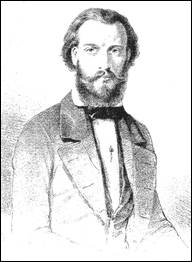
Josef
Alexander Freiherr von Helfert (1820-1910)[331]
Baron Helfert (probably Josef’s son Zdeněk) was an economy inspector of the Princes Paar’s estates in Bechyně in years 1886-1891.[332] Later the administration was transfered to Jinonice, where Eduard Brzorád’s nephew, Vilém Brzorád (1853-1913) was a director as well as Vilém’s son Jan. Zdenko Helfert’s photo given for rememberence of the 1871 visit can be found in the Voith-Herites von Sterbez Album.[333]
24. Juni 1849 Newly appointed country advocates namely … Dr. Eduard Brzorád for Deutschbrod … have already taken an oath at the k. k. High Court of Appeal. „Die neu ernannten Land-Advokaten, und zwar: Dr. Joseph Schwarz für Außig, Dr. Joseph Schönfeld für Böhmisch-Leippa, Dr. Eduard Brzorad für Deutschbrod und Dr. F. Schürer für Saaz haben bereits den vorgeschrie benen Advokateneid bei dem hohen k. k. Appellationsgerichte abgelegt, und sind die beiden ersteren bereits an ihren Bestimmungsort abgegangen.“[334]
According to the Schematism Eduard Brzorád was already in 1851 in Německý Brod, where he was a provincial lawyer as well as a k. k. notary for the rest of his life. He was also a city councilor.[335] The family’s residence as well as the office was at the address Německý Brod Nr. 105, which can still be found at the corner of Dolní street.
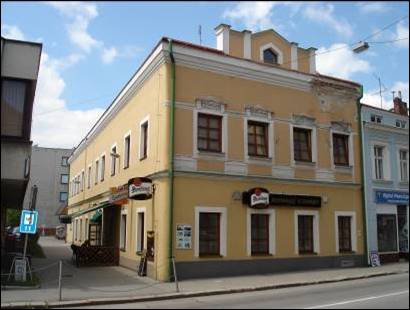
Německý Brod Nr. 105 at the corner of Dolní street in 2006
On the 14th of March 1851 Eduard Krziwanek from Věž sent the answer to Eduard Brzorád’s letter in connection with the wedding of his daughter. In his letter he writes that Eduard Brzorád enjoys his respect and that of his wife’s and that they have no objections to his suggestion. They will be happy to accept him into their family, if he can gain Marie’s liking. He should take into consideration, though, that Eduard Kryiwanek will under no circumstances persuade his daughter, and thus he must owe the gain of her Yes to himself only. He will dare to entrust Her Self to his good tact and also that he will not compromise her innocence. Finally he asked Eduard B to visit him to have a men’s talk, during which they would clear up the financial matters.
Geehrter Herr!
Auf Ihre durch das Schreiben vom 11ten gestellte Anfrage gebe ich Ihnen die Offene Erklärung, dass die Sie meine und die Achtung meines Weibes für sich haben, uns eine verbindung mit meiner Tochter und Ihrer Propose in nichts wiederstrebet, und wir, wenn Sie die Neigung Mariens für sich gewonnen habe werden, Sie gerne in unsere Familie aufnehmen werden. Wollen Sie nur in betracht ziehen, dass in unter keinen Umständen meine Tochter zu einer Verbindung überreden werde, und dass Sie Ihr Jawort nur sich selbst dankend erwerben müssen. Bey meinem noch nicht 17 Jahre alten Mädchen haben Sie noch eine gantz unbekannte Regung in das Leben zu ….. .Ihrem richtigen Takte darf ich wohl überlassen hiebey Ihre Selbst als auch die Achtung meiner Tochter nicht zu compromittieren.
I glaube nichts gegenüber Ihnen in Nothwendigkeit zu seyn über Materielles in Ertörungen einzugehen, und da ich über meinen Umstand nur mir mündliche Aufklärung erbitten muss so erachte ich einen männlichen Austausch für gerathen u. erbitte mir diesfalls Ihren Besuch.
Mit Achtung
Ihr aufrichtiger
Ed. Krziwanek
Wiež d. 14 Mertz 1851“ [336]
If Eduard Brzorád was interested in Marie Krziwanek, he was apparently far from fine then. Regarding the “men’s talk” about the financial matters, we can assume that neither of the parties was disappointed. So it was up to the groom to win Marie’s affection. The letters from later on show that it was not quite easy for him. At the time of her sister Hermines’ wedding Marie recollects as she was afraid of “Brzorád”(as she called him) at first. In other letters (unfortunately undated but probably from the time after the marriage because of the way of addressing „Mein Lieber Eduard“) we read about Marie reproaching her husband for his coldness, or his phlegmatic nature and several times she asks him to tell her the truth openly, so that she could reform and that she would do anything for one friendly word or look. „Schau lieber Eduard sei nur ganz aufrichtig gegn mich wenn dir an mir etwas nicht recht ist, für ein freundliches Wort –freundlichen Blik thue ich dir ja alles alles was du nur verlangst.“
But Marie could also be witty. Once she wrote she is sure Eduard „was not at church on Holy Friday and therefore he is condemned to read this epistle of a lenten sermon, poor Brzorád – Epistel Fastenpredigt, Armer Brzorád“. Some of the endings of the letters are funny too e.g. : „… und endlich gibt dir Ruhe deine treue Marie“. From the letter (sent to Eduard to Lochkov on his way to Prague) we learn about certain Nina, Marie was apparently friends with in Věž. When Nina and a Ms Fischer came to the Věž’s castle for lunch, they played whist until 8 pm. Poor Fischer played so miserably („so miserabel“) and quarreled so much, that if Marie were her she would not rather have played at all. It also clear from the letters that the Krziwaneks would go to Okrouhlice. For example the day after the whist Marie and Nina are getting ready in Věž to leave for Okrouhlice at 10.30 „zu Tisch“ to the table. The Mezers would come there too. Later they would want to go to Janda’s place.[337]
In the list of contributors to the establishment of the Czech national theatre from years 1851-1861 we find entries„E. Křivánek, a landowner and a city councilor, 10 gulden“ and „Eduard Brzorád JD, lawyer, 3 gulden“.[338]
On 12 September 1852 Eduard Brzorád JD married Marie Krziwanek (1834-1898) in the chapel of Věž’s castle’s. (The history of her family is dealt with in the part of the project called Familie Krziwanek.) Still before the wedding silveware for the trousseau worth 412 gulden was bought from the company Prokop Richter in Prague. [339] In connection with Německý Brod we could note here that her father Eduard Krziwanek was not only the owner of Věžs estate, but he was also a citizen of the town of Německý Brod and there he was a member of the city council from 1849. That is why he might well had met a young notary and lawyer living and working in the same provincial town..
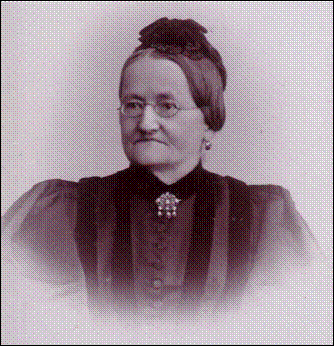
Marie Brzorád née Krziwanek, foto Dvořák N., Německý Brod[340]
The newlywed Marie, like her mother, Karolina, kept a memorybook where she recorded the date of the wedding and then that she moved to Brod on 22 September. We know from the letter to Eduard that the house in Brod was not ready, it had not been painted, and it was not washed as late as on 12 September. The mother of the bride insisted that, until the rooms were polished and the windows cleaned, Mary should not dare to move away, and stay in Věž until everything is finished. Then, in her memorybook she made notes about traveling:
„25 June 1853 through Tirol, Italy, Terst, Laibach, Graz.
10 August to Vienna with Eduard. 15 August was ill.
4 September to Vienna, stayed there untill 18th. [341]
8 December 1854 went to Prague to Lochkov, arrived 10th, 17th got back to Brod.
26 May 1855 went with the parents and siblings to the spa towns Mariánské Lázně and Františkovy Lázně. …
25 August 1855 with Eduard to Lochkov, where they stayed over night and met Ferdinand. … 28th went to Prague, (…) came back to Brod 30th.
In year 1856 from 12 June till 4 July stayed in Boleslav (…)
13 October 1856 to Prague, 15 to ?, 17th back – 18th to Lochkov, 20th to Prague – 22nd evening to Kolín, 28th evening to Čáslav, 29th back home.“
On 31 October 1856 they celebrated Maria’s parents’ silver wedding anniversary in the family circle in Věž’s castle.”[342]
In the years 1855-6 the writer, archivist at the Gubernium and Czech patriot Jan Hulakovský (1804-1877), a politically unsound figure, who had retired early for taking active part in the events of 1848 in Prague found refuge at the lawyer dr. Brzorád. „Hulakovsky tried to solve his financial distress by looking for a job that was at that time offered to him by attorney dr. Brzorad, with whom Hulakovsky agreed on a monthly salary of 15 zl. Despite this small financial injection, however, Hulakovsky's debt kept growing. Therefore, in January 1855, Hulakovsky asked for an increase in the salary and Dr. Brzorad raised his salary to 20 zl. However, when his salary was increased, Brzorad pointed out that if he was not happy working for him, he could file a notice with a monthly notice period. When, at the end of 1855, Brzorad wrote a letter to Hulakovsky that he was dissatisfied about his late arrival at work, Hulakovsky argued that he had worked overtime, and so Brzorad's reproach is wrong. At the same time, however, he asked the lawyer to raise the salary to 25 zl., that is if it could not be 30 zl., because he was working on very complicated conceptual works; and if the increase had not been an option, he demanded a month notice. The lawyer sent him a letter saying that his services might be spared as of February 1, 1856, and so he sacked him. [343]
Later Hulakovsky found the job at advocate Erban with a salary of 18zl. "Let's add that Hulakovsky was then almost deaf and apparently also peculiar:" In his private life, he did not enjoy any pleasant moments in the first decade of his stay. It is known from his daily accounts that he often resolved disputes with his neighbors who behaved very brutally to him and offended him, and in some cases these disputes resulted in a court that had to decide. Hulakovsky did not even have the support in his family that he deserved. The proof of this may be the offense of his brother-in-law Hauser, who once beat and injured him so that he was sentenced to prison. Here we can see that the view of Hulakovsky’s behavior and conduct was often different, and not everyone could agree with Hulakovsky." [344]
In 1856 Eduard Brzorád lawyer, k. k. notary and advocate in Německy Brod contributed 10zl to Společnost Wlastenského musea w Čechách (Society of the patriotic museum in Bohemia).[345] Hulakovsky worked in Wlastenske Museum w Čechách in 30s. [346]
The year 1857 was - according to the memorybook – quite busy, especially taking into consideration the fact that during all the stated events Marie was already pregnant.
26 June 1857 to Čáslav, 27 to Kolín, 28 early to Praha and directly to Lochkov, 9 August back home.
18 August 1857 the wedding of Hermine Krziwanek and Julius Prziborski, the economy director in Veltrusy took place at Věž’s castle.
10 September 1857 to Chrudim for a night, 11th Hradec Králové, 15th to Prague, 16th to Veltrusy – apparently visiting Marie’s sister, 18th Prague, 19th Lochkov, 20-21st in Prague with Hermine, 22nd arrived home.
8 December 1857 Eduard Josef Brzorád was born in Německy Brod Nr. 105. baptized on the 10th by P. Karel Seifert, the chaplain. The godparents were the grandparents Eduard and Caroline Krziwanek. The register says: „Eduardus Josephus Calas.“ So we can assume the patron saint Joseph Calasanz was chosen and taken after his grandfather Josef Calasanz Brzorád, who – as we know from his tombstone – was named after this Spanish saint too. Eduard Josef Brzorad as the central character of this project will be dealt with separately in more detail later on though.
1 January 1858 first teeth. On 6 May 1858 Marie Brzorádová put down just one word: “abgewohnt”, so little Eduard was probably weaned.
On 3rd and 18th March 1859 there are two documents prepared by dr. Eduard Brzorád for the district court in Německý Brod – for K.H. Borovsky’s mother Josefa Havlíčková, who lived for a long time in Německý Brod at her son František’s.[347]
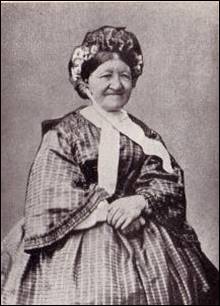
Josefa Havlíčková, KH. Borovsky’s mother
Marie’s niece Selma remembers her Aunt from Německý Brod: „The Aunts sent parcels. Německý Brod’s Aunt Marie, the wife of uncle Eduard kept providing us with aprons. That is why we would always call her „the apron Aunt - Schürzentante“ [348]
In an article about her son Eduard Brzorád we read, „… The oldest generation can remember his father …, but his mother is remembered more; a very noble and educated lady, who came from the Estate Věž, … was for years an example of the most generous virtues.“ [349]
Marie was the chairwoman of the Charitable Women's Association for supporting the poor girls of the primary and secondary school. Founded in 1878, it had 61 members. She was also the Deputy Chairwoman of „Eliška“, the Lady’s Education and Entertainment Union, with a total of 132 members, founded in 1886. Her daughter Karla was the archivist of the union. The room was located in A. Stolz's inn "U Černého orla" (The Black Eagle’s). Inventory assets included magazines, books, and music. Marie was also a trustee for the local orphanage, kindergarden, and the poorhouse.[350]
In Brod there was also an active Society for the Support of Poor Students. This association consisted of 130 members who cared for students without a scholarship. These benefactors were either providing lunches, breakfasts and dinners to the poor or contributed money in cash instead. Mrs. „Brzorádová (1z.)“ is listed amongst these.[351]
6 March 1861 at 8 am their daughter, Marie Brzorádová was born.
On 19. June 1862, a name for the Jasoň singing society was selected at the committee meeting and the appropriate striking motto "Czech Singing to The Czech Heart". The initiator of the whole matter (Josef Menšíková) was asked to accept the honorary role of the mother of the banner and other ladies of the local notables, Tereza Šrámková, the district governor’s wife, Marie Brzoradova, the k. k. notary‘s wife, Mrs. Marie Srnková, the headmaster’s wife and a townswoman Eleonoir Weiss to accept the role of the Godfather of the banner. [352] "In 1862, the association had existed for over two years but still had no banner. This was aided by Josepha Menšík as she managed to get support from other women. [353] In addition, she received two embroidered paintings from the Křiváneks family from Věž, which originally decorated the National Guard Battalion in the Revolution of 1848. [354],[355] During the liquidation of these armed corpses at the beginning of the 1950s, the original banners were handed over to the nearest military armories. Valuable parts like the embroidered pictures or twines were returned to the original owners, the remnants of the banners were destroyed." [356]
The banner was on display at the Jasoň 1859-2009 exhibition at the Vysočina Museum in Havlíčkův Brod, in whose collections it is now kept. With the courtesy of the museum, we can see both sides of the banner:


The deputy of the Provincial Assembly and the leading citizen of Německý Brod Vojtěch Weidenhoffer (1826-1901) was a person close to "Marie Brzorádová née Křivánek, whose parents invited him frequently to Věž in his youth, where balls, theater and other favorite home entertainment were held. Vojtěch Weidenhoffer was an old good friend of Dr. Eduard Brzorad Sr., whom he respected and met every day in a friendly company, both in the morning for wine and in the evening with a glass of beer in a kind, friendly conversation." He was also the admirer of Baron Voith. Thus his diary is a valuable source of information that we cite extensively.[357]
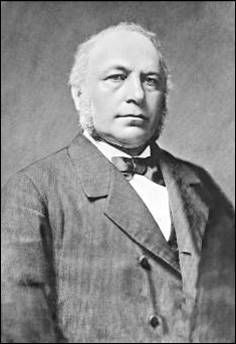
Vojtěch Weidenhoffer in about 1879 [358]
"1863 7th January (from The Diary of Vojtech Weidenhoffer:) A dense fog in the morning fortold today's beautiful weather. It was the desire of the local townspeople but also of the whole area, because today our town (Německy Brod) became the center of all the foremost farmers from the districts of Humpolec, Polenský, Přbyslav and Chotěboř. At the invitation of the Economic Union for the region of Čáslav 113, a branch of this union was set up here. Our community has entrusted all necessary preparation to the committee consisting of Mr. Ed [uard] Brzorad JD, k.u.k. Adjunkt Františkel Fáček, Mr. Ferd[inand] Menšík, Jan Schubert, municipal revenue cler, and me as the chairman of this committee. ... One hundred AND ten present guests, headed by Count Harrach, Count Chotek, Baron Ferd [inand] Voith, k.u.k. regional governor , and many other noble guests. Everybody had very good time and humor was everywhere ... "[359]
1864 1st January, Vojtěch Weidenhoffer wrote in his diary: „Mr. Brzorád JD and I invited B[enjamin] Schwarzl from Baštínov, Mr. Niedermertl Vojt[ěch], Mr. Wolf, Schmitt the shopkeeper, Mr. Jos[ef] Stolz, shopkeeper for a meeting to discuss setting up a spining mill. Generally speaking – people from Nemecky Brod It was agreed that there would be a spinning mill started as a stock company.“ [360]
On 1st April 1865 the 1st meeting of the newly established district council in German Brod met under the presidency of the 1st district mayor, Eduard Brzorád JD Sr and in the presence of 22 members of the council, in which the program was established as well as the regulations to be followed.
The 4th October 1865 „Today, the opening of the district council under the chairmanship of Eduard Brzorad was celebrated.“ [361]
The nationalistic daily Národní Listy of October 19, 1865, gave a detailed report on page 3 of this first meeting of the Nemecky Brod District Council. The district mayor was Eduard Brzorád JD Sr. and one of the present members of the committee Eduard Krivanek. What is remarkable is the reaction of Mr. Křivánek to the idea of establishment of the Institute of a Model Farm.
„Meetings of district councils. From Německý Brod. On 4 October, the district council of the Německý Brod region began its activities. When the elected District Governor, Mr. Eduard Brzorad JD, swore to promulgate the laws and to take care of the good of the district, and conscientiously perform the duties related to the office, he invited members of the committee to swear the same. After a long speech, he hailed His Highness for granting the self-government, which was echoed by the audience.
At half past 9 am, the district deputies left for the dean's church to take part in the festive divine services. At 11 am, the first session was started in the meeting hall of the city council.
Before we come to the depiction of the memorable today's meeting, we draw attention to the fact that the audience of the celebration watched it with its face cool and apathetic. Can it be attributed to political immaturity or actually to its maturity? - The result of the first meeting gave the answers. We interpret the circumstance in such a way that the audience had a bad hunch, which unfortunately happened to be true.
The first thing that seems to be important to the mayor Dr. Brzorad is that he advocates the equal use of the German
and Czech language in the meetings and suggests that the committee meetings
would be held in German and that the protocol would be written in German. The
proposal is justified by the fact that one-third of the Deutschbrod
district inhabitants is said to be of the German origin. When somebody
corrected that there was only one sixth of the German population, he agreed to
the point of view, but persisting in his proposal, which is supported by the
gentleman Švarcl, Velc and Rychlý. Especially Mr. Švarcl urged in a German speech, that the
German language be not forgotten. Only the brave Deutschbrod
mayor Mr. Menšík was against the proposal demanding, that they
hold talks and issue the official statements exclusively in the Czech language.
The result of the debate was that the question was postponed until the time
when the articles of the Rules of Procedure would be discussed.
The first subject of the agenda of the day is
the call of Mr. Brzorad, the administration of the
district property to be taken over and entrusted to two members of the council,
one of whom is in committee. Mr Krivanek
(Member of the Provincila Parliament and the Imperial
Council) suggests that both elected gentlemen were from the committee. The
choice is left to the governor who has chosen the gentlemen Menšík and Švarcl.
After that, the Governor calls on the Assembly
to decide on the amount of the salary for the secretary and suggests 700
gulden. Mr. Rychlý thinks that 600 is enough. After quite a long
debate, Mr Rychlý's proposal was accepted. Now, the
mayor is asking if they should invite applications for the post of the
secretary?
To Mr. Křivánek's remark that if anyone asked for a place to do this, there is no need to advertise this, the governor produced the application of Mr. Láznička, which he did not even read. (It was said to have been handed in in German.) The majority of the three votes for applicant Mr Láznička appeared in the poll.
The servant receives 250 of yearly salary. The applications for the position will be invited.
Now hiring an office is discussed. Mr. Švarcl wishes that the city council leave
their assembly hall for each meeting and in this matter he turns to the city
mayor Mr Menšík, who replies that he is not
empowered to negotiate something on his own and that he would submit the matter
to the city council. It was also agreed to buy the necessary furniture and the
various items needed, such as a seal, etc. The most interesting part of the debate
was the the fifth point of the agenda, namely the
debate on the rules of procedure.
Dr. Brzorád wants to adopt the rules of procedure of the city council and wants to vote on it immediately.
Mr Menšík responded in an apt manner that
something like that could not be accepted in a hurry if it had not been
submitted and if no one of the deputies knew these rules unless they are
accidentally also members of the city council.
Then the governor of the district council
committed himself to draw up the Rules of Procedure, which will be delivered to
each person in the copy several days before the next meeting.
Finally, an official letter of the regional
economic unity is read, in which the proposal is made to establish the
Institute of exemplary farming in the local region, so that half of the burden
would be borne by the regional unity, and the other half by the Deutschbrod region. Křivánek,
Velc and Švarcl stood up against it.
Mr. Krivanek
recommends his farm, encouraging everyone who wants to see an exemplary economy
to come and see his farm.
Here again mayor Mr. Menšík took the floor and tried to prove how beneficial such an institution would be here, yes, it is the necessity and made a proposal that a committee be chosen to consider the matter carefully. Mr. Menšík, Petr and Velc were elected to this.
The session ended in a good German talk. - Let
us now be allowed, by statistical data, to prove that our district is purely Czech,
at least Czech enough to assume the right that the procedural language in the
meetings, as well as in the office was exclusively Czech. Of the 40 localities,
there is not even a single German one; because it is known from experience that
in the villages pronounced to be German a good half of the inhabitants speak or
at least understand Czech; on the contrary, it is found that a good half of the
representatives of districts do not even understand German, but every one of
the representatives speaks Czech!
As the reason we state the case, that a certain
representative of the rural village and a member of the regional council was
asked why he did not disagree, he admitted he did not understand what the
gentlemen said to each other in German. If we assume (but we do not do) that in
the so-called German municipalities, not a single one understands Czech, it
would mean that in the Deutschbrod region there are
4,593 German inhabitants and 25,398 Czechs, ie about a sixth of Germans.
We expect with full confidence that the
deputies will be against the obvious injustice and they will pronounce the
Czech language as procedural language in all the meetings, both quarterly and
those of the committee, both in office and of course when issuing the
protocols. Or did Deutschbrod want to declare itself
truly German? However, we do not ask for the German compatriots to be wronged,
we do not want the German issues to answered in Czech!
In the evening, a festive ball attended by about 40 people was held, marking how pleased we were by the first session of our district council." [362]
Eduard Brzorad JD, as district governor, devoted himself to the tireless care of his hospital, which was proved, in particular, by the fact that besides many other improvements, electric lighting was provided by the cost of the district in the hospital.[363] Eduard Brzorad remained the district governor until his death, and then his son Eduard took over.
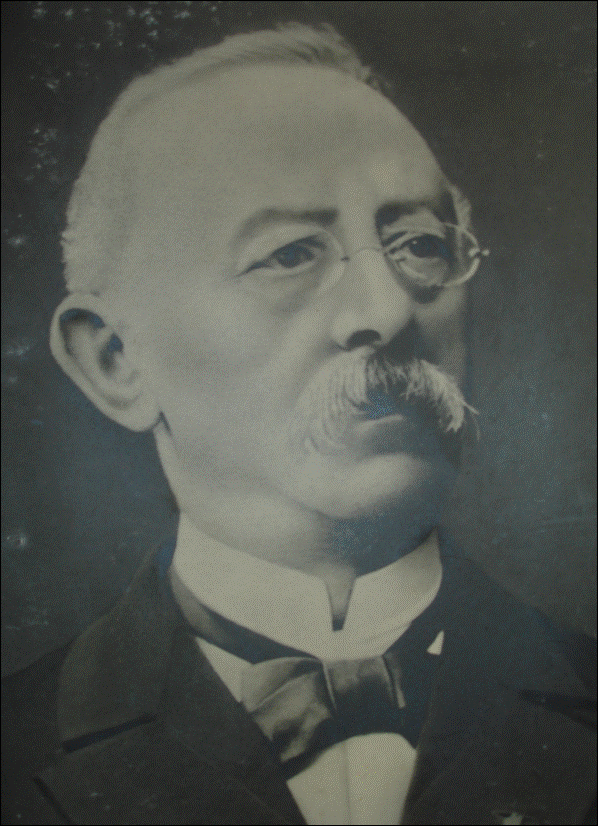
Obrázek 60 JUDr. Eduard Brzorád (1820-1898), foto
Langhans, výřez (SOkA Havlíčkův Brod,
sbírka fotografií, okresní starostové)
According to the Liste der Angekommenen Kur- und Badegäste in der Königl. Stadt Kaiser-Karlsbad " dated 23. 6. 1865, Caroline Krziwanek, the wife of the Věž’s owner with her daughter and Mrs. Marie Brzorad, the wife of a lawyer and a notary from the Německý Brod came to Carlsbad. The apartment given in the list is "Rubin, Kreuzg."
In 1866 Mayor Ferdinand Menšík and another councilor JUDr. Eduard Brzorad received the highest recognition for the loyalty and the deeds during the Prussian occupation.[364] The expression of the highest satisfaction of His imperial and royal Highness was also given to Eduard Krziwanek.[365]
The Národní Listy daily reports on March 16th 1867 on page 3 about the meeting of mayors of the district municipalities in German Brod, where Eduard Krivanek and JUDr. Eduard Brzorad were introduced as the candidates running for the regional assembly. Eduard Brzorád’s views are being commented. The whole text is quoted in the chapter on Eduard Křivánek.[366]
In 1867 Eduard Brzorád JD was elected the first city councilor (after the mayor - one of the five councilors). [367]
1869, 26. January (from the diary of Vojtech Weidenhoffer) Railway. This day will be very memorable for the city. Today, on Tuesday (Tuesday), the celebration of commencement of the construction of the Austrian Northwest Railroad was held. In the place where the station will stand, namely at the barns in the field of Mr. Křivánek, the tent was put up and decorated with banners. At two o’clock in the afternoon the invited guests and the city council gathered in the town hall. Students, the Sokol Society, and the Singers Society with the band and the banner stood in front of the Town Hall. At a certain time, accompanied by an immense amount of people, they all went to the building site where dignified clergymen had been waiting for them. Mr. Vicar R. D. Karel Čermák, an eighty-years-old man, blessed the places where the construction was to be started and had the first dig in the soil with the spade. He was followed by Dean R. D. Karel Seifert, k. k. regional governor Julius Sagasser, ... Mr. JUDr. Ed [uard] Brzorád, ... Everyone named here uttered his motto when digging into the soil. My motto was: "Let this road be a strap for the economy and the industry so they flourish side by side." After the ceremony, the Dean R. D. Karel Seifert held a reasonable speech. At the end the mayor paid homage to our noble monarch Emperor and King Franz Josef I, which the audience echoed with enthusiasm." After the feast on the building site, the entire assembly was taken to the temple of the Lord, where the "Te Deum laudamus" was held. In the evening in the assembly hall of the city council, a feast from the towns was given. ... The fourth toast was made by Mr. JUDr. Ed [uard] Brinade to the engineers. ... "[368]
8th November 1869, Dr. Eduard Brzorad, in spite of strong opposition, defended the election of the members of the emerging district school council. The opposition maintained that the election was not compulsory and that the law on school supervision of 28 January 1869 reduced the autonomy of the Czech country and individual municipalities and that the law was issued without the participation of Czech deputies. Dr. Brzorad successfully disproved these arguments and "rightly argued that the granting of the right to political choice ultimately implies the civil duty to use this right and to do so. At the same time, he highlighted the great benefits of the new school laws and the undeniable progress that has been achieved through them; he convincingly emphasized the opportunity to vote for the practical interest of the entire district population."[369] We can assume that he was influenced and well informed on the subject by his friend Helfert, who was up to the sixties an influential senior ministry official in the field of education.[370] In the election which followed, Dr. Brzorad and Peter von Frauenthaler Höfern were elected to the district school council.
They were elected by the votes of Mr Edler v. Krzivanek, the father-in-law of the speaker and the former Reichsrat, then Mr Verner, economy clerk of Graf Trautmannsdorf in Lipnice, further Mr. Petr, a failed government candidate in the elections to the assembly; then Mr. Benjamin Schwarzl, the owner of the Bastinov farm and the decisive German, then Mr. Schwetz, Mr. Fischer, who secretly is national, then Mr Altrichter from the German village of Blumendorf, finally Mr. Horak, the provincial official. Against voted fro example Vojtěch Weidenhoffer and Antonin Kalin, Councilors of city of Deutschbrod, or MUDr Adolf Felix, a city doctor. [371]
In 1869 the daughter Maria had her "erste Pianostunde".[372]
1870 JUDr. Eduard Brzorad runs in the election to become a member of the Parliament and he is not elected (apparently for not being a declarant[373] - he did not say that he would not enter the Imperial Council) "From Vojtech Weidenhoffer’s diary. [374]
In 1871, the daughter Marie had her "erste französische Stunde.[375]
1872, December 29, Sunday. Today, at the Dean’s house they celebrated the inauguration of our new Dean, Mr. P. A [ntonín] Vančura. I (Vojtech Weidenhoffer) was also invited by the Dean himself. After the celebration in the church, all invited guests, about seventy people, gathered at the dean’s house to have a high diner together. Present were the Vicar P. Karel Čermák Mr. mayor Kalina, Mr. JUDr. Ed [uard] Brzorád, then the city councils, deputy of municipalities and many dignified priests from around the area. (From Vojtech Weidenhoffer's Diary) [376]
In 1872 the political magazine Obrana (Defense) wrote: "It is very important that Deutschbrod with the German oasis, with this wedge in the body of the Czech bordering, become a strong stronghold of our element. For that it needs to be refreshed with the power of spirit and material well-being. This task requires complete and decisive men, not colorless, Brzorads, who envy weather vanes their volatile instability. Mr Brzorad has already proved himself by his deeds that he is not ours, both when discussing the procedural language of the district council and at the election for the school council, etc. We really do not understand why so many of our fellows and compatriots award the fellowship and even the patriotism to the Mr. Brzorad? And the less one can understand how they can deceive themselves and rely on him and trust him in many political affairs. Whoever is not with us in everyone’s matters, he goes against us and the traitor can never be rehabilitated before the nation. There are no other parties between the politicaly honest and the politically dishonest, so disregard Mr. Brzorad, and maybe he will soon be glad[377] to be noticed, for he has the best idea about the variability of secular things. Political instability of individuals often hampers the development of entire communities."[378]
In the school year of October 1873 - July 1874 the daughter Maria received an excellent schooll report at the Haupt und höhere Töchter Schule der Bertha Ritter von Rittershein[379] in Prague. The curiculum consisted of Religion, in German language: reading and recitation, grammar and spelling, style, world history, mythology, aesthetics and history of art, geography, arithmetics, physics and natural history, artistic drawing and painting, singing; in French language: grammar, reading , poetry, mythology and conversation.[380]
"1874 1st June Eduard Brzorád Sr. was elected the second councilor (of five) in the second round (V. Weidenhoffer was not elected at that time). E. B. was absent from the election. "(From Vojtech Weidenhoffer's diary) [381]
In 1874 Eduard Brzorad Sn. became the knight of the Order of Franz Joseph.[382] It is a Merit Order, founded in 1849,for the number of degrees and the range of awards it is a typical example of a modern order designed for practically every citizen of the Empire. It was canceled in 1918.[383] It was awarded to publicly or culturally active persons for civil and military merits for the monarchy.[384] After the death of the bearer, the survivors were obliged to return the decorations to the office of the order.[385]
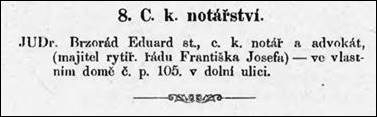
Úplný adresář, dějiny a památnosti královského města Německého Brodu, 1892
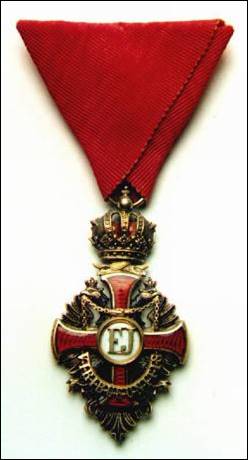
the Order of Franz Joseph
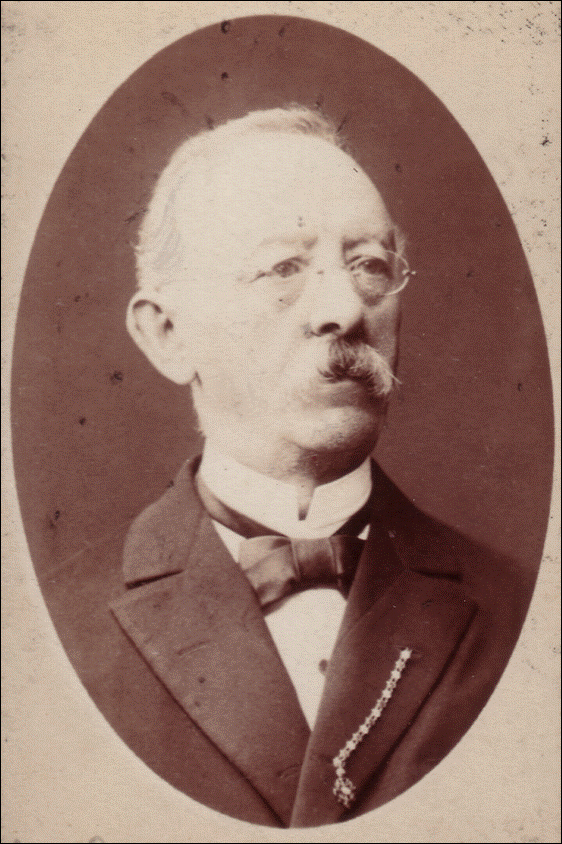
Brzorád Eduard JD (1820-1898) with the order of Fr. Joseph I., photo by Langhans Praha Vodičkova 37 - Prag Wassergasse 39, „ateliér ve vlastním domě - im eigenem Hause“ (Frána’s archive)
.
Eduard Brzorad was in the Administrative Board of Pokračovací škola průmyslová (Industrial School, in existence since 1870, def. established 1883) [386] and the benefactor of the Norbertine and the City real and higher Grammar School in Deutschbrod.[387]
On January 7th, 1876, the daughter Anna was born at 6 am. Baptized as Anna Marta. The name Martha was pushed through by her sister Marie. However, ancestral tradition commanded otherwise.
6.4. "Abgestillt" - weaned, 26.5. "Den ersten Zahn" - the first tooth. [388]
In 1877 Brzorad Eduard, R. d. Fr. J. O. (Knight of the Order of Franz Joseph), JDr., ... mentioned in schematism as the mayor - Obmann of the Regional Committee of the region of Deutschbrod - Bezirkausschus in Deutschbrod. At the same time he is listed as Land Advocate in Brod Landesadvokat, notary K. k. Notar in the same place, a member of notary chamber in Kutná Hora K. k. Notariats Kammer in Kuttenberg mitglieder and a member of district school council in Brod K. k. Bezirksschulrath mitglieder. [389]
On February 7, 1880, Miss Marie Brzorádová was as a bridesmaid at the wedding of Fany, the daughter of František Judman and his wife Františka, (the sister of Vojtěch Weidenhoffer), and Mr Josef Štolla, the district adjunct (assistant clerk). [390]
8. April 1883 Wedding of Marie Brzoradova, who married Alexius Komers. More about the wedding and her family further below.
17. Februar 1892 Dr. Eduard Brzorad Sr. retired as an advocate: „In Deutschbrod hat auf die Advocatur resignirt.“[391]
April 24, 1897 "... Vojtech Weidenhoffer wrote," I had the tomb for a certain Rankl, who came from Gotschev (Kočevje in today's Slovenia) refurbished. He was a lemons seller, who for more than thirty years visited Deutschbrod every year and sold the southern fruit. When he died, away from his birthplace, several of his supporters, namely me and the precious Mrs. Brzoradova, born Křivánková from Věž, together bought a tomb for Rankl, we had a decent funeral arranged and had a decent cross put at his grave. God give him light rest. "(From Vojtech Weidenhoffer's diary) [392]
January 29, 1898 Marie Brzoradova (1834-1898) born "ze Křivánků" as the Czech death notice says died. Buried at the St. Adalbert’s Cemetery in Havlíčkův Brod, in the tomb of her grandparents Karolina and Johann von Herites. Her husband followed her there in two months.
„January 29, 1898. Today Mrs. Marie Brzoradova, the wife of the local. Eduard Brzorad JD, k. k. Notary and the local citizen. This lady (born Křivánková from Věž) was generally popular and respected. Already in my young years, I was often invited to her parents in Věž, where dance parties, theaters and other forms of very popular home entertainment were held. This noble, very nice lady will surely be missed in the numerous numerous family circles! God almighty give her a quiet rest!
January 31, 1898 Today, on Monday, the funeral of the deceased on the 29th of this month, Mrs. Marie Brzoradova, was held with very numerous participation of all classes of the local population. "(From the Vojtech Weidenhoffer daily) [393]
4. 4. 1898 Eduard Brzorad JD died, buried in the grave next to his wife. In the period press, the obituaries said: "On the 4th. of this month at 9 PM evening, Eduard Brzorad JD, k.k. notary and the knight of the Order of Emperor Franz Joseph, Father of the member of the provincial and imperial member of parliament, Mr. Eduard Brzorad Jr., and the father-in-law of Mr. Aleš Komers, k.k. Gubernium Councilor in Mladá Boleslav. He reached the blessed age of 78 years. The burial of the deceased took place with the great participation of friends of the deceased and the bereaved aon the 7th of this month at 9 am at the local cemetery of St. Adalbert.“ [394]
In the newspaper section Rememberance: "The ranks of old friends and debaters are narrowing. They disappear one by one somewhere in the land unknown, unearthly. Th etypical appearance of the old man, a daily guest and a companion of a close circle of faithful friends debating is disappearing from the horizon of the local public and social life. Mr. Eduard Brzorad JD, a notary and a long-time district mayor (27 years), followed unexpectedly –in not long about 8 weeks - his noble wife, the charitable do-gooder, the merciful, patriotic, good-hearted and humble lady. Let you have a imperishable memory!" [395]
„Because of his direct nature, he was very honored and respected throughout the district. He soon followed his wife, Mrs. Marie Brzoradova, who was a great benefactor of all the poor people in our city."[396]
Vojtěch Weidenhoffer wrote: "[4. April] 1898 In a short time Mr. Eduard Brzorad JD, a local lawyer and a notary at the age of 77 followed his dear wife, Mrs. Marie Brzoradova. He was my old good friend, whom I loved very much. Every day I met him in a friendly company, both in the morning for wine and in the evening for a glass of beer in a kind, friendly conversation. Mr. dr. Brzorad was for a long time, up to his senior age, the district mayor of the district and was generally popular. Certainly, all the citizens who have met him will for years miss him in the friendly circle, as well as his public activities and generosity in every respect! Let his eternal memory be preserved!"(From Vojtech Weidenhoffer's diary).[397]
In the article New Graves, which appeared in 1904 in the Osvěta magazine, we find a exalting
obituary of his son. Eduard
Brzorad Sn, however is mentioned
too: „His father was a man of extraordinary
education, but he lived in the views of
that time that considered humanism to exclude the »narrow-minded« national classification. However, the nature
of the young
Eduard has evolved under the influence of the school and the outside world
in the direction so patriotic, ... "[398]

The grave of Marie and Eduard Brzorád at the St
Adalbert cemetary in Havlíčkův Brod, in 2005
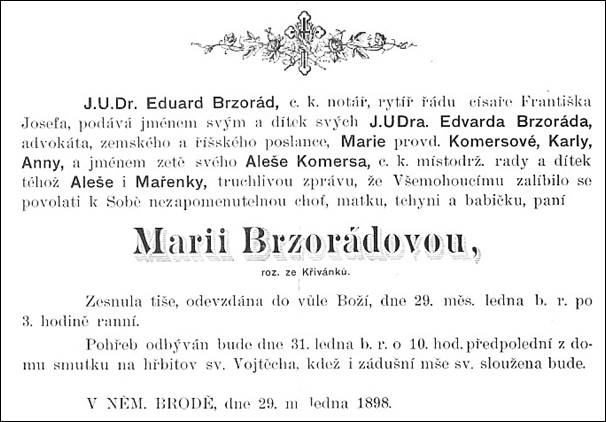
The death notice of „Marie Brzorádová
roz. ze Křivánku“ in Czech
Marie Komers née Brzorádová (1861-1920)
Marie Caroline Ernestine was born on 6 March 1861 at 8 am in Německý Brod.[399] The godparents were her Grandpa Eduard and Grandma Carolin. In 1869 she had "erste Pianostunde" and in 1871 "erste französische Stunde".[400]
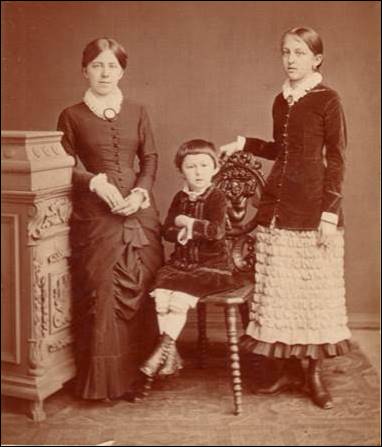
The Brzoráds sisters from left Marie (1861-1920), Anna
(1876-1919) and Karla (1868-1937), fotographer BENDA[401]
On April 8th 1883 Marie married Alexius - Aleš Komers (1852-1909),
the district commissioner in Německý Brod. The
witnesses were Karel Komers, princely inspector (the groom’s uncle) and Julius
Příborský.
Like her mother, she also received
silver in her trousseau. It
was bought in Prague at the firm
E. Kautsch in November 1882
for a total of 261 gulden.[402]
Also a bill for furniture was
issued for Dr. Brzorad (“a deposit was made by
her honour the wife”) by Václav Mayer in Prague dated
12 May 1883. By the train the following items
were transported: two walnut-two-doors-wardrobes, 2
beds, 2 night cabinets with marble surfaces,
big washbasin, a small alder one, an
extensible dining table, an alder bed,
a writing desk, Gredenz. with a marble surface, a sofa, a curtain, a dressing table with a marble surface, 5 poles for curtains,
10 roses for these, 4 tassels for curtains,
2 draperies, a bookcase, 6 chairs bent - a total of
579 gulden.[403]
Marie’s husband
Aleš was later a district governor in Jilemnice
(1890-93), in Vysoké Mýto (1894-6), in Mladá Boleslav (1897-1909) where he died and is buried.[404]
„At the time of his appointment the public affairs in Mladá
Boleslav suffered from violent struggles between the leadership of the Old
Czech Party and the advancing
Young Czech Party. And there
with his prudent action and intervention, the new governor
of the regional
government contributed to the quieter formation
of the further
development of public events.
Thanks to this he made a good impression at the Prague Deputy
Governor, and so his next career was secured.
He was awarded the rank of the
Statthaltereirat - Governor's Councillor, later the Hofrat – the
royal court councillor and the Knight of the
Order of the Iron Crown III. class. It was only
at the end of his life that
he experienced bitterness.
He was blamed by those in official places for not having been able
to prevent demonstrations during the exit of the Mladá Boleslav’s
troops at the time of
the Bosnian mobilization, and indeed the consequences soon became apparent.
In Mladá Boleslav, there were
rumors that the court councillor
Komers was to be transferred to Tábor. Except for his unexpected death, this would have
happened. He got the news about
it in Grad, where he was treating his rheumatism. It is quite clear that
the dissatisfaction and embitterment had no good
influence on the further
development of his illness.
… Perhaps it was possible to criticize the introversion of the deceased,
reservedness, and finally perhaps some kind
of haughtiness - nowadays there
is no place for such remorse. On the contrary, it must
be acknowledged impartially that, although he came from a time when
it was not natural in political office to remain a good Czech, he kept the warmth of
his heart for the national efforts
even in a rigid uniform of a bureaucrat."[405]
Marie Komersová kept a memory book ("Karl"), which she took
over from her mother. In it we
read about their three children.
Aleš
(1884-1903), a very talented student, shot himself dead in the first year
of university studies of medicine in Vienna. "He died on October 5, 1903 with 4 revolver shots. He shot himself at 7am in the morning,
died around 6pm. In the letter left,
he writes that he cannot live longer because of excessive
nervousness or neurasthenia. He was buried on the 7th in the cemetery in Mladá Boleslav. Hopefully he has found peace, which he had been looking for
in vain."[406]
He fell into a premature grave, leaving behind his grateful monument to the modern philosophy of labor and unreasonable
human living."[407]
Eduard
(1888-1890) – died as a small
boy. The gravestone with the inscription
"Edíček Komersů"
(Little Eduard Komers) is on the grave
of the von Herites and the Brzorads at the
St. Adalbert’s Cemetery in Havlickuv Brod to this day.
Marie (1891-1964),
a writer of the hereditary book and a letter about Anna Dostálová, as a child,
welcomed Emperor Franz
Joseph and received a brooch.
She married Augustine Frána (1882-1931), a financial clerk, who later
worked in the secretariat of the Supreme Court
presidium for Emil Hácha, whom
he respected a lot - his wife said he would
never have praised in vain. In 1928 he built a villa in Prague’s quarter Hanspaulka, where the Frána’s
family of still lives today.
Many pictures and photos of the family
Krziwanek, Anna Dostálová's
correspondence from
America, the collection of death notices
and the abundance of other material from the family
fund were provided by courtesy of Augustin Frána’s daughter in law Milica Fránová and his grandson Ing.
Aleš Frána (*1957).
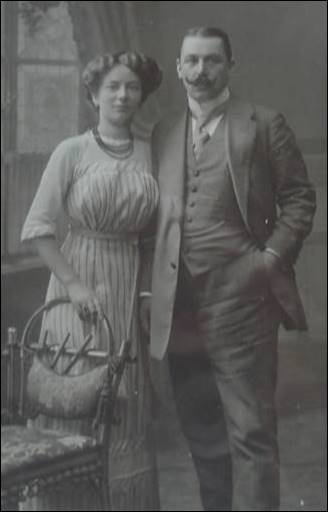
Marie Fránová roz. Komersová (1891-1964) a
Augustin Frána (1882-1931)[408]
Karla Kratochvílová née Brzorádová (1868-1937)
Karolina Anna Hermina was born on November 21, 1868 in Německý Brod No. 105. [409] She stayed with her brother Eduard for a long time engaged socially and therefore unmarried. Then the weddings of two sisters followed soon after their father's death. In the newspaper report on Dvořák's oratorio "Stabat Mater" we read about her performance on Palm Sunday: "... The solo parts were presented with the perfect routine and precision by the ladies Brzorádová, Hadačová and Kabeláčová ..."[410] Also later in America her sister Anna Dostálová missed her beautiful voice."[411] Her obituary said: „In her youth, she was a co-worker of her brother and the numerous politicians at that time, today mostly deceased, who greatly respected her lively interest in the basic political demands of the Czech nation grounded in her deep national feeling. The knowledge of several Slavic languages extended her interest in the cultural and political development of other Slavic nations and she was corresponding with some of the South Slavic political figures. Also, those who remember the social life of Německý Brod in the nineties know how the deceased gladly supported theater and singing cultural events, if possible by active participation. Being herself an excellent singer, she enjoyed singing and music above everything else. And finally, all those who knew her and come in contact with her will never forget her good heart and noble nature."[412]
On February 4, 1899, Karoline / Karla (1868-1937) married Antonin Kratochvil (1861-November 1945), k. k. captain, later retired Lt. Col. The soldier and Karla’s living together was not reported to be the easiest. They lived in Galicia in Přemysl, in Vienna, and later in Prague. In Vienna, the Kratochvíls were visited by Eduard Brzorad, a medical student Aleš Frána was living there. Teresa of Hillmayers wrote to Lt. Colonel asking for help being hard up. She was in touch with Karla, who wrote her regularly and also with (and perhaps even related to) Baronesses Voith von Sterbez. In a letter written by Karla to the family of her late sister Andy to the USA in 1920, she thanked them for sending cloths, clothing, and food from America. It was delivered by a porter from the Strahov Abbot Zavoral[413], in a "bulky trunk on a cart with little horses." Parts of the consignment traveled to Německý Brod’s orphanage, to Hermine Voith to Kolín, to Dejvice in Prague, to the Frana’s. Karla remained in contact with the Voiths (according to the letters), and is also named on their death notice. Karla’s husband Anton was in Slovakia at the recruitments when Karla wrote her letter, but he was only waiting for salary adjustments and then planned to quit. He did not like the situation in the army at the time. In addition, in Bohemia "everything is not as it should be. Quite dismal it is here so far, and our parliament commands a very strange view and even weirder listen. - But we have to hope that God will provide and things will get better. If not, then our children will live to see it."[414]
They had two
sons, Jaroslav and Karel. Jaroslav Kratochvíl JD
(1901-1984) - a Czech national economist,
graduated from the Charles University, 1924-39 and was
secretary of the Union of Mines
Owners in Czechoslovakia,
1939-40 and Deputy Director
of the union. From February 1940 to January 1942 he was the Minister of
Industry, Trade and Trades in the Protectorate
Government. He regularly published in the professional national economics reviews and daily newspapers. His apartment
in Prague's Old Town Square, where he could have had more family memorabilia for his relationship to history, was unfortunately burned down completely
in 1945. The descendants of both brothers
Karel and Jaroslav Kratochvíl still live today. From the
archives of Jaroslav
Kratochvíl JD The
family album of Marie Brzorádová née von Krziwanek (1834-1898) has been
preserved, and it was provided by the courtesy of
his granddaughter Petra Křížková.
She has also presented the extraordinary
figure and the remarkable life of her grandfather Jaroslav
Kratochvíl JD in a monograph
whose text is provided as a supplement of the Czech version
in full.[415]
Ing. Karel Kratochvil’s
daughter Ing. Věra Malinská very
kindly provided, among other things,
the Blue Memory Book[416]
(a hereditary memory book started by Caroline Krziwanek née von Herites), a memory book by Marie Komers, born Brzorad and a number of photographs.
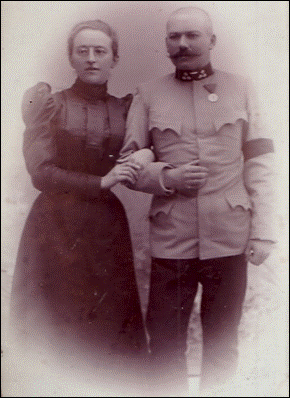
Karla Kratochvílová née
Brzorádová with her husband Lt. Col. Antonín Kratochvíl[417]

Karla Kratochvílová née
Brzorádová with her husband Lt. Col. Antonín Kratochvíl[418]
Anna Dostálová roz. Brzorádová (1876-1919)
The youngest daughter, Anna Marta Brzoradová (1876-1919), was born on 6 January 1876 in Německý Brod. The Godparents at the baptism on 9 January 1876 were her grandparents the Krivaneks.[419] We learn more about Anna from the text of her niece, Marie Komers: "... When she was born, Anna had a 19-year-old brother, Eduard, a 15-year-old sister Mary, and seven-year-old Charles. I remember her as an adult girl (she was 15 years older than me). She was a little strange, but a democratic body and soul. There were always 2 maids in the house, a laundrywoman and so on, but Aunt scrubbed the floor in the kitchen, did the washing, she carried out the democracy seriously. She was a patriot of the purest grain, and therefore she did not learn German on purpose, although it was quite unheard of in the noble family at the time. She was religious, almost fanatical, and she had heaps of devotees. I remember that there were always the whole crowd of them under the windows. Every Friday she went with her friend to decorate the cross above the “Lesíček”, the Německý Brod’s orchard. The flowers on this garland were naturally picked in the orchards, and I often had the noble task of making sure the watchman is not near. From a love letter that aunt received, I learned that a student kisses the footprints of her feet on the stone at the cross, and as we left home, I was fast on the stone and I was delighted Vaclav kissed my footprints. (I was about 5-6 years old). She spent all her youth in her birthplace and took a lively participation in national and political life."[420]
Anna Dostálová roz. Brzorád (ateliér R. Dvořák N. Brod)
On 21st September 1899, Anna married Hynek Dostal JD (1871-1943) in Spillville, Iowa, a town well known to American Czechs because of the time spent there by Antonín Dvořák in 1893.[421] He was born in Boršice in Moravia. He attended schools in Přerov, Olomouc and Německý Brod where he met Anna. After completing his education at the law faculty of the Charles University in Prague and turning down a job offer in the civil service in Vienna he decided to take the position of a religion teacher at his brother Josef’s parish in America. By 1900 the parents, and nine of their 11 children along with one adopted daughter had emigrated to America. [422] Hynek's younger brother Václav also became a priest in America.[423] Two sisters both nuns, were able to leave Bohemia to work in the Hessoun orphanage which Hynek would help found. [424]
”It was a great outrage in the family when aunt Anna decided to follow Hynek. She left on August 29 1899 on a fast steamship "Kaiser Wilhelm" from Bremen to New York, where she arrived on September 5, was greeted by her bridegroom and married on 21 September. Their life would prove to be unsettled and not without sadness. The uncle was first a teacher, then he rented a farm.."[425]
The farm in Dakota, which was bought on loan together with R.D. Dostal, also with the money from the share of the Německý Brod’s fields of Baštinov and the field of Okrouhlické Dvořáky, is dealt with in the letters by Anna Dostalova to her sister Karla Kratochvílová, "Márinka[426] has surely written you that we bought the farm in Dakota. I have ceded my unpaid[427] share of Baštinov and the Okrouhlické Dvořáky fields to her and she was so nice and paid us the cash to buy the farm we bought together with the Reverend[428].[429]
"In 1902, Anna writes:" As you know, we hold the farm with the Reverend in half, so we have the burden of debt together with him because we have taken a large share of good land but also expensive one. But we hope, if God grants us a good harvest for a few years, we will pay all of it back slowly. However, the hope of man is often disappointed! - Regarding the area of all fields that are in one piece, it measures 1 1/2 km in length and 1 km in width. That's I think twice as big as Bastinov. All fields are enclosed by a "fence", ie a barbed wire fence; besides two large pastures, there are also 2 small beech and oak trees woods. Probably in the middle of the fields, right next to the district road, there are both the farmyard and residential buildings, which is not as you think new, but still preserved and solid. It is one-storey high, the main entrance facing the road; it is only wooden ... (followed by a description of the interior and the garden and its surroundings). "[430]
"... and finally (Hynek) became editor of the Czech Catholics‘ magazine HLAS (Voice) in St. Louis."[431] Thus in 1901 when Josef Hessoun offered him the post of editor of the Catholic magazine of American Bohemians HLAS - founded by Hessoun in 1873, Hynek Dostal was in a position to begin his career as a Catholic newspaper editor, dedicated to defending the faith, and advocating for a “free” homeland.
In 1904, the Czech writer František Herites addressed the Dostáls to ask the relative to take care of his wife and daughter, a violin virtuoso, who would play at the St. Louis World Show at that time. In this case, also a letter by Baroness Hermine Voith von Sterbez in Kolín for Miss Herites was kept, in which Hermine's family relationship is described. Hynek replied with cordial invitation. [432] Later, we learn from Anna's letter that the young virtuoso did not impress Hynek and Anna with her play. But Miss Herites managed to marry happily in America, and then she would teach.
“Our Aunt, even with so much to look after with a large family, seven children - edited the magazine “Česká Žena“ (Czech Woman). In his dictionary Český Slovník Bohovědný, the distinguished Prague bishop Antonín Podlaha (1920-1932) wrote that Anna (under the pen-name Anna Čechová) wrote many fine articles of education, instructive and apologetic in both magazines (Česká Žena, Hlas). The dictionary contains extensive entry on Hynek.“[433]
The American magazine HLAS of September 3, 1907, wrote: "Purchase of a land estate. Mr. Robert of Stanglery (sic!) bought the land estate Věž from the Civic Savings Bank in Choceň (Německý Brod District) for 193,000 crowns. - The estate has until lately belonged to an aristocratic Bohemian family, recently extinct, lords of Křiváneks (pánům ze Křivánků). The mother of the "HLAS" co-editor, Anna Čechová, was the last female descendant of the noble family. Her cradle stood where a foreigner is the lord now. "[434]
In one of the letters after Eduard Brzorád's death Anna regrets the sale of the Německý Brod’s house „at the Brzoráds". On January 14, 1914, she wrote Karla about Věž’s castle: "I was very pleasantly surprised by the news of the new uplift of the castle of Věž. Even if a single chip does not belong to us, it makes me feel the sincere joy that the seat of my ancestors and the birthplace of my dear mummy is rising back to new life. It is a shame that it had not happened in her life; how happy it would have make her!"[435]
"After the World War we learned about our aunt’s death in 1919. Her deep desire to return to her beloved homeland was not fulfilled and she rests there in the distance. A handful of land she brought from her homeland was put in her coffin."[436] She died on April 8, 1919 in St. Louis City, Missouri from breast cancer. [437]
There is an interesting document related to her death. She died in St. Anthony’s hospital in St. Louis and when Hynek was filling in the death certificate he stated her maiden name as „Count Marie Křivánek“ and the birthplace of her father as „Lochkov – Castle by Prague“. Perhaps he wanted to be sure that her “aristocratic” origins would not be forgotten in the new world. His own address was given as „3513 Nebrasca Ave. , their home, located in St Louis, Missouri.“[438]
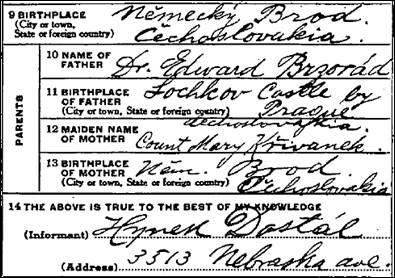
A cut out from Anna Dostálová’s death certificate.[439]
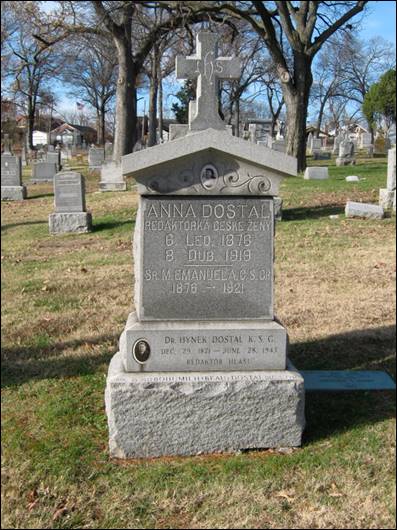
Anna and Hynek Dostál tombstone in the st. Peter and Paul’s cemetary in St. Louis.
(K. S. G. = = Knight of the Order of St Gregory the Great )[440]
“After World War our
Uncle arrived in Bohemia as
an American officer[441],
and that was the first time
we saw him. A very pleasant
man, of impressive build, handsome and young looking. He participated actively in the liberation work of the Czechs
in America and also signed the Pittsburgh Agreement.”
[442]
Dr.
Masaryk visited St. Louis twice
to consult Dr. Dostál; we can say that
in a sense the map of Europe was
changed by enthusiastic liberators who met in a small room on the
South Eleven Street St.
Louis, near the center of settled Czechs.
[443]
Hynek's
signature can be found under
the Pittsburgh agreement from May 31, 1918, just under the signature of
TG Masaryk, where, for
the first time, the
Czechs and Slovaks publicly approved the program of a common democratic state. With his brother, they travelled
in December 1919 at the expense of
the National Catholic War Council
as the delegates of its mission around Czechoslovakia. They were to inform the war
council on the state of the
Catholic Church. Hynek gave over one
hundred lectures. In 1920,
he was admitted to a private audience for an hour of
his Holiness, Pope Benedict
XV. They consulted religious
and cultural issues as a relationship between Catholics and the Czechoslovak government. The whole conversation
was in Latin. [444]
„Later he came back to his homeland, to Moravia, where he was operated on in Brno by his classmate and friend dr. Prof. Petřivalský. It was cancer of the rectum. Only this year I learned about his tough fate from Mons. Zlámal who came here from America and was a close friend of Uncle Hynek.“ [445]
In 1928 he became the Knight
of the Order
of St. Gregory the Great. This is the
highest honor that a layman in the Catholic
Church can achieve. It expresses the recognition of the Holy
Father of special virtues and extraordinary acts for the Church
of God and the country. In 1934 he was also awarded the
Knight Order of St. George. He also received papal distinctions for "Ecclesia et Pontifice" and "Pro Fide et Ecclesia"
for his work.
In 1837 he became Czechoslovak Consul in St. Louis; in 1838 he lectured against Hitler. He lectured in English, Czech, German, Slovak, Polish and Russian. He cited Greek and Latin sources.
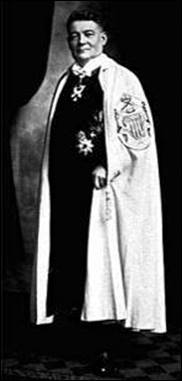
Dr. Hynek Dostál as the Knight of st. Gregory [446]
„Hynek later married a reportedly very noble woman, Bronislava (I did not remember the surname), but he had diabetes, which caused his leg to be taken off. In the last years he was bed ridden and suffered a lot. He remained the editor of Hlas until the last minute. Perhaps the last couple of years of his life he was also anxious about his children's relationship with his new wife, which was not the best. I did not learn much about the kids. His son leads the editorial board of the Hlas, but no longer in the spirit of his father.
That way ended the life of these two people who dared so much for their love. Their fate was not favorable. Good was not rewarded in this world, perhaps their happiness was their belief in life after death.“ [447]
Hynek died in America in 1943.
Let us add what Anna - "the Democrat in body and soul" - felt to the Emperor. In a letter in which she tries to console her sister after the suicide of her son she says, "Look at others, they also suffer, they suffer terribly. The best example of family misfortune you have in the Austrian Emperor! His brother got shot, his wife was murdered - the only son in whom he had so much hope in his position, died in such a way and now again a new misfortune, the victim of which his (Rudolf’s) only daughter became! One blow after another lands on his carewarn head and each is worse and heavier."
Anna and Hynek had 7 children:
(1)Ludmila (1900-1994) m. Charles Vanek
(1900-1936), whose granddaughter,
Mary Petersen has worked as
the coworker on the American edition
of this book,
On the Ancestors, which covers the
project for the years 2002-2017. Her cousin, Charles Williams, also a grandson of Ludmila Dostal Vanek is the author
of The Dostal Project. (2)Stanislava
(1903-1979) m. Jerome Jecmenek
(1903-1982); (3) Mojmir (1905-1965) m. Marion Enger (1921-1995); (4) Vaclav
(1907-1969) never married;
(5) Jarmilla (1910-1973) m. Arthur Steinmetz (1916-1998); (6) Bohumil (1912-1992) m. Veronica Kulpa (1916-2006); (7) Vladimir Dostal (1915-2001) m.
Margaret Drees (1918-2007). Like so many Czech immigrants, they and their families continue to prosper in what was once
a “New World.”
Eduard Brzorád Jr., JD (1856-1903)
Eduard Brzorad Jr., JD (1857-1903) is introduced in a text by Václav Klofáč[448] written for the 200th year anniversary of the Německý Brod grammar school's almanac[449]: … „Dr. Eduard Brzorad, who was born in Německý Brod in 1857[450], belonged to the generation of the Německý Brod grammar school students, from which later grew deputies at the provincial diet and at the imperial council. The oldest generation still remembers his father, notary and attorney at the same time. But they also remember his mother, a very noble educated lady, who, coming from the estate in Věž, where with his amateurs Havlíček played theatre in German as late as 1845, she was a model of most noble virtues for many years. It seems to us that all the beautiful qualities of his mother were inherited by her son Eduard. As she did, he never thought of himself, but of the greater interests of his nation and of his hometown. And surely it was Josef Barak[451], whose favorite Brzorad was, who made him understand patriotism as a sacrificial and constant service to the people and especially to the poorest. As early as when he was a student, Brzorad was a radical nationalist, but also a radical democrat.[452] In Prague he was the head of academic life and was also elected mayor of the famous Academic Reading Society (chairman of the association in 1877), who at that time were a big joint representative of all university students. For this real and great student center we have never found any replacement since its dissolution in 1898 under the vice regent Count Thun's rule.[453]
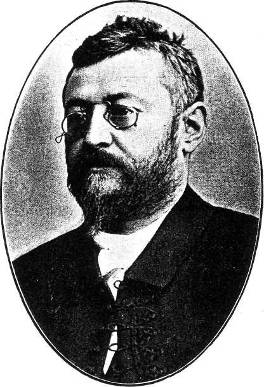
Eduard Brzorád
Jr., JD, an MP, the mayor of the
region and the city of
Německý Brod.
At that time dr. Brzorád also works in the foreground of the National Liberal Party[454] and it was not without significance at that time that he was appointed the secretary of the club of that party, in which position he remained, even when on 16 June 1880 he was promoted the Doctor of Laws. The three years of secretarial work in the club[455], in the club whose politics stirred the national enthusiasm and political offensiveness of the entire nation was still the preparation for active politics in the coming years when he settled in his native town in 1888.(SIC![456]) Immediately he became the hub of new social and political life. He was not limited to political activity, in Prague, he had been in the Matice Česká headquarters[457], and this interest in our minority education did not flag in Brod either. Besides, German villages were close and he could not stay idle, when, with the help of the k. k. officials, Germanization activity became increasingly cheekier and more and more dangerous. Those who lived in Německý Brod in the eighties, remember Brzorad as a gifted actor. The former theater director, professor dr. Forchheim, the illegitimate son of Joseph Kajetan Tyl[458], found a real talent in him. Of those who played with him, perhaps the only one still alive is the bookseller Švejda,[459] an irresistible comedian who had created a number of interesting characters with the late director of the district Kovář.
At age 32, in a big battle against the Old Czechs, he fought for a mandate in the provincial diet. At first he was not victorious, but when he was elected as a member of the Imperial Council in January 1891, he was elected to the diet of the Bohemian Kingdom in the by-election, which in the 1990s was a battleground on which the MPs led an unscrupulous struggle for rule against the German deputies and Rieger’s group for the so-called „punktace“[460], which in fact were just a tearing of the Czech kingdom into parts and the division of all the provincial and administrative institutions as the Germans wished. Dr. Brzorad stood there among first and foremost fighters, uncompromising and ruthless. In those moments, his ruthlessness and his constant clashes with the German radicals made him popular throughout the nation. The Czech Radicals won it then, the „punktace“ were after the effective obstruction at the provincial diet thwarted and in 1891 Rieger was not elected to the Imperial Council. Dr. Brzorad proved to be a good and excellent speaker at the Imperial Council, and as an unshakable representative of Czech democracy and national resistance.[461] This is evidenced by all his appearances, and by all his manifestations in the great political mass meetings, as they were held at different places at that time.[462] He took part effectively also in the Austro-Hungarian delegations. It is interesting to read today, as in the 1894 delegations in Budapest, he spoke against militarism, general disarmament, and an international agreement which would deal with all conflicts.[463] Today, when we have achieved all the freedoms after the coup, we can not appreciate the importance of his struggle and his speeches in favor of a general right to vote[464], for linguistic equality[465] and for the defense of the interests of teachers and others.
At the same time dr. Eduard Brzorad managed to be an exemplary mayor of the city and the district mayor. His characteristic feature is that for the past years he was the chairman of the Řemeslnická Beseda (The Labour and Craftsmen Club), which he attended daily and where he also often lectured, and it is obvious that a man so patriotic and democratic was also the leader of the Sokol[466] in Německý Brod.[467] Dr. Brzorad was simply a man of extraordinary energy, and he considered the versatile work he did to be his civil, national and human duty. He was a beautiful man with a soulful face, from which the nobleness of Brzorad's genus really shone. He was incapable of any ruse and of any lowness, and therefore had no enemies; and when he died, not yet 46 years old, at his grave at the St. Adalbert’s Cemetery, on November 21, 1903, many grieving people met, without distinction of political parties. Above his tomb, his classmate from the grammar school, deputy dr. Adolf Stránsky spoke, and then what he said about the prematurely murdered politician, was surely spoken from the hearts of all who knew Brzorád and his activities. The name of Dr. Eduard Brzorad is sure to be a credit to the grammar school that raised him and to the town of Německý Brod, which put him at the forefront of all his national and political institutions. …“[468]
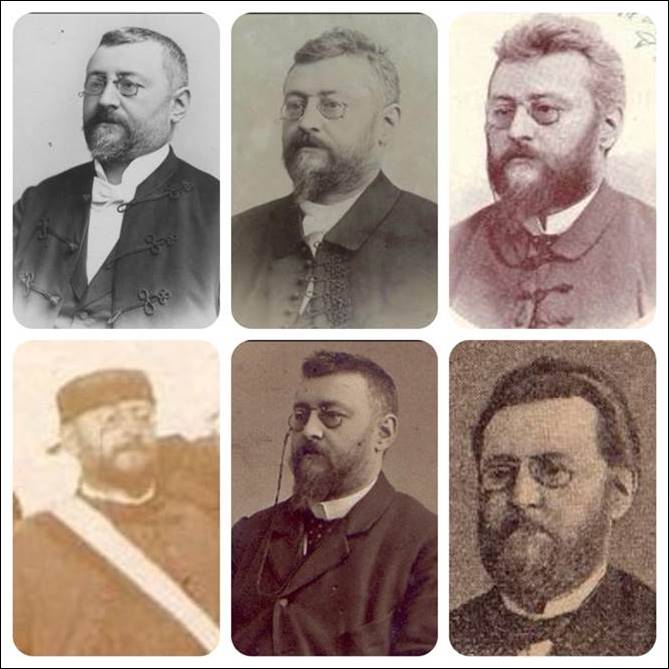
Eduard Brzorad
Jr., JD (1857-1903) in various photos
Occasionally, Eduard Brzorad was heard to say interesting sentences in the parliament, especially considering the origin of the wealth that enabled him his costly political life, and which did not survive his administration.[469] For example, on the 18th of October 1893, Dr. Pacak said, "The landowners rule in Bohemia and they are responsible for everything that is happening there." Brzorad screamed, "These are the worst enemies of the Czech nation."[470]
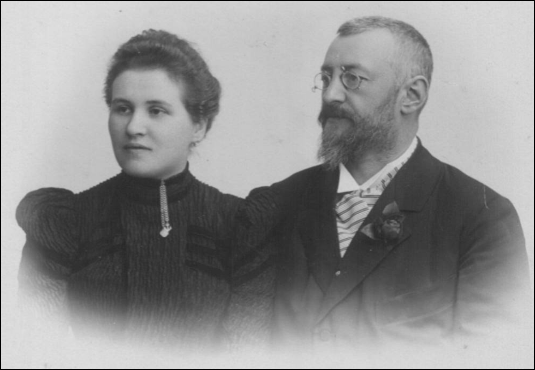
Vlasta (1876-1946) and Eduard Brzorád Jr., JD (1857-1903)[471]
On the 10th of November 1899 at 10.00 Eduard Brzorád married Vlasta Mayer, a telegraphic operator in Německý Brod, born 1876 in Prague. She was a daughter of Adolf Mayer, the telegraph warden in Polička and his wife Leopoldina born Vondráček from Prague.[472] Sister Marie remarked in her letter: "Married under the assistance of the Reverend fathers from Německý Brod. Lunch at Ellner. ... There were 20 people, all very happy to the end. Vlasta is pretty, good looking and I hope she will make Eda happy; he is in love a lot. I do not like the parents that much. They spent 1899 Christmass a tour place."[473]447 Even more critical is his second sister, Anda Dostálová, in her letter of 27th November 1899 to the third sister, Karl Kratochvil:" Eda is mad, what he does is not dignified, I am afraid he will regret it soon! " Later in November 1902, Anda writes: "I do not know anything about Vlasta, just that Miss. Příhodová wrote that she was very kind and modest, she did not push herself to the foreground, she did not go with the first ladies, and she wore tasteful but not wonderful gowns.[474]"
On the 4the of October 1900, Jaromír Eduard Brzorád was born.
On November 2nd, 1903, the son Eduard was born. Eduard Brzorád (1903-1963) was a post office clerk. He lived and died in Prague. He only had a daughter.
On November 18th, 1903, Eduard Brzorád JD died after a long, severe illness.
In 1911, Vlasta Brzorádová (1876-1946) was the postmaster in Kolín, later the postmaster in Trója, in Prague.
Jaromír Brzorad (1900-1968) studied grammar school in Prague, then 6 semesters of the medical faculty at Prague University, after the end of his military service, from 1927, post office employee. During World War II, through the destruction of consignments, he participated in resistance activity as an employee of the post office at Masaryk Railway Station. Unfortunately, in 1948, he took part in the Communist Party coup as a member of the Revolutionary Guard securing a warehouse for weapons at the Pohořelec in Prague. From 1954, he was employed by the local council, in the Department of Construction. His son from the first marriage Ing. Jiri Brzorád (1928-2004), majored in precision mechanics and was later a professional soldier, lived in Ostrava and had two daughters. Jaromír’s second son, Milan Brzorád (1943-2002) from the second marriage (Jaromír widowed in 1942) was a communications technician, later worked for Český Telekom in Prague. With his wife Marie (* 1949), also a communications worker and now the owner of the family archive he had three daughters. Daughter Blanka was employed by a freight forwarding company.
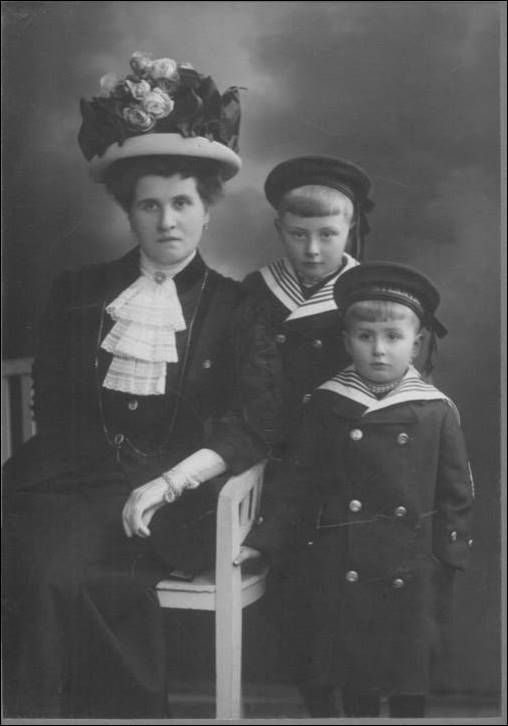
From the
left Vlasta Brzorádová née Mayer (1876-1946) and her sons
Jaromír (1900-1968) and Eduard (1903-1963).
[475]
The END
The full
Czech version is available here .
