of JD Eduard Brzorád,
a Young Czech member of the Austrian Imperial Council and the Diet of Bohemia.
Chronicles of the von Herites,
von Krziwanek, Delorme and Brzorád families.
Written by Jan Steinbauer, translation © Mary Petersen
Email for your
comments and additions:

Familie von Krziwanek

Krziwanek’s origin, the lordship of the manor Věž
Václav Seegenschmied (1723-
before 1789) and the origins of his property
P. Joseph Knight
Lodgman von Auen (1742-1813)
Jan Ludwig Krziwanek
(1795-1861) JD.
About how Dr. Jan L.
Křivánek founded the glassworks in Janštejn in 1827
Edward Ernest
Edler von Krziwanek (1799-1876), lord of Věž, the imperial and provincial
deputy
Taufzeug and the Blue
Memory Book
Slavomil’s article on
Věž’s industrial school in 1845
Marie von
Krziwanek (1834-1898) and JUDr. Eduard Brzorád (1820-1898)
Oil factory and the Krziwaneks in Brixen
Eduard Karl
Edler von Krziwanek (1844-1896), the owner of Věž
Hermine von Krziwanek (1839-1908) and Julius Příborský
(1824-1905)
Anton Emanuel Ritter von Komers (1814-1893)
Emanuell 'Mani' Prziborski (1859-1921)
Ella née Prziborski (1863-1936) and Captain Karl Hánl Edler von Kirchtreu (1848-1897).
Anselma née Prziborski (1863-1934) and
JD Franz Ritter von Komers (1848-1935)
JUDr. Leo Prziborski-Voith-Herites (1867-1940)
Kurt Leo Julius Prziborski-Voith-Herites (1902-1943)
Introduction[1]
Right at this point it would be useful to highlight the diversity of the
spelling of the names Křivánek. The many
options we find are due to the great number found in the text citations fund in
the sources. For the same name we also
find Skrivanek, Skřiwánek, Krivanek, Kržiwanek, Krziwanek, Křiwánek and the
likes.
Within an introduction to
the humble origin of the Krziwaneks of Věž we will examine in detail the family
of Bernard's father-in-law Václav Seegenschmied, who was a successful
businessman and a weaver from Velké Meziříčí, who bought the estate with a
castle in Věž for his daughter. We also note Bernard’s children godfathers such
as Baron Joseph Langer from Langendorf, or activity of the descendant of an old
Irish family, Knight and Canon Joseph Lodgman von Auen, who is financially
independent former Jesuit who stayed in the Věž castle in the years 1780 -
1793.
Of Bernard’s children we
mention in more breadth J.D. Jan Krziwanek, who in 1827 founded a glass factory
in Janštejn. Thereafter the focus moves on to his brother, a prominent farmer
(E.g. his estate excelled in pig breeding and progressive methods of
fertilization; he also tested brewing with distillery steam boilers). This was Eduard von Krziwanek, member of the
Diet of Bohemia and the Austrian Imperial Council and the defender of the
German element. Our attention is also paid to his wife, "zealous Bohemian
patriot" Caroline née Baroness von Herites, her scrapbook, baptismal suit
and relationship to her friend and later related Countess Pachta.
Thanks to found family
albums the text is illustrated with numerous photographs, and drawings. At the same time we pay attention to what is
happening on the Věž estate, especially around the year 1848, when Eduard
Krziwanek supported the Pan-German Frankfurt Parliament and comes to the
forefront of political events. Thus we read about him in newspaper articles
written by Havlicek Borovsky – who mentions him as “frankfurtoman”, or “amongst
those for the German tricolor hankering masters”, or JK Tyl, who ranks him
among “the renegades of the higher classes and other similar slyboots.”
We read about Havlíček
attending masked balls at the Krziwaneks in Věž, and about his participating in
the theater in German as late as the 1840’s. The following are excerpts from
Havlíček’s correspondence from Brixen on his feelings about an oil production
plant - a joint venture of Eduard Krziwanek and Havlíček’s brother František, who
respected his business partner. Also the Brixen meeting with the Krziwaneks
will be described, showing also Havlíček’s respect and the joy of having a rare
visit.
Together with the
announcement in Wiener Zeitung we read the lost wording of Krziwanek’s Adelsdiplom
(grant of arms). We do not finish the
story with the death of a single, childless son, but we also read about
families of his sisters. One was married
to Baron Kutschera, the second one connected this story with the careers of the
prominent economists and farmers Anton Emanuel Knight von Komers and Julius
Příborský.
It
is in this and the next generation that we will again touch upon issues of
national identity of loyal Austrian citizens.
For example the Lanškroun episode is due to the role of Edward
Krziwanek’s granddaughter, Anselma von Komers, who throws deputy chairman of
Pan-German party as a troublemaker from the apartment into the hallway of the
headquarters, remarkable. Her twin
sister Ella brings speech to the House of nobles Hanl von Kirchtreu. The story is completed
with the family of their brother Leo, who adopts the name Voith-Herites. Thanks to his father in law, the wealthy and
notable businessmen and an MP, Viktor Porák de Varna we get acquainted with the
case of renobilitation trials, which could have affected the final transfer of
the title of nobility.
Krziwanek’s
origin, the lordship of the manor Věž
Much of this chapter will be devoted to the character of Edward
Krziwanek and his offspring, but let's first start with how he came into
possession of the Věž estate, to where Eduard later brought his bride
Caroline. We can start with the first
Kržiwánek known to us, who was Thomas with his wife Anna. They lived in Velké Meziříčí and there their
son Jan Nepomuk Krziwanek was born in 1749.
We should mention the possibility that he later became Johann Nepomuk
Krziwanek (05.05.1749 - April 19, 1828 Wostopitz) Doctor of Law and Philosophy,
provincial lawyer, perhaps identical with Brno lawyer Jan Krivanek a member of
the secret society of the Illuminati, who operated in the circles of Brno’s
Masonic Lodge "Zu wahren Vereinigten Freunden” under the name Attilius
Claudius.[2]
Here, however, we are interested in the other son, Bernard Jan Nepomuk
Kržiwanek, born on 20th March 1763 in Velké Meziříčí. There, in 1785, as a businessman, he married
fifteen year old Mariana - Maria Anna (1771-1842), the daughter of a local
merchant and citizen, Václav Seegenschmied.
Bernard's middle name Jan is skipped in the wedding registration and
when he baptizes their son Edward, he will already be Bernard Laurenz
(Lawrence), and this form we will continue to encounter.
Václav Seegenschmied was
apparently very wealthy, because in 1787 he bought the estate Věž with a castle
near Německý Brod, today called Havlíčkův Brod. [3]
He bought this farm estate of 870 hectatres from Knight Degen, before
whom Baron Moser lost his entire fortune on silver mining there.


Castle Věž from the village in 2004
Probably the prettiest pictures of castle Věž can be found on a website
blog of Petr Pechač. Therefore I highly
recommend that you visit the website http://pechacpetr.blog.cz/0805/zamek-ve-vezi
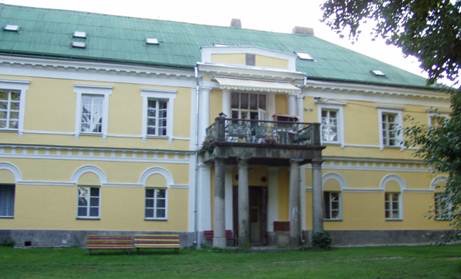
Balcony from the garden in 2004
Václav
Seegenschmied (1723- before 1789) and the origins of his property
A lot of information about the
fabric merchant from Velké Meziříčí, Václav Seegenschmied (1723 - before 1789)
and his family can be found in the works by Dr. Marie Ripperová[4]. Regarding the first generations of
the Seegenschmieds from Velké Meziříčí
we read: "What was outwardly a more inert structure of local guild owners,
hid the more dynamic changes which occurred between generations of burghers who
lived from their crafts. An example of
these changes is the extended clan of Seegenschmieds whose members settled in
the late 16th century as prosperous sickle makers. In the mid-17th century they completely
abandoned their original craft and undertook a one generation experiment as leather
tanners and then permanently moved up in the ranks to become rich local
stocking makers."[5]
The
first Seegenschmied in Meziříčí in the 17th century was the infamous Jan:
"... Apart from municipal reeves the craft guilds of the town continue to cooperate
in maintaining public order ... in order to preserve the reputation of their
"honest craft.” Their attention was
especially turning toward apprentices, but also toward troubled masters. Let’s mention from them all at least the
stocking maker Jan Segeneschmied, who was punished by his Guild, both
professionally and financially, for the breakup with his wife.”[6]
Next, we can draw continuously from
a very precise work of Dr. Marie Ripperová, whose article “Textile Production
in Velké Meziříčí in the 18th century”[7] provides comprehensive information
on the origins of the wealth of the later owner of estate Věž, Václav
Seegenschmied (1723-1789):
"In
the second half of the 18th century, the cloth manufacturers of Velké Meziříčí
were marked by lack of capital, thus furthering the expansion of investment
activities “nákladnictví”. Apart from
wealthy Jews mentioned in 1746 now it was also masters of cloth and fabrics who
began to buy larger quantities of wool than they could handle themselves and
then gave it to poor fellow craftsmen to process, those who otherwise would not
be able to purchase it for themselves.
They then bought back ready-made draperies from them, paying only for
their work. Besides the expert knitter
and merchant Václav Segenschmied, who needed fabric for army supply contracts
and therefore supported two other masters
in Meziříčí, there were two other investors “nákladníci” long time
guildmaster of the the drapers guild Francis Kallab and master draper Jiří
Eichler.[8]
Among
the stocking makers was Václav Segenschmied.[9]
He was born on September 28th 1723
the last of five children of his father, Dominic Segenschmidt (1687-1752) and
mother Marie.[10]
Most of his siblings, including two brothers, however, died in their
youth.[11]
Václav thus became the heir to his father's stocking business.
In
1740-1742, during the war between
Maria Theresa and Prussia, Václav supplied the imperial army with knitted
goods. From the profits he bought a
house on Town Hall Street in 1744. On
25. 11. 1742, he married Anna
Žamberská and in 1754 Václav
Segenschmied owned two houses, one in the town, the second in the suburbs. The following year, he was listed as the
owner of three houses, because in January 1755,
he had bought another house in Radnická Street, the commercial center of the
city at that time.
Following
in the footsteps of his father, Václav apprenticed as a stocking maker, but did
not practice the craft. Sometime in
1760, if not earlier, he was asking for a permission to trade. Because he intended to expand his
business, he asked in 1760 to be
able to add knitting, in which he was trained, to the trading. The local trade representative reported that
Václav Segenschmied trades in small goods, that he himself does not operate the
knitting trade; but many times he funded poor masters with wool and money, and
then bought their ready-made stockings and sold them at retail. Because his knitting trade, the associated
trade and the turnover is useful for the other masters too, they acknowledged
that Segenschmied should operate his knitting business. Although it was not usual for someone to run
two trades simultaneously, Segenschmied received this permission. Probably even before the official
confirmation he engaged in nákladnictví - lending/investment activities. He was very enterprising, "lending wool
and money" not only to stocking makers but also to fabric and cloth
makers, who worked for him. He was possibly
urged to business with concern for his numerous family.
With
his wife Anna Václav Segenschmid had 12 children: Josef (*23. 2. 1744), Václav (*9. 1. 1745), Ignác (*31. 7. 1746,
+23. 6. 1747), Anna (*3. 5. 1748), Josef (*6. 2. 1750,+13. 9. 1750), twins Jan
and Mariana (*16. 6. 1751, +22. 4. 1755 and 20. 10. 1754), Filip (*27. 3. 1753,
+23. 6. 1753), Rosalie (*30. 7. 1754), František Josef (*19. 9. 1756, +27. 12.
1757), Jiří (*24. 4. 1758), Eva (*14. 12. 1759, *12. 2. 1762). Segenschmid’s
wife Anna died on 8th of October 1782 at the age of 45.
Very soon he got married again , because after 1764 he had had other nine
children with Josefa, about who we have no more information. The marriage is
not registered in the Meziříčí register so she probaly was not local. Václava
Segenschmid and Josefa’s children: Kateřina (*24. 11. 1764), Josef Valentin
(*13. 2. 1766, +19. 4. 1774), Jan Babtist (*22. 6. 1767), Dominik (*16. 4.
1769), Mariana (*8. 9. 1771) oo Bernard Krziwanek, Anna (*14. 7. 1773,
+30. 4. 1774), Josefa Vincentia (*31. 3. 1775), Anna Magdalena (*27. 6. 1777),
Josef Martin Jiří (*9. 11. 1779).[12]
By
1760 Václav Segenschmied asked for
permission to trade 200 centnýřs[13] of Hungarian wool. The request is
dated 6.10.1760 and it is justified by the fact that he lends money and wool to
cloth makers in Velké Meziříčí and Měřín in exchange for cloth, which he
delivers to Vienna. It is also
accompanied by a certificate from Velké Meziříčí’s and Měřín’s fabric makers
and drapers. We do not know if he
received his permission. In 1762 Václav
Seegenschmied asked Velké Meziříčí’s knitters and fabric makers for a new
permission for 300 Hungarian centnýřs of wool. The request is dated 6.1.1762
and says that it is for the Viennese imperial military warehouse of cloth and
stockings. For the production of the
required quantity he must supply 24 knitting masters with wool, that is why he
needs 300 centnýřs.
The
report presented by the representative of trades, Tomáš Žamberský on 6.2.1762 confirms that Segenschmied
supplies the warehouse in Vienna with cloth and stockings, which are then
supplied to some regiments. The already
mentioned 24 masters, who Segenschmied supported, can process much more so the
300 centnýřs is no excessive amount.
Another view was that of Jihlava’s regional Subaltern Gottfried
Schöpss. He calculated that from 300
centnýřs of wool one can produce 30,000 pairs of military stockings. In Velké Mezirici the cost of a
centnýř of wool is 34 gulden, so for pure wool Segenschmied will pay 10,200
gulden. When you pay 5 krejcar to the
knitter, for a pair, then 30,000 pairs cost 2500 in gold. Altogether, 12,700 gulden, which Segenschmied
quite definitely would not be able to pay for.
Therefore it was advised to give him permission for just 100 centnýřs so
he could produce 10,000 pairs of stockings and almost five regiments can be
served. The representatives of the Chamber recommended granting only 150
centnýřs, adding that Moravian wool is also suitable for stockings. Again, we do not know how many centnýřs
Segenschmied finally received a permission for.
That year Segenschmied bought 200 pieces of plain uniform cloth from
Meziříčí’s fabric makers, 18 cubits long and 11/2 cubits wide.
On
21. 12. 1764 Václav Segenschmied
asked again for the permission, this time for 600 centnýřs of Hungarian
wool. Soon he should deliver different
kinds of cloth, hats and stockings for four regiments. Local cloth and stocking
makers produce such goods for him also in other places, but he needs to have at
least 600 centnýřs. Therefore he asked
for a permission for the aforementioned 600 centnýřs. We have no knowledge of the results of this
application.
In
1767 in Měřín cloth makers made 18
units of wide fabrics and 50 pieces of cloth lining for Václav Segenschmied
from his own wool. In that year
Segenschmid achieved victory over his competitors - the Jewish traders, who had
illegally rented shops around him in the Radnická Street. After several years
of litigation they had to leave their stores.
In
subsequent years the promising business of Václav Segenschmied seems to be
limited. At least we have no further
reports about him from concessions for commercial materials. He led a lawsuit with the stocking makers’
Guild, with the city council, syndic Mr. Zálejský, with the directorat the
castle, František Král, the Regional Governor Baron Balthazar Clement von
Bossi. Only shortly before his death did he win his
lawsuits.
Also, in 1766 his son Václav, born in 1745, won his authorization to
trade. He also had a large family.[14] Both are in the city registers
(books) called "burgher", "businessman",
"hosier." It could be assumed that they continued to operate a store
at least, if not lending activities.
This assumption, however, has not been substantiated because no
documents in City Hall from this period have survived.
“The
pharmacy was in the house number 20 on the city square, which on 31.12.1771 was purchased by a businessman
Václav Segenschmied for 805 zl. 27 Cr.
When the pharmacist Pischl married his daughter, he left the house to
them. After the death of pharmacist
Pischl, his son-in law Antonin Eberle took over the pharmacy in 1801, and in
1809 took over the house. The pharmacist
trade remained associated with the house.
In 1837 the pharmacist Eberle’s son Anton took over, who sold the house
again in 1851."[15]
In
1787 Václav Segenschmied bought the
estate Věž with a castle near Německý Brod.[16]
Václav
Segenschmied probably died in the year 1789.[17] (The recording of the death of
Václav Segenschmied is not listed in the state archives, although it was
maintained up until 1830.)
If
we ignore the craftsmen who only worked for a limited number of clients, only
three professions were working for wider markets - the weavers, stocking makers
and fabric makers. The sales of their products were done by traders, especially
by a master stocking tradesman Václav Segenschmied. But Václav Segenschmid,
whose business already then had features of manufacturing, did not become a
pioneer in factory production." [18]
Joseph Krziwanek, son of Bernard and Marie Anna, was born in about 1788, as he died in Věž on September 9, 1795 at the age of 7. The
cause of death is stated as "died of stroke". Between 1786-7 one or
two more children could have been born.[19]
In 1789 after the death of
Václav Seegenschmied the estate estimated at 50 000 under inheritance
settlement went to his daughter Maria Anna, who married Skřivánek.
On November 21, 1790, Thomas
Leopold Krziwanek was born; his godfather was Joseph Maria Baron Langer von
Langendorf, Lord of Česká Bělá, and Rosálie Reinchadtová, ginger bread maker
from (Velké) Meziříčí.
In 1791 the estate of
Květenov was sold for more than 23,275 florins; after that the estate consisted
only of the Věž estate and Veselí. The
owners, or rather co-owners of this heritage were apparently Bernard and Marie
Anna. Also in 1791 Bernard Krziwanek along with Věž’s citizens asked to move
the parish from Skála to Věž. Because of
the resistance of Skála residents that has not been achieved.

P.
Joseph Knight Lodgman von Auen (1742-1813)
Krziwanek’s godparent P. Joseph Knight Lodgman
from Auen ( 1742-1813 ) belonged to the life at the Věž castle. And it is just
the character of Joseph P. Lodgman of Auen and the events during his stay in
Věž at the end of the 18th century that the whole chapter of the book Dějiny
Úsobí[20] by author Jiří Bořecký deals
with. The memorial book of the parish in
Skala[21] served as the main sources of this
engaging and detailed text. P. Joseph
Knight Lodgman von Auen (1742-1813), a descendant of an old Irish aristocratic
family is obviously the main character.
Until the order was abolished in 1773, he was a Jesuit priest; after
that he decided not to become diocesan clergy, but chose the path of an
independent priest. Thanks to the family
foundation, in 1778 he became an honorary canon of the Chapter in Hradec
Králové[22].
Below J. Bořecký is quoted extensively.[23]
P. Lodgman stayed in Věž from 1780
on. He probably lived in the local
castle. The manor Věž was owned by Knight Franz Anton Degen in the
years 1774-1787, then by his successors
Václav Segenschmied who owned it in years 1787-1789, Bernard Křivánek
who was the owner in the years 1789-1792 and Leopold Goško von Sachsenthal in
the years 1792-1795. Leopold Goško von Sachsenthal (1757-1831), a
descendant of Jihlava patrician family enobled on March 8, 1642, owned the Věž
estate only for a transitional period, since by 1796, it belonged to Bernard
Krivanek once again. [24]
Gosko was the Jihlava postmaster in the years 1793-1801. He died in
Jihlava on August 26, 1831. His cousin
Johann Jacob Goshko von Sachsenthal
(1746-1820) belonged in 1794 together
with Wenzel Adabert von Herites among “Domherren zu St.
Veit ob dem Prager Schloss.”[25]
P. Lodgman served the Holy Mass as
an independent parish priest in the chapel for the nobility and the people from
around Věž.
Everything
changed after the the local chaplain in Skála (1787-1800) Joseph P. Pankrác
Jenč[26] was appointed. It seemed to him that Věž’s public worship in
the castle chapel disrupts the worship in his church in Skála. In 1792, P. Jenč raised a complaint to Hradec
Králové’s Episcopal ordinariate about the situation in Věž and his parish. The letter stated that ex-jezuit P. Josef
Lodgman Knight of Auen, living for many years in Věž, does not recognize his
authority. In Věž’s castle chapel he
often serves private Holy Mass at exactly the time when the parish church
services are held in Skála. Lodgman’s Masses were attended not only by Věž’s
residents, but also by residents of other villages that belonged to the
parishes Krasné Hory, Herálec and Skála.
People who gathered there, could not hear sermons from Skála,
catechetical instruction and reporting of bishops and royal ordinances, because
in Věž nothing like that happened at the end of the Holy Mass. Many residents of Věž rarely attended Skala’s
church, not even during Holy Easter and they did not go there for confessions
either.
At that time, when worship was taking place in Skála, people gathered in
Věž, at a local Jew’s place, where they drank brandy and beer, which are
cheaper there than in the surrounding areas.
People luxuriated in drinking there and often caused public nuisance and
desecrated the Lord's Day excessively.
During the pilgrimage, which is in Věž celebrated for the Feast of Saint
John of Nepomuk, P. Lodgman was invited to serve Mass in the chapel coupled
with preaching, while P. Jenč was not been informed. Permission from the Prague consistory, once
granted for the afternoon litany and exposing the Blessed Sacrament is getting
unbearably expanded. Even Krásná Hora’s and Herálec’s parish priests
are suffering from this. Finally, P.
Jenč pleaded with the consistory, to restore the current situation to the
situation before the year 1774, when it was permitted to serve in the chapel,
according to the standards of other castle chapels. The Prague consistory at the request
of knight Franz Degen issued on March 24, 1774 a permission for Věž’s castle
chapel, where on Sundays and during holidays Mass could be celebrated and
afterwards the priest could teach and interpret the gospel.
The
consistory, having considered the complaint, decided in a decree on March 15, 1792, that the Holy Mass, with
the exception of major holidays, can be celebrated in the chapel for the the
comfort of the nobility, but every year they must ask for new permission. The worship in the chapel however
should not be attended by parishioners from Věž and surrounding villages. Prior permission of the Prague consistory is
considered superfluous invalidity because of the newly established Skala’s
church parish.
This decision, however, did not help
P. Jenč. On the contrary, when in Věž
P.Jenč read the decision from the Bishop and a copy was sent to Jihlava to the
new owner of Věž’ estate Leopold Goshko von Sachsenthal (1757-1831), a new
great controversy started. Goshko by his own nature did not take this
decision well and shortly thereafter came to Věž. We learn about his visit from a
letter from P. Jenč to Lipno’s vicar P. Matěj František Svára on March 29,
1792: "On Monday at five o'clock in
the afternoon I had visitors Mr. Gosko von Sachsenthal, otherwise a
professional grain trader from Jihlava estate with his wife, and P. Lodgman
with another stranger who was unknown to me." After greetings they were seated, then Gosko
asked Jenč who was the beast, which sent the indication about his chapel to the
consistory: "I myself have done it, so this makes me a beast?",
replied Jenč. Goshko then got very angry and severely threatened him. When he got even more irritated, P. Jenč
said: "Remember that you are not in your house, here I'm the host." To that he responded: "With me, you have
to talk differently (politely), I'm no Křivánek, no village reeve." Since all four guests, especially
the mistress, yelled, P. Jenč considered the most useful thing was to be
silent.
Gosko after a while calmed down and behaved more moderately. P. Lodgman then said: "I will ask for
satisfaction/compensation, I was dishonored; I was considered a castle
chaplain." To that P.Jenč countered
by saying that he did not mention him in his letter to consistory. Then both (Goshko and Lodgman) assured Jenč
that they will appeal to the bishop. During new threats Goshko repeated many
times that with money one can accomplish anything.
Briefly
it seemed that consistory decision in favor of Skála’s localist will apply
permanently. Soon thereafter, however, it happened as
predicted, and Goshko with Lodgman really turned a request in writing to the
bishop. Goshko begged him to keep worship in Věž as they were happening in the
past. Canon Lodgman asked the bishop to
punish those who offended his reputation and for his former powers to be
extended. The letter was accompanied with a pamphlet
which stated all the reasons for maintaining Věž’s worship and refused Jenč’s
arguments. The consistory decided to
accommodate all. The vicar communicated
this decision to P. Jenč. The castle chapel will not be closed or
services reduced. All else remains up to
P. Lodgman, as long as he is the parish priest, to worship and serve in his
chapel. The Bishop's decree of 15 March 1792 did not ever get changed only
Skála’s priest misunderstood it.
P.
Jenč showed great dissatisfaction over this decision, and in his letter dated 28 April 1792 he pours his heart out
and gave free rein to his indignation: "If sir, the owner of Věž’s estate
asks for worship, which was previously served in his chapel, he is asking it
from profit so the Jew would not break his lease. How did the reputation of Mr. canon
(Lodgman) suffer? I did not even mention his name, and deliberately postponed
all concerning the person, for another time. And how does is it in accordances with
what de Auen wrote to your dignity and said to me in presence of the manor farm
estate owner; what was his plan? This is
impossible to even write about. The
honorbale P. Auen should be careful, when he thinks that he could triumph over
me. He has been hiding in Věž away from the royal
gubernium, without their knowledge, almost 12 years deceiving the estates of
the Bohemian Kingdom. He appropriates
spiritual service, which he is disturbing in my parish. It is strange that in our Directory
his name is omitted every year. I did
not declare Věž’s chapel closed, but word for word, I translated the decree
into Czech and read it. But what followed I don’t understand. Lodgman’s
jurisdiction remained. But when he is
given the right to serve in the chapel in Věž as the parish priest and worship
in the manner: then will there remain any of my authority in castle chapel of
Věž? Who will ordain in Věž, him or me? If it will be me, will he be able to
be called in this case a cooperator. What hurt his reputation, even the
consistory expressed it as, a castle chaplain. Reproach and heinous threats are
thrown at me from the owner of Věž, though I patiently wanted to swallow, are
still hurting me. I was hoping that I
will be worthy of protection from the high office, but disappointed and
everything that Mr. Gosk predicted followed, not a false oracle, but like
according to a book."
This
letter impressed Lipnice vicar P. Matěj Františk Svára enough that he stood up
for him with a local bishop. After his
testimonial the new bishop Hay decided with decree of May 31, 1792 to adjust
Věž in favor of P. Jenč as follows.
1
) In Věž the Holy Mass will be served on Sundays and holidays from the feast of
St. Gregory until the feast of St. Havel at 7 am, from the feast of St. Havel
to Gregory at 8am so that in the parish of Skála and the surrounding churches
people were not confused, and the parish people would not be lured away from
worship, but rather could find comfort, so that part of Věž’s people could
attend the morning's Holy Mass and the second part would be present at the High
Mass at Skála’s church.
2)
When a priest comes to Věž’s, whatever his name is (a hint to P. Lodgman), who
on Sundays and holidays serves the Mass, he can after the Mass let people read
the Gospel, briefly interpret or speak about the Christian truths. Let him not forget to do that under any
circumstances.
3)
A priest serving the Holy Mas in Věž should see to that the people did not go
drinking during service in Skala, not to desecrate the day of the Lord.
4)
The priest having jurisdiction over the hearing of confessions in Věž’s chapel,
will greet the local chaplain ahead of time, never commits anything at the
expense of parish’s morning worship as prescribed by parochial jurisdiction, not
to lure people from their pastor, as bishop's office expects the same from the
Honorable P. Josef LODGMAN beloved Knight von Auen, honorary canon of Hradec
Kralove, now dwelling in Věž, and his noble conduct. The Bishop does not allow the Věž’s chapel to
storage the Blessed Sacrament.
5)
The service in Věž will begin at 6, that is before Skálas’ Mass and end earlier
than Skála’s begins, as not to suffer any loss for Skála’s parish worship. In Skála the service begins at 8 and
after it ends, at 10 o’clock the next worship in Věž will begin. This will be done for the comfort of the
locals and desire of Věž’s owner of the manor, parish law will be upheld, and
for good order, without any cause for future complaints.
"In
this way ( wrote P. Jenč ) the argument that caused me many troubles for a long time was terminated.
"[27] The manorial lords in Věž’s nobility and P.
Lodgman were not easy for him…. '' Bernard Křivánek wanted to transfer the
parish of Skála as early as 1791. At the beginning of 1796 for the third time
he renewed his request for a transfer, which was definitively rejected due to
the resistance of Skála’s localist P. Jenč by Hradec Králové consistory decree
of June 6, 1796.[28]
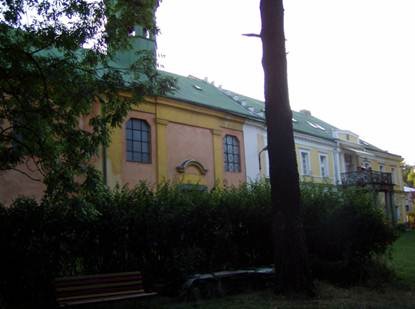
Chapel and a balcony facing the park
in 2004
P. Lodgman dwelled at that time at
the castle in Věž as a former Jesuit priest, living mainly from his annual
income of 300 florins making him almost financially independent and the
religious fund did not have to pay him.
He was not taking care about any parish, only served mass in the chapel
of Věž’s castle, and on some days he was reading from the gospel there. On August 15, 1793 Smrčná’s magistrate Jan
Pavel Streichsbier with Matěj Michlfaith came to Věž asking whether he would
take over their spiritual authority.
They promised to build a parish house and the free importation of all
the firewood. Their offer pleased P. Lodgman very much, therefore, did not
think about it at length and he agreed, because he was used to working in the
vineyard of the Lord, and the idea to become an independent parish priest
attracted him.
After
approval from the Gubernium and Hradec’s consistory, he started on November 1
at Smrčná. At first, he lived in a
peasant’s cottage. Only after a year he moved to a newly built church housing.[29]
Probably out of a pity he took to the parish an old, single, poor
noblewoman Maria Barbara Vraždová von Kunvald (* 1727), who also in Smrčná’s
parish died in March 3rd, 1799. Out of
gratitude she made in her testament Lodgman her sole
heir of her certainly not a huge fortune.
At that time she did not have any close relatives, since she outlived
all of her siblings, who passed away without descendants . ... Marie Barbora
perhaps for some time lived with (her brother – Editor’s note) Jan František in
Německý Brod, where the brother died on Aug. 23, 1772. After that she probably enjoyed the
hospitality at Degen in Věž castle. From
there probably together with P. Lodgman she went to Smrčná.
P.
Lodgman took perfect care of Smrčná’s church, which was well equipped due to
the diligence of local parishioners.
Shortly before his departure to Hradec Králové a new stone tower was built
on the site of a dilapidated wooden tower of the church."[30]
On March 3, 1795 Jan z Boha (Joanes de Deo) Josef Krziwanek was born in
Věž. The godparents were Josef Maria
Baron Langer from Langendorf, Lord of (Česká) Bělá and Rosálie Reinhard,
gingebread maker from (Velké) Meziříčí.
In the same year on September 9th the above mentioned Josef Krziwanek
died at age 7. [31]
About
the family of barons from Langendorf : Severýn Remigius Langer (1681-1757)
bought a farm in 1712 in Mlýnice at Červená Voda near Prostějov and became a
Knight in 1729. (His son, Ferdinand Otto
sold the farm in 1739). Severýn Remigius
still owned Bělá and Petrkov and in 1754 and became a Baron. Perhaps in the years 1737-1740 he probably
was also the builder of so called Langer’s or Pachta’s Palace in Prague in
Celetná Street no. 31. [32]
The godfather of Krziwek was Severýn’s son, Baron Josef Maria Langer von
Langendorf ( * Mlýnice November 21, 1725; +October 15, 1798). [33]
He was the last lord of his family estate - the not too distant from Věž
estate – Česká Bělá estate in Německý Brod region. Joseph's daughter Rosalie (1770-1836) married
the Count Jan Václav Špork. [34]
On 24. 1. 1799 in Jihlava, house no. 102 in the Špitálské suburbs the next
owner of the Věž estate Eduard Krziwanek was born.[35]
4. 1. 1800 the Krziwaneks daughter Apolonia Genoveva was born in Věž, the
godmother was Josepha Kratochvílová.[36]
Joseph Krziwanek
was born in Věž on February 13, 1804;
the godparents: Joseph Lodgman von Auen, honorary canon at St. Spirit in Hradec
Kralove, at that time a local priest in Smrčná and Josepha, wife of Mr.
Kratochvil, salt trader from Třebíč.
In “Schematism”
for 1804 both Bernard and Marie Anna
are listed as the owners of the Věž estate; in a registry entry at the time of
baptisms of their children, they are given as the then “Bernard Lord of Věž”,
or “the estate of Věž” and Marie Anna.
We also know that under the reign of
Joseph II . (1780-1790) the school was located at the Castle. The last teacher
was dismissed in year 1808.
Another interesting year is 1809, when Bernard is deprived of
ownership and Anna Marie remains a sole-owner of Věž’s estate.[37]
June 17, 1816 "Lady Josefa Segenschmied, widow of late Mr. Waclaw
Segenschmied, Mezříč burgher from Moravia and Wěž farm holder" dies at the
age of 73 from Brustwassersucht and on the 19th she is buried in Skála
(Sepelivit Admodum Revendus Deus Ignatius Ulrich Vicarius Eppistis ... et
decanus Krasnohorensis.)[38] In the chronicle we read: "...
In the sacristy was a tombstone with a German text. “In the tomb rests Věž’s
former lady 'Johanna (SIC! – should say Josefa) Segenschmied' who died 16. 6.
1817(sic) at the age of 73 years. During
the repair of the church, a tombstone was brought out and outside the sacristy
it was leaned against the wall ... ".
In 1827 the fund for two poor (Armen Institute) was founded in Věž.
The municipal granary was built in 1832. At that time there were 520
citizens of which 56 were Jews.
During Marie Anne Křivánek’s times "there was a classicist rebuilding of
the main western facade, in 1835 the
size of the chapel was reduced, as the choir section was abolished.” [39] About the chapel we read in the local
chronicle: "During Marie Krzivánek’s times a certain retired spiritualist
used to read daily holy Mass in it, and people from all surroundings so loved
the chapel that in huge numbers they took part in God’s services. The neighboring priests complained
about this, and since then Holy Mass had to be celebrated there with the door
closed/locked. After the death of this
priest it was ensured that every fourth Sunday and second feast day the Holy
Mass was celebrated in the chapel by a priest from Skála for which he received
from the landowner 21 zl.r.č .. "[40]
Jan
Ludwig Krziwanek (1795-1861) JD.
On 1795 March 3rd Jan Josef
(baptized John of God - Joanes de Deo)
Krziwanek, was born in Věž; the godfathers were
Josef Maria Baron Langer from Langendorf, lord of (Česká) Bělá and Reinhard and Rosálie, gingerbread maker
from Velké Meziříčí[41]. Jan studied at the gymnasium in
Jihlava in the years 1806 - 1810. His brother
Eduard studied there in 1810-1813[42].
On
1825 July 1st Jan married 23 years old
Barbora Hafenbrädl, from a glassmaking family. The witnesses were František
Nádherný, C.K. Gubernatorial Council and the regional governor in Jihlava,
Josef Sebastian Řehola, Jihlava, county commissioner. In the registery, Jan
Křivánek is listed as the son of Bernard
Křivánek, owner of the farm Věž. In 1826
Meziříčtí’s school children can rely on the Foundation of Dr. John Křivánek
from 1826[43].
In
1827 Jan founded the glassworks in Janštejn as a "skillful lawyer from
Jihlava." The circumstances are
described in detail in the article A. Kopp suggested that he was really
capable, and here we learn more about his wife's family. (See the article
further below). In 1829 Jan sells Janštejn’s glassworks to his son in law Johan
Ignatius Hafenbrädl of Zďár nad Sázavou.
A
dispute over the glassworks (in Květná near Uherský Brod) ran until 1834, when
the municipality issued a judgment unfavorable for Reich. Reich, however,
appealed, and the dispute dragged on.
Meanwhile, in the first half of the 30s), a Viennese doctor of law Jan
Ludvik Křivánek was enlisted as he was interested in the glassworks. He was
also a glass entrepreneur. In 1827 he
founded the glassworks in Janštejn, which exist to the present day in the
Bohemian-Moravian Highlands. There he held a patent on the production of
mirrors on a clay surface. He wanted to
run the smelter factory for 20 years and intended to rebuild it. The manorial lords denied his request filed
February 6, 1835 for the reason of the
considerable costs of rebuilding. On May
3, 1836 another auction for the lease of glassworks was announced, however,
because it was fruitless, next one was supposed to be held on May 27,
1836. Isaac Reich applied again.[44] .
In the yearbook Polytechnic Institute in
Vienna for 1837 under the number 2117, it was stated that
"Johann Ludwig Krziwanek Doktor der Rechte in
Vienna Jägerzeile Nro 57 auf die Verbesserung
Glasspiegel auf einer Thonplatte zu giefsen Auf ein Jahr vom 29 September. (annual patent for the production of
mirrors on an earthen pad).[45]
In „1840 Verhandlungen der kk Landwirthfchafts in Wien und Auffäße vermifchten ökonomifchen Inhaltes“ we find on
page 120 „Güterbesitzer Johann Ludwig Krziwanek Doctor Mitglied der
Rechte und der juridischen Faculty in Vienna.“
About how
Dr. Jan L. Křivánek founded the glassworks in Janštejn
in 1827
The article " The origins of
the glassworks of Janštejn in the Jihlava, or is the glassworks Janštejn 200
years old?" was published in 2010 in Vlativědný Věstník Moravský.[46]
It was written by a descendant of local glassmakers Antonín Kopp, who,
in 22 pages very thoroughly described how a skillful lawyer from Jihlava JD Jan
Křivánek founded the glassworks. Dr.
Křivánek’s idea of running the glassworks is related to
the origin of his bride's, whose maiden name was Hafenbrädl. She was daughter of a prosperous glassmister
in Herálec, Franz Ignaz Hafenbrädl (1753-1828), whose portrait in an oil
painting can be found in above mentioned article.[47]
Franz’s
uncle Johann G. Hafenbrädl was ennobled in 1783, and his nephew filed an
application for the same in 1805. For
this reason he bought the estate Český Rudolec and there he wanted to set up a
glass factory. But the request was
rejected and the estates even with its large debts sold. Franz settled in Žďár, where he bought part
of a Cistercian monastery, which had been devestated. He then repaired it at great expense. In this former seat of prelature he then led
a more noble life and led the business side of his glass works from there.
The
production, which was extended from Herálec to neighboring Vojnuv Městec
prospered. Hafenbrädls overcame even the
state bankruptcy in 1811. Over time,
however there were problems with the
supply of wood and the production was endangered. But then Franz’s son-in-law, JD Jan Ludwig
Křivánek (1795 -1861)[48], doctor of laws from Jihlava, who was
married to Franz first born daughter from his second marriage came to
assistance.
Dr.
Křivánek knew from his experience the circumstances at Teleč’s estate, where they faced problems with insufficient sales
of overaging wood in the forests.
And so he decided to take advantage of this situation. He proposed therefore, that on behalf of his
father-in-law, Herálec’s glassmater Hafenbrädl, discreetly and under his own
name, he would found a new glass plant on Teleč’s estate, which could then, and
ever since 1827 serve as a replacement for Herálec.[49]
Dr.
Křivánek first looked for suitable land
in Horní Dubénky. On March 1, 1827
he entered into a purchase agreement.
Then on April 2 1827 he entered into negotiations with Count Leopold
Podstatský-Liechtenstein, the lord of Telč.
The manorial lords contracted to supply wood for Křivánek, and Křivánek
pledged among others to buy schnapps and beer exclusively from their manorial
brewery. The Count did not provide the
land; under the agreement Křivánek had to look for that by himself. Also the glassworks had to belong to Křivánek
and would not just be rented. That way Křivánek allowed an obligation to
be given which he had already fulfilled.
“Later (in July) he received permission from the Governor's Office to
build a glass factory, although it used to be customary, and the authorities
strictly demanded that the one who ran the glass factory, had to not only be a
trained glassmaker, but also had to be certified in this craft. Something like that could not be said about
Dr. Křiwánek, because apart from his wife, who was a daughter of a glassmaster,
he had nothing to do with the glass industry and did not understand it. Nevertheless, he got the permission.[50]”
Moreover, it seems that the
construction was started immediately after the approval of the Count in April
and they did not wait for permission from the Governor's Office from July.
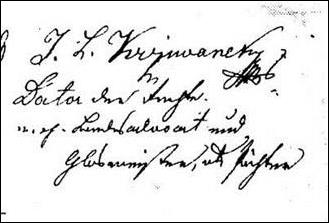
The signature on the rental contract from 1 April 1828
, " J. L. Krziwanek Doctor of Laws, also a provincial lawyer and a land
lord "
At the time of the death of Franz
Ignaz Hafebrädl (1753-1828) the
glassworks in Janštejn were in full operation, and according to IOUs Dr. Křiwánek by overpaying in deposit payments, probably
deliberately and purposefully increased
the debt of the glassworks. Křivánek
probably did not want to have all his
property invested in the glass factory which was eventually intended to be
sold to Hafebrädl’s estate and moreover then
did not have to be sold too expensively.
After
a year and a quarter of operations on 31st January.1829 JD Jan Křiwánek sold
the glassworks to his brother in law, the glassmaster Johann Ignaz Hafenbräl of
Žďár nad Sázavou for 7,600 zl. conv. currency and 25 ducats in gold. In the contract of sale a careful notice of
the seller that he, that is Dr. Křiwánek
now or in the future is not a guarantor of any debt, can not be overlooked.
In
addition, though without any necessary connection, it might be noted that the
household Hafenbrädl was regularly visited, allegedly with her illegitimate
children by the lover of Chancellor Metternich, Elisabeth Hafenbrädl. This niece
of Franz’ lived originally as a ward of his family, later in Viennese
high circles and to the chancellor she gave birth to a range of children, eg.
the future Austrian ambassador Count von Hübner.[51]
Edward Ernest Edler von Krziwanek (1799-1876), lord of Věž, the imperial and provincial deputy
Euard Ernest was born on January 24, 1799 in Jihlava in the house no. 102 in Špitál’s suburbs. However, it was only the contents of his grant of arms that led us to this place of his birth. Why he was born in Jihlava remains a question. He was baptized at the same place with the name of Edward Ernest. Both names can be found later in the registers where he was naming his sons.
Both brothers Jan (*1795) and Edward Krziwanek (*1799) studied at the gymnasium in Jihlava. Jan in the years 1806 - 1810. Eduard 1810-1813[52]. But we do not hear about him again until 1831. At that time he is marrying the five year younger Baronin Caroline von Herites (1804-1876) at the church of St. Wenceslas in the castle of Nový Stránov. The registry has listed the bride as: "Noble Miss Maiden Baroness Caroline of Herites" and the groom as: "Gentle Lord Edward Ernest Kržiwanek Lord of the farmhouse Wiesch, son of the late Bernard Lord Wawřinec Kržiwánek, holder of farm Wiesch”. Her family is thoroughly presented in the chapter about the "Familie von Herites". The wedding venue, thus the church itself, we can now see again renovated. The wedding of Stránov’s Baroness was certainly “the” event and a number of eminent guests attended. Among the wedding witnesses can be found the regional governor and also the owner of the neighboring estates of Skalsko or Kosmanos.
Among the wedding guests, let us notice the witness Gothard Count von Mirbach (1808-1870). Leaving aside the fact that he was the ancestor of the wife of the son of the last Austro-Hungarian emperor, Archduke Otto von Habsburg-Lothringen (*1912), which he could not have known himself at that time, it can be stated that Count Mirbach, as the owner of a nearby estate Kosmanos certainly embellished the whole event with his presence. The wife of Count Mirbach was Matilda born Pachtová who dies soon after, whereupon Mirbach is marries her sister Aloisie. (About the relationship with the family of Mirbach we can add that the announcement of the death of Edward Krziwanek will be sent to the address of Countess Natalie Wratislav, née von Mirbach[53]. Thanks to the obituaries we know, that Natalia Wratislav née von Mirbach, was the daughter of the wedding witness, Count Gotthard von Mirbach from Kosmanos, born at that location.[54]
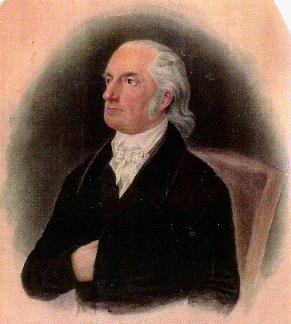
Gotthard Friedrich Graf von Mirbach (1806-1870), Zeichnung 1837 Josef Zumsande[55]
Surely other representatives of the family of the count Pachta of Rájov (von Pachta Rayhofen) were not missing. Relationships with family Pachta were in fact alive almost certainly because their ancestral estate was not only Jablonné v Podještědí (Gabel in German), but also Bezno, which bordered directly with Stránov’s land – the distance between the castles is 5 km. According to featured places of birth, marriage and records in the local Chronicle the Pachtas certainly lived there during the first three decades of the 19th century. Perhaps the most significant role in our story will be played by the oldest sister of the wives of Count Mirbach, Johanna née Countess von Pachta Rayhofen (1806-1878) with whom Caroline was obviously very close. Caroline Krziwanek nee von Herites called her "Freundin Jenny.” When Jenny, who since 1835 had been Baronin Johanna von Kutschera, gave birth in Vienna in 1836 to a boy, he was baptized (in the name of Karel) in a baptismal dress, which Caroline bought for her own children. We will return later to Jenny von Kutschera, née Countess Pachta and her family, mainly because her friendship with Caroline did not seem to leave her son, Baron Karl von Kutschera with much room for a choice of his bride. He married Caroline's daughter Ernestine von Krziwanek and the girlfriends became relatives. Caroline then titled Johanna "Grossmama Jenny."
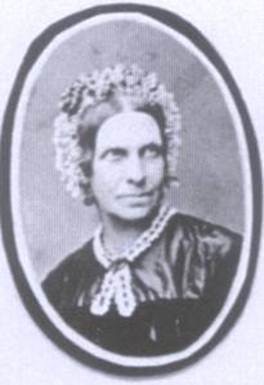
Johanna ‘Jenny‘ Freiin von Kutschera, née Gfin. Pachta (1806-1878)[56]
It is perhaps appropriate to add that the Pachta family had apparently already had the greatest period of ancestral glory behind them. The great-grandfather of Jenny, Count Francis (+1799) was during the reign of Maria Theresa, as the governor, financially and politically the most powerful man in Bohemia. He aggrandized Bezno at great expense to make the farm not only an economic base, but a representation of his status. Bezen’s castle at that time was a place of frequent visits of influential people and was undoubtedly the center of the provincial political life.[57]
Later on we read unflattering words about the father of Jenny, Count Franz Joseph (* 1776) in Bezno’s Chronicle: “From 1810 until 1820, Count Franz Pachta remained in Bezno. "As was a bad landlord, he was given Count Salm, and later Baron Kapoun as an administrator. Count Pachta was a simple man, one day he came to our Sedlacek, saying: Listen you old man! Sew for me gray dress suit. Go to Boleslav, select the cloth, and on the first I will pay you for it. "Sedlacek went for advice to director Rotky. Director: "If you want to pay for the cloth yourself, God help you, but I can’t not give you a penny, I have to pay the butcher and baker. Sedlacek later made an excuse to the Count that in Boleslav they did not want to give him cloth on credit. He already owed Sedlacek 27 golds, and when on the first of the months he went to the castle to ask for it, the count sneaked out through the back door of the castle and when they met and he was reminded, he gave him only 1 or 2 golds as "discretion" and "that more has to come on first (of the month)! "This Count wore a winter coat with fox skins. In the summer Sedlacek removed the foxes from the coat, and the Count had a summer coat!“[58]. For balance, let's add that in 1817 the castle in Bezno, built in 1750, was reduced to ashes, but within a year it was built again into the present magnificent form.[59] However Bezno was eventually purchased by 1881, by the administration of the private estates of his Majesty (The Emperor) for one million gulden.[60]
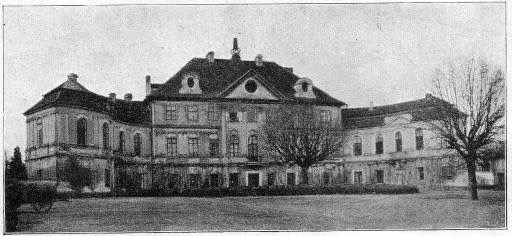
Castle Bezno in the year 1818[61]
Taufzeug and the Blue Memory Book
Returning now to the christening gown “Taufzeug”, which Caroline apparently bought for the baptism of her eldest son, Ernest Benjamin Thadeas (1832-1840) in 1832. Then, as with all her children, the godparents were grandmother Maria Anna Krziwanek (in the register she is given as the owner of the Věž estate) and uncle Thade Baron von Herites. The outfit was used by Caroline alone nine times, but because "Taufzeug" later became a traveling (outfit) - everyone baptized in it was recorded. Thus not only was this heirloom, as well as an interesting family tradition, preserved. It also provides an original picture of family togetherness . depicted in what resembles detailed branches of an extensive family tree. There are, in fact, with different handwritings gradually entered 11 children of Caroline’s sister Maria Baronin Voith von Sterbez, 9 grandchildren - the children of the three daughters of Caroline, and so on through six generations. The writers have changed, but the immaculate gown was worn over and over until the 30s of the 20th century. The last entry says that "the gown was lost at the death of Antonin Kratochvil (1861-1945), who had it with him, and apparently was stolen by somebody.” The entire list was not just a loose leaf, but a page in a book that Caroline began to write.
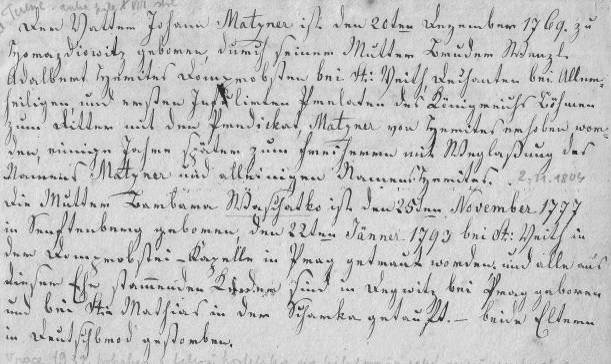
Sample entry in the Blue Memory
Book. The page about parents.

The Blue Memory Book – the blue printed cover, Caroline’s notebook, 38 pages, cca 20x15 cm
These were 38 pages bound with a printed envelope about 20x15cm. She did not put there any heading, but because it is almost a contemporary genre with the ladies of her position and times, and the cover ws blue, let's call it the Blue Memory Book.
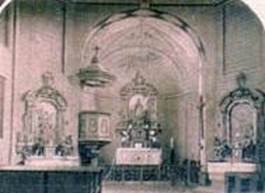
The interior of the chapel of St. John of Nepomuk in Castle of Věž
Like other ladies of her background, Caroline noted births, baptisms, godparents, weddings, witnesses, deaths, funerals, ennoblements and honours. The entries did not lack places, dates and times, for births she gave the stage of the month and the corresponding signs of the zodiac. For example: „Den 26ten August 1832 um 10 uhr Abends gebohren und den 28ten getauft Mein Sohn Ernest, Thadeus, Benjamin. an eine Sontag beim Neu-Mond, an den Planeten der Jungfrau. Pathen Bruder Thadee und Schwiegermutter.“ The handwriting gradually changed, as the book wandered through the generations. As late as 2005 - completely filled – it was lent to the author by a bloodline successor.
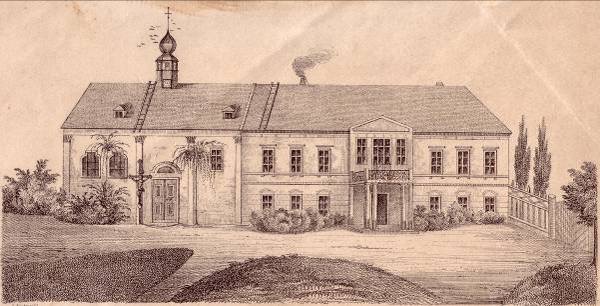
Schlofs /castle Wěž, J Sandtner j.l. (Fránas archive)
After Thaddeus Ernest Benjamin (1832) Caroline gave birth to Maria Anna Barbara (1834), then came Mathilde (1835) and Friedrich Ferdinand (1836). At that time the estate already formally belonged to Eduard Křivánek, because, according to state records of 30/07/1836, he bought if from his mother Anna Marie, born Seegenschmied, as a townsman of Kutná Hora.[62] Mathilda’s godmother was Baronin Marie von Herites with Thadeas Baron von Herites. Friedrich Ferdinand’s godparents then were Aunt Marie and her fiancé Ferdinand Baron Voith von Sterbez who were later married in the chapel in Věž in 1837. But then comes a difficult period. Nearly two years old Mathilde dies when Caroline is in her sixth month of pregnancy. Three months later, little Caroline was born, but died after six days.
The following year 1838 nearly
two year old Friederich died. In 1839
Hermine is born, but in 1840, when
in July the village suffered from severe hail and all the grain was beaten into
the ground, her firstborn, eight year old Ernest died in Prague in November. Caroline is pregnant at the moment
and has less than a month before giving birth, and that is why it seems obvious
why the little girl, born in December of that year, receives the name of
Ernestine.
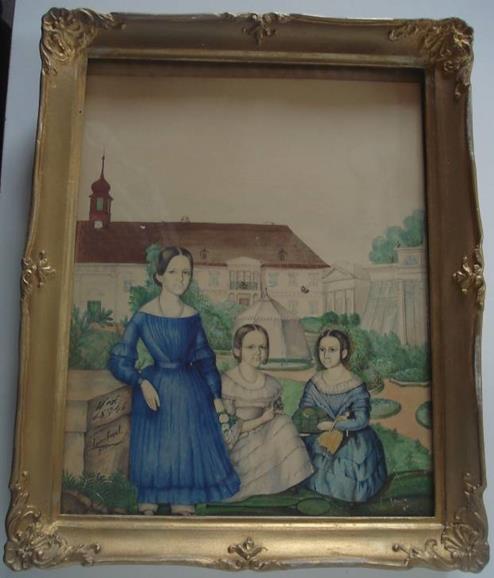
Maria (9), Hermine (6) and Ernestine (5) Krziwanek in front of greenhouse in the park 04/16/1845 signed Josef Just [63]

Maria (9), Hermine (6) and Ernestine (5) Krziwanek in front of greenhouse in the park (cut out) 04/16/1845 signed Josef Just [64]
In 1841 Caroline's father, Johann Baron von Herites dies in Německý
Brod and in 1842 her mother in-law
Anna Marie Krziwanek also. In the same
year a great drought came. Grain without
moisture did not "make ears”. The
harvest collected was not even as much as what was sown. Among the people poverty and hunger
started. In 1843 Caroline’s mother Barbara Baroness von Herites died in Německý
Brod.
In 1843, Professor Balling writes about the contributions of the
Association to encourage an entrepreneurial spirit in Bohemia (Aufsätze uiber
Dampfbierbrauerei, in Mittheilungen des Vereines zur Ermunterung des
Bewerbsgeistes in Böhmen). He reports
that a few years prior they had tested brewing in Věž’s steam boilers. However, this technology of boiling wort and
hops to achieve the desired quality of beer was not successful. [65]
In 1844 the last child Eduard Carl was born. He remained the only male descendant. He was left only with three sisters: Mary,
Hermine and the Ernestina.
During the time of “corvée” in 1844,
they built a two-story so called Krzivanek’s "New House" between the
brewery and manor smith shop (No. 62).
It was situated opposite the castle through the park. In the years 1846 to 1847 the house
was bought cheaply by merchant Meisel, who served in the village as the Jewish
rabbi (descendants of the buyer Meisel still live in the Slovak Republic). Krziváneks had the 1st floor
available for free use. A considerable
portion of the outstanding balance of the purchase price was invoiced by
businessman Mr. Meisel to the last of Krzivaneks for meals - and the debt was
cleared.

New House in Věž number 62 At Meisl‘s in year. 1930.[66]
Havlíček’s theater company
Eduard Křivánek became a character
in the novel Havlíčkův Máj by Josef Jahoda (1872-1946). The book was written in 1936, but it is
inhabited by people the author met in his youth in Německý Brod in the 1870s
and 80s, or at least he had learned about them from living verbal tradition.[67]
The story is set in the period after the comeback of K. H. Borovský to
Německý Brod from Russia in July of 1844 when Havlíček organized the Czech
theatre for the enlightenment of a Germanised bourgeoisie. We meet Edward Skrivanek in the book several
times. Karel Havlíček and his company
presented plays not only at the theater in Pekhaus – the restaurant Na
Holubníku, or in the large school hall, but played also at the estate of
Věž. Known in the future as a champion
of the Czech language, still here at this time, he participated in German
theatre. The estate in Věž is mentioned
by Václav Klofáč[68] as a place where "till the
year 1848 K. Havlíček Borovský participated in German theatre" Also in The
History of Czech Theater we can read that Havlíček was already presenting plays
in Věž in the thirties: "The then
Německý Brod’s upper class was Germanized, but thanks to young Havlíček the
national Czech consciousness had just begun to penetrate into higher social
circles. The theater had been active
here during the past decade, but mostly in private. It was Havlíček who laid the correct
foundations here ... The first theatre performance took place in the old school
in a small building behind the rectory of the Church, but the theatre was also
active in Věž and Havlíček was present there as well. It did not matter that the plays were in
German, he took part in them and used the contacts to lobby for organizing
Czech performances, in which he also succeeded."[69]
From Jahoda’s novel we
are selecting places that directly mention Věž’s Skrivanek. Havlíček said in
strict manner: "... Here in Brod we will start. Brod is spellbound. Cursed by such as Doubravová,[70] such Skrziváneks and Müllers, Brod was cursed by the stupidity of the
local people!" (p. 30) ... "And above the stage we will display the
Czech lion!” Havlíček decided.
"Nothing other than the Czech lion.
We will not put there the black and yellow two-headed creature[71], " he is smiling at Žák.[72]
"Věž’s
Skřivanek, Kundrát from Květinov and mayor Vjeznický will have heart attacks,
"says Žák. (p. 44)
“... Oh, dear aunt
Halamasková![73] Straw is still sticking out from
this family’s shoes; the aunt does not even knows how to bow properly, but
pushes her way in to get among Brod’s dignitaries. And how humble is her behaviour, when Věž’s
Skrivanek graciously talks to her "(p. 51) ... Havlíček is counting the
actors and recalls, "We must not forget the director from Věž, Dokoupil.
Yesterday he offered to participagte.
That will catch Květinov, Věž and all the rural nobility."(p. 91)
..."You must understand this Lori (Jenčová)," says Havlíček.” She is an ageing madam, and would like to
marry in high circles. She wants to
become rich and is peeking into the Špital’s farm, to Věž to grab some
Germanized “Milord”."(p. 109) ... Havlíček warns:" The most
interesting thing is that there is a huge rush for the entrance tickets. The tickets are wanted by people from Věž,
from Sv. Kříž, Humpolec and almost all the neighboring villages. Pekhaus would not be big enough! "(p.
159) ... Žák was willingly sharing:"
There will also be Skřivánek from Věž, Müllers from Špitál’s court, all
surrounding top officials will come. And
professors[74] come – all of them ...."(p. 160) ... (after Havlíček’s short
uncensored introductory speech about the importance of emancipation of the
Czech language – editor’s note.) Also Věž’s Skrzivánek applauded Havlíček -
perhaps his heart wanted otherwise, but one never knows... (p. 166) ... on
pages 186-187 the author mentions a "šlitáž" of the patriotic theater
members - a sleigh ride for which two sleighs were loaned by Věž’s director Dokoupil.[75]
We do not know how much interest
Eduard Skrivanek had in the theater itself.
Certainly we know that his wife Caroline, a “heated patriot" of
voluntary and amateur theater , had already appeared in Klicpera’s play
"Good morning" in Spálené Poříčí in 1820, at a celebration after a
meeting of the patriotic literary society.
We read further in the book by F.
Drašner that Havlíček was often a frequent visitor at Věž. He quotes Gabler, who remembers how Havlíček
was at a masquerade party dressed as a Cherokee, or how, although uninvited,
poked fun from other guests. František Drašner writes:
"Also the estate owner in Věž Krivánek organized balls and
masquerades to which the notables came down from Brod, Humpolec and its
surroundings. Věž’s manager Dokupil was
a member of Havlíček’s amateur theatre club and he played the role of Skočnožka in the
"Epigram". Through Dokupil Havlíček’s influence was transmitted
from Brod to Humpolec. And since
Havlíček was well-known in Humpolec, they voted him deputy to the Reichstag in
1848.
Havlíček was a frequent guest in
Věž. This is also proved by another of
Gabler’s remark which depicts a family celebration on the estate, during which
a home theater, an allegorical tableau and masquerade were organized. Gabler
was at the feast with Vaclav Žák and Havlicek in a fancy disguise. Another
visit in Věž is described by Emanuel Weidenhoffer when at a masquerade Fany
acted as a Spaniard and Havlicek as a Cherokee.[76]
Seven poems[77] by Emanuel Weidenhoffer[78] about the relationship of Havlíček
to his (Weidenhoffer’s) sister has an aggregate name "E l e g i e, an old
lame poem about a love affair of my sister Fanny and Karel H. B." The cycle dated 23. 2. 1848 had been written
for his sister Fanny, as can be deduced from its contents.[79]
The sixth poem Masquerade in Věž (small farm nearer N. Brod, owner of
Skrivanek - ed. P. W.) depicts a carnival ball on the farm Věž, which Havlíček
and Miss. W. attended. The bitterness
towards K Havlíček spurts out in the last two stanzas of the poem:
Carnival sumptuous feast
generous gentleman of Věž is
celebrating again;
for surrounding rare clans
Castle Hall particularly prepared
is.
Already at pleasing sound of tones
Different masks stroll around,
Behold! There herself the daughter
of the regiment
in modest attire comes in.
Ha! What's there for compatriots
They joined the company right now?
Everything remains to look at him!
Cherokee brings a Spanish lady.
Limbs constrained by corset
lined with gold,
skirt decorated with a silver cross,
plentiful precious laces.
And in the rich hairdo
silver needle flutters,
She flies dance with
her northern friend.
Hotter than the sun,
glowing over the Spaniards,
love formed the thrones,
which they both worshiped.
Love burning so cleanly,
he himself a traitor always
extinguished
and the burnt place
by far he avoided.
The burnt place torments
Girlfriend’s disappointed heart,
she sheds bitter tears
having no more than sad
forget-me-nots. [80]
In Věž the
amateur theatre company from Brod gave a German performance, in which Karel
Havlíček played alongside “a young Countess Stubnikova, apparently a guest at
the estate Věž”.[81]
And who was the Countess Stubnikova? In the years 1844-1846, when Havlíček apparently arrived to give the performance
in Věž, there were only two Countesses Stubick von Koenigstein. These sisters Anna (1821-1875) and Wilhelmina
(1819-1887) were cousins of Úsobí’s Count Eduard Fučikovský von Grünhof
(1814-1891), whom we know, for example, as a companion of Edward Krziwanka or
Frantisek Havlicek in the oil mill company in Květinov. Both families - Fučíkovský von Grünhof and
Štubík von Königštejn - are described in
detail by Jiří Bořecký in his History of Úsobí and Chyšky.[82]
We read here that Anna and Vilemína were the daughters of an impecunious
captain of 8th Infantry of the Imperial Regiment, Count Johann Nepomuk Štubík
von Koenigstein (1782-1840). Their
mother, Leopoldina Countess Stubick von Koenigstein née Fučikovská von Grünhof
(1791-1875), however, received as an inheritance from Úsobí’s estate lifetime annuity. In 1849 Wilhelmina married Dr. Med. Franz
Xaver Güntner (1812-1887), and later professor of medicine at the University of
Prague.[83]
In their places of residence reported in the New and Old Town Prague is
no mention of children.[84]
Sister Anna remained single and according to the family chronicle of
Fučíkovský von Grünhof she also loved a doctor from a burgher family. But Leopoldine allegedly objected to Anna’s
marrying him. At the time her niece
Marie Fučikovská (1814-1897), stayed with Vilemina to learn the city's manners,
then Anna, out of despair, jumped into the river Vltava and drowned.[85]
In
a magazine article Vilém Gabler recalls Havlicek in Německý Brod, where he lived with him in
the 1840s , literally as
follows: “Havlíček then was very
inclined to perform some wicked pranks.
On the neighboring estate a family celebration was scheduled to be held:
home theater, an allegorical image and masquerade. In allegorical image Havlíček took over the
role of genius, for which he was not exactly competent, but for him it was just
fun. He made Žák and me to go with him
to the masquerade ball (although we were not invited), it goes without saying
though in some disguise. And Havlíček
brought there a hussar and a Turk, who he did not introduce to anyone and that
no one knew, and it was a particular pleasure for him when he could whisper to
us: “They keep asking who the hussar is and who the Turk is!””[86]

Eduard Ernest Edler von Krziwanek ( 1799-1876) on the
balcony of Věž’s castle - a greenhouse in the background[87]
E. Křivánek, landowner and city
councilman, with 10 gulden" and "JUDr. Eduard Brzorád, adv., 3
gulden” are listed "as contributors from Německý Brod" in the
"List of contributions to the establishment of the Czech National
Theatre" from the years between 1851-1861."[88]
Slavomil’s
article on Věž’s industrial school in 1845
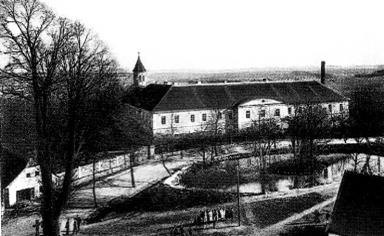
Castle Věž at the beginning of the
20th century.
In the memorial book of Věž’s school
the head teacher Kořínek mentions an interesting article about the technical
school in Věž, which he saw in the magazine "Květy" from 1845[89].
There it is literally written:
"Many
will wonder that in that village a technical school like this could ever
exist. And yet it does. Slavomil[90] traveling for his affairs through
Humpolec stopped in the village of Věž.
It was Sunday. He saw a lot of
young men and women walking toward the castle, and asked what it meant. He was happy to hear that there was Sunday
Industrial School.
At that time, according to the
description, Věž was an ordinary village in character, with a very beautiful,
manor castle. So he rushed there and saw
how a gentleman was teaching simple traditional craftsmen the sciences of
geometric principles and also practices such as drawing. The director and teacher of the school was a
clerk (actuarius in Latin) and an ardent patriot EF Schwarz of Věž. He graduated from a technical institute in
Prague and returned to his county; he knew how little practical knowledge
existed in the country, although Věž’s craftsmen annually earned their bread by
building and craftsmanship. It moved him
to share - according to his capabilities and forces – what could be of some use
in their craft.
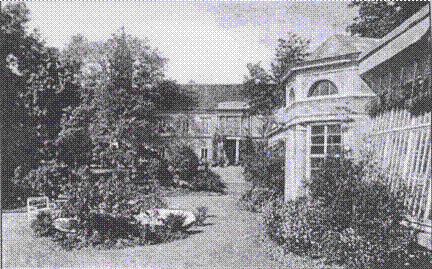
Věž’s greenhouse with castle in the
background
In
mid January of 1845 he begins to turn the idea into a
reality. Since he was teaching the
subjects falling within the architectural field, it was really a special
industrial school for builders and bricklayers.
Exercises in drawing were an important subject of study. There were regularly 8-12 persons, mostly
neighbors of Věž. The results of the
schooling were not preserved in any records or catalogs, but in the same year
B. Slavomil writes that many of the students and perhaps everyone of them spoke
so wisely, they could embarrass those uneducated city artisans, though German
speaking. … So in this unknown corner, without all the noise, soon was realized
an important educational venue and it alone – only for the love of homeland.
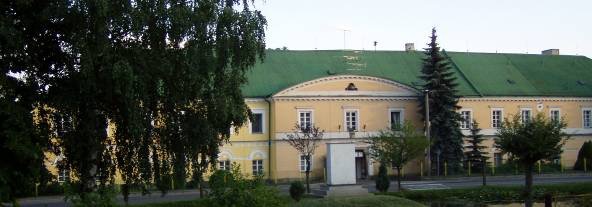
Věž’s castle from the front in 2004
In
this activity Schwarz, who was heavily supported by a teaching assistant from
nearby Skála - Dvořák. He as an ardent
patriot promoted literature by buying books, and also lectured to children
about poisons and antidotes so clearly, and with such success that Slavomil,
unwittingly shed tears, when hearing their answers.[91]"
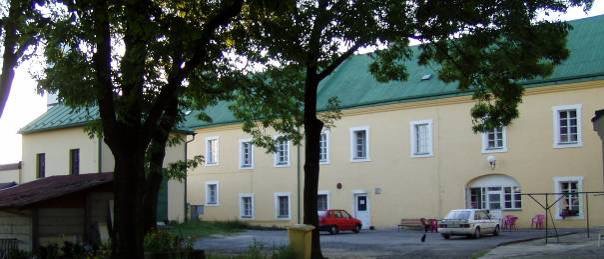
Věž
castle – look from the back in 2004
Let us give a few lines to describe
the estate, as it was presented by Sommer’s (book) Czech Kingdom.[92]
In the 30s of the 19th century Věž’s estate included over 870 hectares
of fields, meadows, woods, ponds, pastures and gardens. After the sale of the village of Květenov (
in 1791) the estate consisted of the community of Wěž (also Wiež, Wiesch )
attached to a parish Skála; with a seigniorial castle and a public Chapel of
St. John Nepomuk, where every 4th Sunday Mass took place. Also, there were offices of a property manager;
a farm with pens for sheep, a brewery for 4 barrels (4 x 23.4 liters), 2
alcohol distilleries, a tavern, a mill with a saw mill; also another mill
called Saliterna. The dominion also
consisted of the Moserov village and farmstead Veselsko with sheep pens, a
distillery and a gamekeepers lodge. The
last village is Lhota (also Lhotka) on Skalský brook, also with a
distillery. The mill pond in Věž has
carp and pike in it. The estate includes
993 inhabitants of which 10 are Jewish families. The language spoken is Czech.
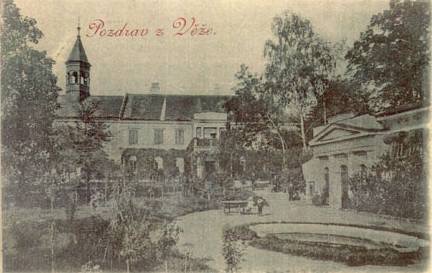
Postcard with greetings from Věž,
Foto Dvořák and ?, Německý Brod
The main source of income and food
is agriculture. The soil is mostly sand,
mixed with clay of only slight fertility, especially suitable for corn and oats
and also, barley, peas, potatoes and flax.
Fruit trees are just in gardens. There are 12 horses (4 assigned only
for manors), 337 head of cattle, 730 sheep, 100 pigs, goats 6. Both estates of Věž and Veselsko have sheep
pens. Forests cover 52 hectares and are
mostly coniferous and some broadleaved trees.
Wood is harvested just a little and part of it is sold to Německý Brod.
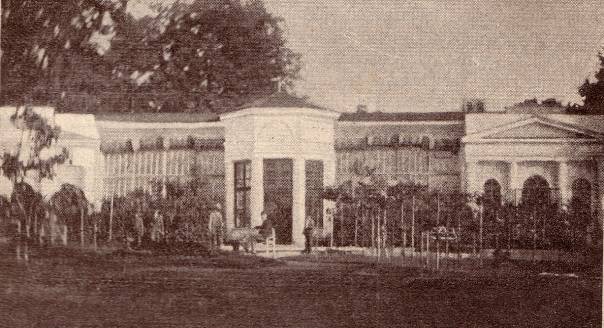
Greenhouse in Věž
Věž is an estate farm recorded in the land register
(Zemské Desky) managed by the administrator who is housed within the Věž estate
and acts as director. Artisans are counted as: 1 barrel maker, a baker, 2 beer
drawers, a brewer, 4 distillery operators, a butcher, shopkeeper, liqueur maker
(Moyzes Pick) with a single production authorization, 2 millers, 2 blacksmiths,
2 tailors, 2 shoemakers, a stonemason, wheelwright, weaver and a midwife (for
523 women).
For
completeness we should add that an estimate of the value of the property from
1841 amounted to 136,990 gold coins.
According to the Orth’s dictionary besides the brewery and liquer
distillery there had been a flour mill for bone meal. During Eduard Krziwanek’s times, according to
the chronicles of the manor, three distilleries were established there. In 1838 a property inventory of land was also
conducted for the purpose of taxation.
The list of properties in Věž and its surroundings is a very monotonous
reading, because most of the fields belonged to Edward Křivánek.
But it is interesting that
Křivánek’s name
can also be found on maps and lists of properties in Německý Brod. Besides owning extensive lands there, he also
owned the house no. 23, which was the inn “At the Sun,” which was also a an outlet for beer and spirits made
in Věž. This travelers’ inn, which was
mentioned by Josef Jahoda in his novel "At the Sun" stood in the
Lower square on Jihlava street. Today a
building technical school is in its place.
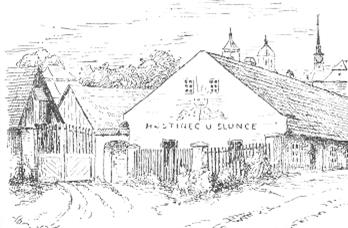
Inn “At the Sun” in Německý Brod[93]
The novel by František Hamza
"Šimon Kouzelník” (Simon the Magician), which besides being a story of the
fictional enlightened patriotic Norbertine priest, is also a kind of chronicle
of life in Německý Brod, in the first half of the 19th century, with a mention
of the Brod’s inn "At The Sun”. It
is where on Saturdays the innkeeper prepares for students blood sausage feasts. There is a scene in which P. Simon is coming
here among cheering students and explains: "I allowed the children one, two
sausages, a pint of beer and a decent song on a fiddle.“ The scene in the novel is set around the year
1822 when the inn already belongs to Skrziwanek or could have - we know that it
belonged to them in the 30s.[94]
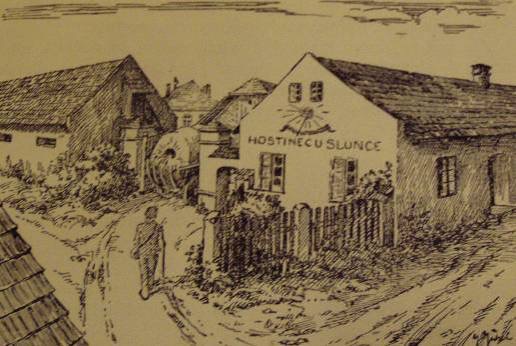
Inn at Sun in Německý Brod, drawing
by Jan Jůzl[95]
Before proceeding to the events of 1848, let’s complete the picture from
the times of serfdom as it is described in the municipal chronicle: " Even
Serfs from Lhota used to come to Věž to perform corvée. The old-timers remember these unfortunate
times as the manor “dráb” (A uniformed servant/employee of the manor,
performing official orders, usually a veteran soldier ) waited for them by the
cross statue, and when some did not come in time, he laid the first farmer on
the field balk by the cross and mercilessly beat him up for not going faster,
and keeping the others late. The
nobility in Věž had its own court and those who opposed were “swept away”.
AE Komers
writes that already in the 30s individual industrious landlords, namely the outstanding farmer Křivánek (in
Věž) and following his example the best farmers of Čáslav region found out
that the fertilization with bones pays very well. ... "[96]
Events of 1848
The
revolutionary events of the year 1848 and the authorization of a constitutional
government had its responses even in Německý Brod, Humpolec and its
surroundings. Eduard Kržiwanek was one
of the main characters of these events in this region. Responses to these events are not only
recorded in the private correspondence of Brod’s patriotic citizens[97]
but also in the press, in Tyl’s Pražský Posel (Prague Messenger), or Havlíček’s
Národní Noviny (National Newspaper). J.
Sochr[98] in
the introduction of the letter of 6. 4. 1848 writes: "The fear of stirring
up the mob" which was something even K. Seifert was afraid of, was one of
the reasons why the scared bourgeoisie[99] so
quickly organized the National Guards, to protect property and maintain
order. Part of the urban population,
however, saw the guardsmen as the defenders of constitutional rights and
freedoms. We are interested in this
letter because Pater Seifert, a chaplain in Německý Brod comments here on E.
Krziwanek’s joining the National Guard.
He writes: "... And what I also dislike is that lieutenants
Skřivánek of Věž and Mr. Kundrát of Květinov were elected - why, when as
villagers they will not serve - and for decoration they are not needed; plus Skřivánek
is eating away the local workers’ daily bread by bringing Věž’s craftsmen and
labourers to till the fields here; he also delivers his beer to Slunce (a
former pub “At the Sun” in the Lower suburbs of Deutchbrod - many are
complaining about it! ..." The banner of the National Guard of the
revolution of 1848 in Deutschbrod, however, was adorned by two embroidered
pictures, provided by the Krziwaneks family, who were given the precious parts
of the banner back in 50s and later on donated the two embroideries to the
Jasoň choir in Deutschbrod.[100] One picture shows the municipal emblem, the
one on the other side shows St. Wenceslaus.
The flag is now kept at the Muzeum Vysočiny Havlíčkův Brod.[101]
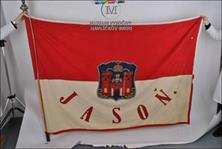
The front of
the Jasoň choir flag, with the embroidery which adorned the National Guard
banner in 1848 and was donated by the Krziwaneks.[102]
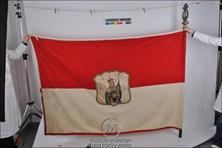
The back of
the Jasoň choir flag, with the embroidery which adorned the National Guard
banner in 1848 and was donated by the Krziwaneks. [103]
On
April 21st 1848 Der Prager Zeitung newspaper published a German article by
Eduard Krziwanek" Nachhall von der maehrischen Grenze"(Echo from the
Moravian border), in which Krziwanek encourages accession to the all German
League. Here he calls for fixed, cordial
unification with Germany and the Union.
He ends the article with the words: "Therefore, the venerable
German club in Prague! Hear our unified
thousand voices in response which in our mountains stretches far: Just bravely
pin a Grerman cockade on your hat right next to the Czech one! Also, here in a village we know well the
colors of black, red and gold, and to our Czech farmer their high and important
meaning is not strange, despite some whisperings saying otherwise."
Now we quote from
a letter by Pater K. Seifert, from 24. April 1848: "Dear friend. Very
strange things are happening here. Mr.
Skrivanek Ed. (who submitted an articile to German newspapers from 21.tm
"Von der maehrisch Graenze") drives around the surrounding estates
and invites all "zum deutschen Bund." - Today in the town hall in the
great hallway on the table Dr. Pankrác held an explanation of the entrance to
the German league, and Thursday there should be a meeting for other regions
here at “Na Ulehlích”. - What do you think?
You are against it, but behold Brod - Věž - Lipnice - Okrouhlice -
Přibislav - Polná - Štoky etc. from a large part very Czech places – are for
it. Mr. Skřivánek, against whom the
local workers might soon rise up, commented that city officers should not even
subscribe to Pražské Noviny (the Prague newspaper), because apparently they are
asking the people to rebel against the masters - so? – it is about time that
the people escape the ancient slavery.
By the accession Skřivánek perhaps wants to raise the sales of his
liquor, which he is burning in Věž? It
is time to answer him. But in the German newspapers, as he does not read the
Czech ones. ... Good bye, PK Seifert."
In Tyl’s Pražský Posel no. 9, year 1848, among other things it
says," ... But thank God that the cause of this is always just a few crazy
people and that they are misusing the good minds of our rural people to
hoodwink them with shameful tricks. And
there we have, for example, Německý Brod.
For God's sake, there he can print anything he wants, that he wishes to
belong to the German League! ... Doctor Pankrác! Oh my gosh!
This is a charlatan, for whom the National Committee is not good enough,
perhaps he wants to be an ambassador in Frankfurt, and is trying to confuse all
good heads in Brod! Kudos to him! I can see him in my mind as he, after the
deed, after confusing the whole nation of honest burghers (it was said that
there was four hundred heads altogether) proudly marched from the City Hall
and towards - in the spirit to him
related "Krživanek" from nearby Věž, he sent the message with the
wind: " Rejoice, we won! We're in the German League! "
Further
developments are described in several other sources. Let’s consider the report by prof.
Jiří Rychetský in the article “Karel Havlíček, the First Deputy of Humpolec,”
"... on April 26 Jan Danek, mayor of Věž arrived in the town (of Humpolec)
with the news that their master, estate holder Skřivánek orders them to convene
all citizens from around the neighborhood of Německý Brod on April 27 to a
public meeting. At this meeting a local
attorney Dr. Pankrác is supposed to speak, and there is to be announced that it
is necessary to send a note to the German parliament in Frankfurt and that the
whole eastern “Čechie” (Bohemia) is requesting this. For this reason, the people of Věž’s
landowner distributed posters, inviting all of the surrounding towns and
villages, to the meeting. Only the city
of Humpolec was omitted, because as the chronicler says, "they could see
that here the Slavic spirit prevails, there we would rather harm than benefit
them".[104]
The
resolution of Brod’s “Frankfurters” for election to the German Bund was
published in the Prager Zeitung and Constituzionelles Blatt on 27 April 1848
and it was signed by Josef F. Kundrath, Eduard Kržiwanek, Karel Kalina, Lukáš
Weidenhoffer, František Hallamásek, V. J. Zdeborský, Jan Spurný and JUDr.
Pankraz.“[105]
When
the news about the meeting in Brod spread throughout Humpolec, the same day a
meeting was convened with drummers of the National Guard. (We may add here that
Colonel of the Humpolec’s Guard was a draper Kajetán Příborský. To his son Krziwanek will later give his
daughter as a wife.) The officers and
men discussed how the meeting could be prevented, so that the Czech people
would not be seduced and that no deputies would be sent to Frankfurt, but only
to the Czech parliament, which was to be held in Prague. Humpolec’ citizens were well briefed from
Havlíček’s newspapers about the negative significance of the elections to
Frankfurt and its impact for our constitutional position. The Národní Noviny often drew attention to the
dangerous activity of Frankfurt’s Association of Germans in Bohemia the so
called Constitutional Association, whose
members were Věž’s landowner Skčivánek and lawyer Pankrác .... The people of
Humpolec were not forced against the all-german state and for the preservation
of Austria (but constitutional) only for patriotic, but also for existential
reasons. Mostly drapers/fabric makers
had at that time already established good sales contacts particularly with the
Hungarian and Austrian Balkan countries, which protected them against import
duties and lower quality cloth. On the
contrary, for Humpolec Greater Germany would mean considerable textile
competition from industrialized German states.
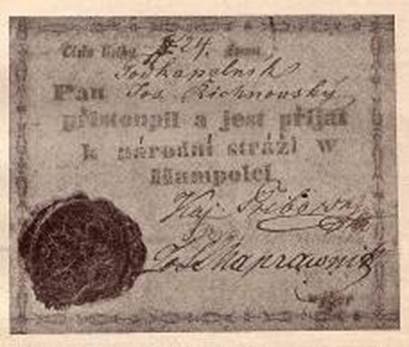
The card of
the member of the National Guard in Humpolec with the signature of Kajetán Příborsky
When they had considered all these
reasons they voted that on April 27 Humpolec’s National Guard would pulled out
their arms on Věž and there landowner Skrivanek, by hook or by crook, will be
talked out of his intention, and if necessary they would marched to Německý
Brod to stop the meeting and preclude incorrect decisions.
The
important decision was leaked, however, the same day by a financial officer in
Věž, but duly exaggerated. Humpolec’s
Guard is said to intend to kill landowner Skřivánek with his family and loot
and destroy his castle. The owner of the
estate called immediately his workers and told them what disaster awaits him. Tearfully he asked everyone not to abandon
him and defend his property. So the next
day they armed themselves with weapons, and also with axes, forceps, and
scythes. Skřivánek allegedly fled to
Německý Bord, and his wife and children reportedly sought protection in the
morning at the wayside cross in the fields.
(Tyl’s Prague Messenger stated: " The news reached Wěž, where they
were stunned, all items were bundled up and hid, as they thought that people
from Humpolec will be there soon"[106])
In
Humpolec on April 27 already at five o'clock in the morning the Guard drummed
to arms. They all gathered in large
numbers, but in the morning they were already in subdued mood, so it was
decided that it would not be practical for the guard to run into Věž and
Brod since this could bring bad consequences for the town. It was therefore decided to select only the
excellent speakers, and they were sent straight to Brod to the public meeting.
Then the town physician Dr. Štulc, an excellent speaker, James Smrčka and Jakub
Mottl, two classmates of Karel Havlíček, and six other members of the National
Guard (Kajetán Příbroský was not among them.) were elected, and they
immediately drove carriages toward Brod.
In Věž they were awaited by armed men who broke up peacefully when
instead of armed guards they saw only a few people.“[107]
Here we should add another version,
which, according to an eyewitness was reported by Věž’s chronicle: “In the year 1848 the Guard of Humpolec came
to Věž, the castle was besieged and attempted to be conquered. But when they rolled a few barrels of beer
out of the brewery there was a general reconciliation. Thus ended the memorable expedition of the
Guard of Humpolec and will long be remembered."
The
next events in Brod are described in another letter by Pater Seifert:
"Dear friend. ... And I want you to know that on the 27th - yesterday
there was a "Meeting" on the city square, where first Pankrác spoke
for the Association for Frankfurt and then Dr. Štulc from Humpolec in the name
of Humpolec people who are against it – they did not like to listen to him,
even though people called Bravo. Then
the Commandant of the Guard in the midst of his speaking shouted Garde
zusammen! and started to drum, and kept going until Štulc stopped talking. Pankrac also left, he could not endure to
hear the truth. Very strange things are
happening here. Humpolec’s people wanted
to attack Křivánek’s castle for his sending his opinion to the newspaper. Why are they threatning peaceful people. We were always last in everything. People from Polensko and Chotěboř sent word that they will not
participate ... I think there will be no more of such meetings. It would not take much and Pankrac would get
it, because he is not favorite among the people. Good Bye, Your old friend Charles.” It should be noted that the successful
attempts of Humpolec’s were completed the next day when an expedition of
farmers from Vez arrived in Humpolec and announced that they formed a section
of the National Guard, and that they are putting themselves under the command
of Humpolec.
On
a national scale, however, the whole event is obviously important: "...
The only success (for which, obviously, they were proud) the frankfurtomans
could pride themselves in the Czech region, namely the protest of Německý
Brod against the National Committee and their agreement with the election,
which took place on the 27th of April thanks to several renegades (attorney
Pankratz and land owner Kriwanek).”[108]
So,
after the failure of the election to the German assembly in Frankfurt an
election of deputies to the Czech assembly in Prague was held on June 13. Even though the deputies were elected, their
convocation was constantly postponed so that the Czech assembly never convened
again. On July 8 the election to the
Reichstag in Vienna was announced. The
Czechs decided to send candidates for this council. They did not want to give this up because
this was the one chance that remained, if they wanted to exercise their rights.
... The right to vote, was given to every citizen at least 25 years old, his
age had to be confirmed by the parish priest.
The Election was done through electors who were first elected in their
districts with 250 to 500 voters. The
Humpolec’s electoral district included the city of Humpolec and the estates of
Heralec, Želiv, Světlá, Lipnice, Větrný Jeníkov, Věž and part of Dolní
Královice so it had about 50,000 inhabitants.
For the election of the Reich deputies in Humpolec there assembled about
157 electors, of which 109 deputies voted for Karel Havlíček, then a
27-year-old editor of the Národní Noviny (National Newspaper). ... Humpolec’s
residents for a long time in advance tried to convince the voters, that a
candidate must be an educated man, faithful to the nation, unscathed, and
interpreted it so zealously that even Germans from Štoky ended up voting for
Havlíček.
That
same day (07.08.1848) JV Krajník wrote to Havlíček to Prague about the outcome
of the elections. We are printing here a
letter with the Krajník’s signature
"Kokořínský" probably chosen by the castle Kokořín from the
neighborhood of Krajník’s birthplace.
"Mr. Havel. I announce to you that you are elected by 109 votes in
Humpolec. All voters amounted to 157. Just now on the city square trumpets are
sounding in trades in your honor. I
advise you to accept this county election, because after you the one with the
most votes is Křivánek (and you know how he is), as he got 13 (votes) and after
him court counselor Karl Komrs has the most.
Theres is therefore a danger that if you do not accepted Křivánek could
easily become a deputy. Keep well, I am your faithful Kokořínský." In fact Havlíček had also been elected in
four other electoral districts. Havlíček
accepted the choice of Humpolec’s residents.
He represented Humpolec in the Reichstag in Vienna and then in the
Constitutional Assembly in Kroměříž until December. Twelve days after the
accession of a new emperor, on December 14, 1848, he resigned from the office
because the Kroměříž parliament, with his endless chattiness and non activity
was not to his liking and his national newspaper in his absence declined. Humpolec’s residents then chose on 17. 1.
1849 as the new Deputy Antonín Komrs, the economic advisor of Count Thun in
Libverda, a native of Humpolec.[109]" Here is a place to get ahead a little and
reveal that Komers, together with Krziwanek probably were not that far from
each other in their ideas; the marriage of their children later in the future
even made them relatives.
To
illustrate the atmosphere of the times we can add what else was said about Eduard
Kržiwánek, among others by the Tyl in The Pražský Posel, page 8 : "
... a few renegades from higher circles and some lords, as Křiwánek from Věž
... and other to him similar weasels (“ptáčci”) . " Or in Havlíček’s paper[110],
"This is a piece of parliamentary mastery especialy from two Lords :
landowner and citizen of Brod Skřiwánek
and from lawyer Pancras. The
other day Sřiwánek reportedly wrote an article to Prager Zeitung about the
expansion of the anarchy etc. do you understand that? I am not sure about that. Who would now at the current flood of
important matters be interested in small and obscured articles or even care
about them. " ... Or elsewhere : " Prague’s Committee could not wait
for the advice and opinion of the honorable authority of Kwětinov ( Kundrath )
and Věž ( Kržiwanek), and God willing that even in the future the Czech nation
can get by without the advice of Německý Brod, the Kwětinov and Věž. "
In 1849 Eduard Křiwánek was elected the
councilor of Nemecky Brod with 44 votes out of 84 candidates. Likewise, in 1850, as we know from his
brother-in law’s statement – the undersecretary of Governor Voith, who
presented the four new councilors on 20th June 1850 to all "bourgeoisie in
the council hall. After completion of
the introduction of the local committee the oath will be taken by the members
of the committee in the main temple of the Lord."[111]
By 1851 Eduard Křiwanek is an active member of the Patriotic Economic Society – k.k. patriotisch ökonomische - Gesellschaft in Königreiche Böhmen. The main character of this influential institution was, here already mentioned, Anton Emanuel Komers, to whom we will return even more extensively later on. The Economic Society was the founder of an agricultural school in Libverda, about which we will also talk in more detail.
Marie von Krziwanek (1834-1898) and JUDr. Eduard Brzorád (1820-1898)
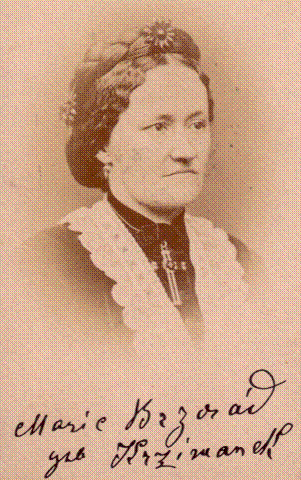
Marie Brzorádová born Edle von Krziwanek (1834-1898), Atelier von Geber Staegler, Elkergasse 128, Iglau [112]
In 1852 in the chapel of Věž, an eighteen year old daughter Marie Kržiwánková (1834-1898) married a 14 year older lawyer from Brod JUDr. Edward Brzorád (1820-1898). More details about this relationship will be mentioned in the relevant chapters of the Familie Brzorád chapter. Marie, because of her passion for aprons was later called "Schürzentante" in German = “apron Aunt”. After the wedding she moved into an imposing, sightly, two-storied corner house No. 105 in Dolní Street in Německý Brod. In the text by a descendant of her sister Hermina we read that "at Brzorád’s” in Německý Brod ... Erna and Herma often visited during the ballroom season. Oh, there is one very memorable with teacher Lorenz!"[113]
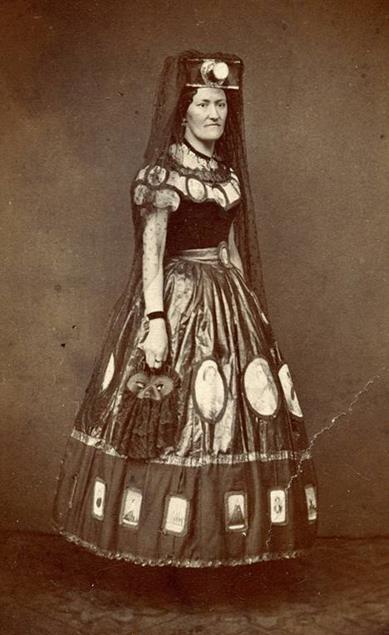
Marie
Brzorádová roz. von Krziwanek (1834-1898)[114]
Mary led an exemplary household with the help of a maid, a laundress, a manservant, etc. She was considered to be “a very noble and educated lady who came from the estate of Věž ... was for years a model of most noble virtues[115]." One obituary recalls her as “charitable woman, a dear lady, patriotic, good-hearted and humble”, the other as “the fairy godmother of all poor people in the city.”
Beautiful silver dessert cutlery, originally a part of a large set bears on the underside of the handle the initials "MK" in Gothic script. The fork measured 17 cm; the knife 20.5. Next to the silver hallmark there is a distinct numeral "2" (perhaps the last digits of the year of production) and on the front there is the maker’s label, ”MS.” From the type of the hallmark we can infer the production of the late 18th century up to the year 1867. The silverware was provided by the direct descendant of Věž’s Krziwaneks. If the "MK" monogram stands for Marie Krziwanek, it could belong to two people: the grandmother or her granddaughter. Marie Krziwanek born Seegenschmied (1771-1842) or Marie Brzorád born Krziwanek (1834-1898). The first one was Krziwanek from her wedding in 1785, the second only till her wedding in 1852.
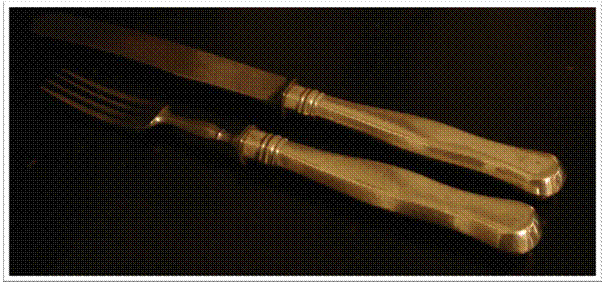
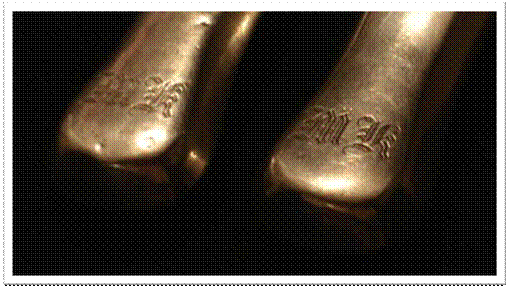

Another preserved item that came down in the family[116] is a bulky Album - a herbarium with drawings, clippings, photographs and German, or French handwritten quotes. As donors of the flowers are listed Hermine, sometimes "deine kleine Treue Irma", or Irmerl. Elsewhere is a note about the death of Ernestine. These suggests that the owner could be Marie Brzorádová née von Krziwanek. In the album there is also a nice group photo of the family Eduard von Krziwanek from before 1869. The quotes are on paper with embossing of the baronial crown and the letter "W" written in a castle of the Pachta family in Jablonné v Podještědí (in 1862). The content of the album also shows that the owner maintained a close relationship and visited with relatives in Libková Voda (1861) - namely, Hermine Komers von Lindenbach (* 1842) or Marie Irma (1844-1929), whose cousin was Julius Prziborski (1824-1905), since 1857 the husband of Hermine née von Krziwanek (1839-1908). A number of very nice colored drawings of neighboring domains, or birds were donated in about the years 1859-1860 by the neighbor from Květinov, who after graduating honed his skills in the management of the estate at his parents’ – William Rychly (1837-1904). Thus we now not only know how the now ruined castle in Mirošov looked, but also that they kept a nice parrot at the Věž’s castle.
Among the cited authors in the album are Baron Ernst von Feuchtersleben, Friedrich Martin von Bodenstedt, Friedrich Rückert, and Johann Gottfried Herder, Friedrich von Schiller, August Graf von Platen-Hallermünde, Freiherr Franz von Sonnenberg, Otto Graf von Loeben, William Shakespeare, Johann Wolfgang von Goethe, Heinrich Daniel Zschokke, Rognette and Otto Friedrich Wilhelm Waiblinger. Other parts bring excerpts with the following names: August Gottlieb Meißner, Julius Sturm, Theodor Storm, N., Johann Wolfgang von Goethe, R. Pruty, and more. There are images of Karlstein and Nový Stránov castle, reminders of Karlovy Vary, Mariánské Lázně and other locations.
The cover of theAlbum
of the family of Marie Brzorad born von Krziwanek (cca 20x30cm)[117]
Not as much for artistic or documentary value, but to get a better glimpse into the tastes and interests of the girls in the middle of the 19th century, we tried to provide access to the whole album. Due to the large volume of data it is placed on a special page: Album .
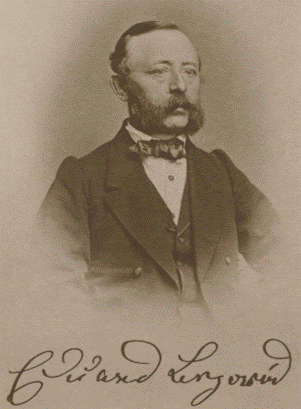
JUDr. Eduard
Brzorád (1820-1898)[118]
The Brzoráds family in this generation already used the German language in their social, professional, as well as family relations. However, we can say that their national feelings were still Czech. Eduard Brzorád’s father Josef Brzorád (1777-1857) was a contributor to the National Museum, one of founders of Matice Česká and a classmate and friend of Josef Jungmann[119]; his uncle JUDr. et PhDr. Jan Filip Brzorád (1765-1851) a member of the National Committee of 1848; his brothers Karel and William friends of the national revivalists and members of the revolutionary year 1848 prof. Helcelet[120] and philosopher Hanuš[121]. His cousin Antonín Brzorád (1809-1877), the Nymburk mayor hosted and later became a benefactor of Božena Němcová[122]. At the same time we know that Edward Brzorád was a loyal Austrian, because he was even awarded the imperial order of Franz Joseph II. And yet it was in his family where JUDr. Eduard Brzorád jr. and his sisters grew up as ardent Czech nationalists. The whole fourth chapter - "Familie Brzorád" is dedicated to the Brzorád family.
Oil factory and the Krziwaneks in Brixen
In 1853 an oil press factory was founded by Eduard Krziwanek with his partner František K. Havlíček (1823-1912), brother of Karel Havlíček Borovský and gentlemen Grünhof and Richlý, in Květinov near Německý Brod. We learn a lot about this enterprise in the correspondence[123] between Francis Havlíček and his brother Karel, who was then in exile in Brixen. More about the role of Edward Krziwanek’s brother in law, Ferdinand Baron Voith von Sterbetz, who arrested Havlíček in Brod on the way to Brixen, and who was probably close to Havlíček is found in the chapter about the family Herites. In the letters from Brixen’s isolation Havlíček wrote basically about two main themes - beekeeping and about his brother's company - the oil factory. That is why the correspondence of Havlíček’s letters from that time, collected by Zelený, is rather tedious reading. But not for the lovers of bees, and for those of us who are interested in the oil press factory and are interested in the comments about Eduard Krziwanek. In the letters we find a note on how Krziwanek stopped in Brixen to visit Havlíček. Karel Havlíček urged his brother to be cautious - in cooperation with Skřivánek. Brother František, however, as we read at the end, regarded Skřivánek as the most reliable partner.
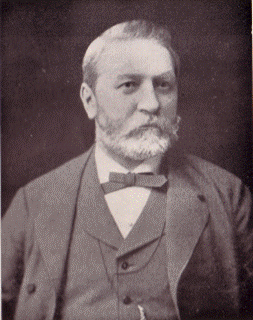
František
Havlíček, brother of K. H. Borovský[124]
From the correspondence (with one exception) only the letters by Karel Havlíček were preserved, so we do not know the answers and we do not know to what he is responding. We selected interesting comments that refer to Eduard Skřivánek. The direct reference to Křivánek is in bold letters for better orientation:
"The change in your business would not have be to the worse; only, doesn’t Skrivanek have anything on his mind? ... to place the factory would be safer than in Věž where there are more opportunities for “leftovers”. I also think they will need you, alright and that you need not to worry about being got rid of. ... If Skrivanek gives his half for the machines, you will need a lot less capital. "(14/03/1853 Brixen)
"... Concerning your factory I do not think that you have erred with Květinov; first of all, I'm kind of glad it escaped from the hands of Mr. Skrivanek and secondly it is better that it is closer to Brod ..." (March 31, 1853 Brixen)
„I have to announce to you that Věž’s[125] dropped in here with the whole family. That day, however, I had a singular accident and it has been the second one this year already. Since spring this year only twice it happened to me that someone from Bohemia was here, and each time I was not at home. There is about an hour away from our little apartment a brewery cellar in the rock, where we often go with Julie and Zdenka in the afternoon, and when someone new happens to be there (because it is the most excellent exit from Brixen) we stay there a little longer with them. With the locals there is very little to talk about. ... The second time, there were Bavarians here and also we were long delayed and at that time Věž’s Skřivanek was at my place; but because he just happened to come when they were here for wine (as the cottage has a cellar of the innkeeper) he could go up and hung his visiting card on the doorknob of my room. Especially because now in the summer when we come home late I do not go to my room, but we go straight to sleep, and I would not have learned about it until the next morning. But it happened that in the brewery we were arguing about the economy, and I said that in England they already fatten a pig for 12 cents.[126] - Julie opposed to it. When I was already undressed, I remembered it, and I went into my room for a book to convince her. There I found the visiting card - (what a coincidence! Věž’s is just as powerful in raising pigs…), so I quickly dressed again and went to Elefant. But they had just gone into their room and as the ladies were present I could not have been visiting them that late. To my chagrin, I learned that they had been there all afternoon and were leaving in the morning about 5.30 am. Yet I did not fail, at least in the morning to come to the coach but I hardly talked to him. (Do not tell him about the pig, he would probably think it to be a bad joke.) ... "(June 13, 1853 Brixen)
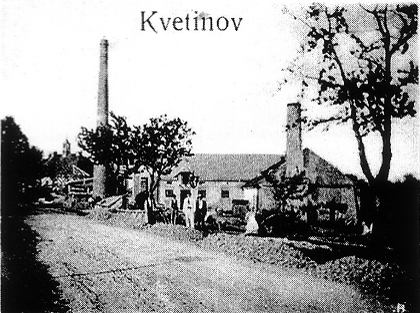
The place of
former Oil press factory in a postcard published by Gustav Jílovsky in Prague
in 1915
“… Do not – together with Mr. Krziwanek- intrigue against other companions in any way; I myself think that they will not be any bother, and that all will go as you two wish. "(07/01/1854 Brixen)
"... I'm surprised that the last year you had such bad results in the factory! 5 measurements per cent of rapeseed oil! It is not necessary to set up the factories as any miller can do that. So Mr. Božek nicely tricked you all... Because of the factory I wish I could be there, because then both of us could supervise - the 4 eyes see more, and I would be really pleased.” (11/25/1854 Brixen)
At the end of the letter sent to Brixen by brother Francis, which is not included in Havlíček’s published correspondence, we read:
„In the factory we make great dealings this year. At the current price of oil we all earn cleanly over 100 gulden of silver per day. ... All gentleman, I think 3 others are starting to appreciate the factory (only now they are beginning) and Křiwanek only regrets that we included them in our business, that he does not care that his benefit could have been so much greater at present, but rather the fact that they are causing many obstacles to our even more outstanding progress. This year if we had listened to Křiwánek, we could have had not a few hundred but a few thousand in our pockets. But I take it also from the other side, I would have obeyed him there, only had he been holding a bag of money in his other hand... Grünhof intends to emigrate to Hungary, then buy there a larger farm. As Křiwanek told me he has a buyer for his share of the factory, Jeníkov’s Baron is giving him 10,000 in silver but he wants 15 000. Imagine dear brother! This is a joke. He alone contributed only 2 000 and last year's earnings amounts only to about 500 silver. But I can honestly say that I would give this money, if that coward did it. Imagine, a guy who could best support the factory financially but does nothing, and is always in the way with his impracticality. My greatest happiness would have been if I had listened to Křiwánek and had run the business with him only; we could have started in small, and we could have been way ahead by now. My plan about taking on a business was famous, I'm proud of it in front of the worldwide; imagine in 10 years the machines will not cost us any money, money with all the interest will be back in our pocket, and God willing there will be more capital. If God gives us health in 10 years we will still not be that old, we still can start something together so your Zdenčinka, if nothing better happens by then, also has some pennies. Only health and good friendship and nothing else, dear brother, we will miss. ... "(František Havlíček, brother of KH Borovský, Deutsch Brod 10/12/1854 - Brixen 16.12.154 (PNP fund KHB)
The business partner “Rychly”, was probably Josef Richly (1804-1872)[127], lord of Mirošov. "Grünhof" who "intends to emigrate to Hungary, and wants to give up his part of the business" was Eduard Fučikovky Knight von Grünhof from Zelený Dvůr (1814-1891), a member of the Provincial Assembly, a businessman in the glass industry and owner of the estate Úsobí. The Květinov estate at that time (1852-1865) belonged to Prokop Richly (1806-1879), brother of Mirošov landowner Joseph Richly. This oil factory was located in the no. 32 and 41 plat, which was called an oil factory for a long time, because there was processed linseed from Květinov, Věž and Úsobí’s estates.[128] Both of these businesses were short-lived as the main organizer Havlíček was harmed in his commercial business by the government, probably because of his famous brother, and on 27 January 1860 František Havlíček accepted the post of clerk in Prague.”[129] After 1860 the factory was cancelled and part of it (No. 32) adjusted to become a blacksmith forge.[130] We learn about the families Richlý and von Grünhof in more detail in the books by Jiří Bořecký[131]
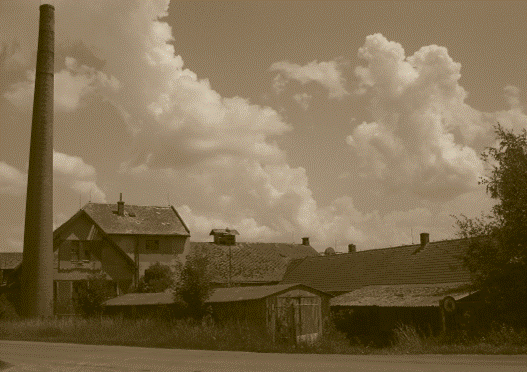
Oil press
factory in Květinov, as standing in 2006
Apart from a certain social isolation, Havlíček in Brixen did not materially suffer; his correspondence there offers some remarkable insights. Because it otherwise does not relate to this work we could cite just one example of Havlíček’s approach to education, which must have bewildered his brother's wife. After returning from Brixen, he lived in Brod at his brother František’s and was ready to punish their children. "Anyway, it never harms to be more strict with children, as long as one shows them his love but does not just torture them for his own entertainment. So for example in our household when Zdenka gets a beating from me, only, when it is needed (but my rule is: hardly ever, never in anger, but always till the blood draws, so it keeps longer in her memory) and she likes me all the same so much as she likes Julia, maybe even more."[132]
In 1856 Edward and Caroline Krziwanek celebrated their silver wedding in the family circle in the castle Věž, as his daughter Marie wrote in the Blue Memory Book.
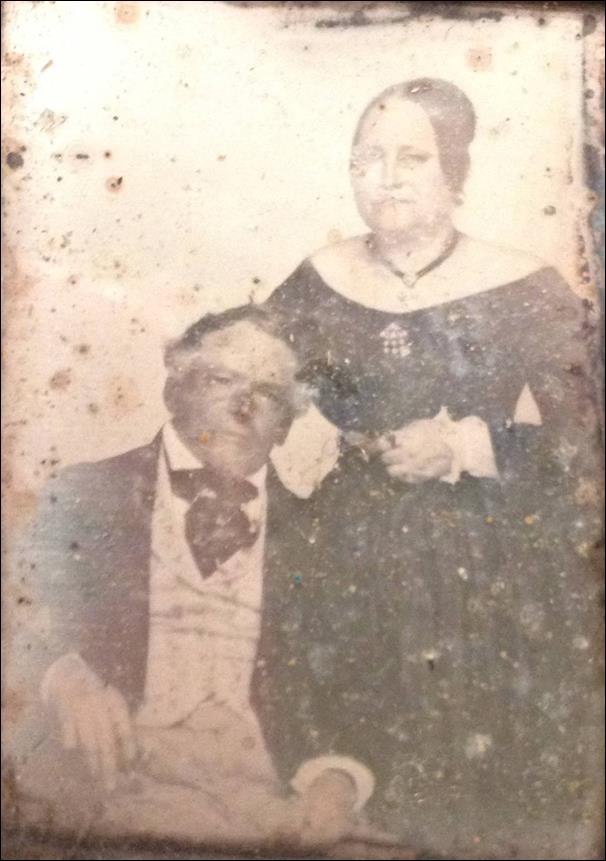
Eduard
Krziwanek with wife Caroline née von Herites, probably between years 1852-1866[133]
Visiting
card of Eduard Křivánek (today’s common size, archive of Frána)
Visiting
card of "CAROLINE KRZIVANEK NÉE BARONNE DE HERITES" (archive of
Frána)
The following year, in 1857 in Věž Hermine’s daughter Barbara (1839-1908) married Julius Příborský (1824-1905), an agricultural director in Peruc. The wedding is recalled by one of her great-nieces: "Julius's wife was a lady of noble and generous ways and manners. They married in the same year as my grandfather and grandmother, but certainly much more luxurious. On a long, long wedding table there was a row of - sugar cones, covered with flower blooms. This decoration was procured by newly established sugar refinery in Most, with which Julius was associated.”[134]
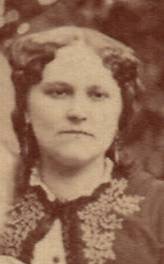
Hermine
Prziborski born Edle von Krziwanek (1839-1908), cutout from around year 1865
The Příborský family was among the major Humpolec’s cloth makers; the groom's father Kajetán was the mayor and in 1848 Humpolec’s commander of the National Guard. Hard to say whether Eduard Krziwanek would have given his daughter to wealthy draper Příborsky back in the revolutionary year of 1848. Kajetán Příborský had clearly defended the economic interests of Humpolec’s drapers, who would have been harmed by the customs union with Germany, praised by Krziwanek as stated above. The wedding witness was "Onkel Toni" the groom's uncle, her mother's brother, the economist AE Komers (1814-1893), the director of the agricultural college, the leader of the Patriotic-Economic Society of the Kingdom of Bohemia, Central Director of the estates of Count Thun and Count Chotek and a leading expert on the sugar industry. We may add that Komers and his brothers, barons von Lindenbach (one was a sectional chief of the War Department, the second Minister of Justice) were the sons of Humpolec’s once wealthy draper and cotton merchant.
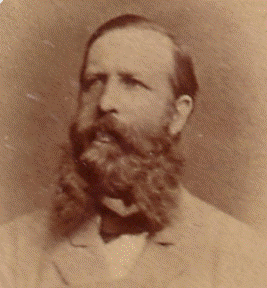
Julius Přiborský (1824-1905)
Groom Julius Příborský due to his successful uncle and teacher AE Komers became not only his deputy at the agricultural college and the inspector of Komer’s estates in Most and Lžín, but most importantly the economic director of the Thun estate in Peruc and then the central director of the estates of Prince Thun-Hohenstein, or those of Count Chotek in Veltrusy.
It seems that the reason for the choice of the groom was his origin in Humpolec’s drapers the families of Příborský and Komers. To the families of Hermine and Julius Příborský and AE Knight von Komers we will come back in more detail in sections Familie Příborský and Familie Komers below. Partly, because the marriage of their children will connect them, but also because it was their offspring who adopted the family name Herites. Additionally while Julius Příborský as an economist became a worthy successor to the brilliant agricultural economist Křivánek, Hermina and her children were those who insisted on defending the German element. First, however, let us finish the story of the parents - Edward and Caroline Krziwanek and remaining siblings - Edward and Ernestine.
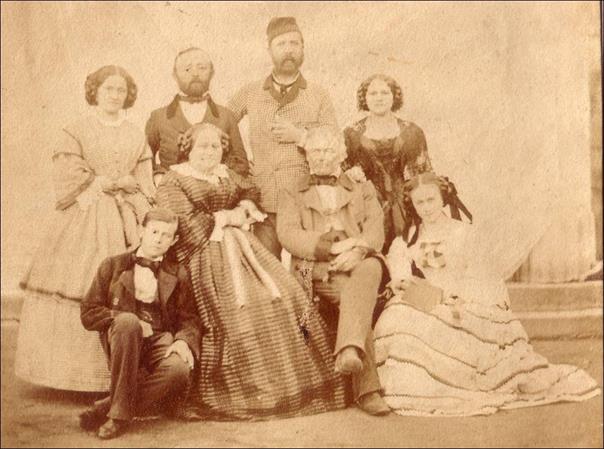
This photograph of the family of Věž’s Křivánek was inserted in the album. We can see Eduard Brzorád (standing second from left) and also Julius Prziborski in a comic cap, who is noticeably towering above them. Ernestina (seated far right) was at her wedding in 1868, eighteen years old, and because her future husband Karl von Kutschera is missing here, this picture seems a little younger. Here we also see Edward Krzivanek the younger. (magnification of the size of about 7x7cm)
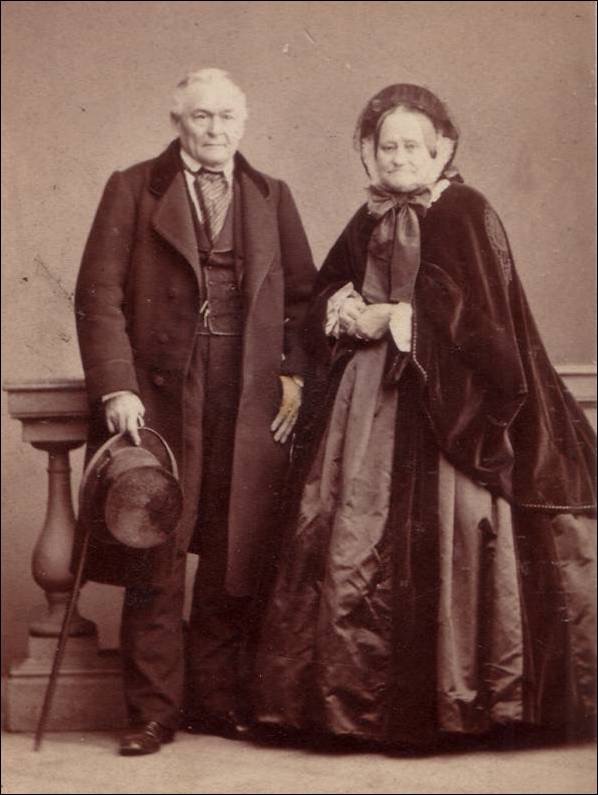
Eduard Edler von Krziwanek and Karoline in the ateliér of Winter, year 1862 (Frána’s archive)
Julius Příborský’s grandniece dedicated this note to the life at the castle of Věž and shared her memory : " A lot of guests, arriving in winter sleighs always gathered at the castle Věž near Německý Brod at the Krziwáneks.[135] Taking off their fur coats, scarves, foot-warmers and slippers; it was all carried away by an assistant to a special chamber; the assistant had only stumps instead of hands, but reportedly he quickly and skillfully cleaned and organized everything. "[136]
Another long and faithful servant of Věž’s castle was Anna, who had a very good mutual relationship to the local nobility. It is clear from the text of a letter to Mary Brzorádová born Krziwanek as well as from her last will, she wrote at the age of 74.[137]
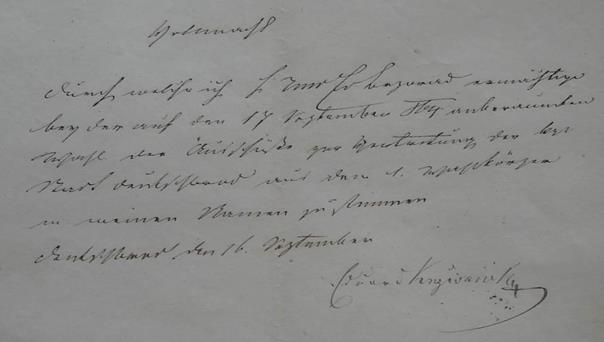
Autograph of the procuration from Eduard Krziwanek to Edward Brzorád for the elections to the municipal council in the year 1861[138]
The contacts of the Krziwanek’s with the Richlý’s family are (apart from the Květenov’s oil press company) also documented in the album of the offsprings of Marie Krziwanek, where there are color drawings of birds as well as those of the neighboring estates by Wilhelm Richly. Thanks to the drawing of a parrot and an attached note, for example, we learn a new detail about the interior of Věž’s castle. Although dating is harder to read (about "1859"), the word " Wěž" is obvious.

A parrot by Wilhelm Richlý, dated 1859 in Wěž
Furthermore, in the album cut and pasted on single sheet are three colored little drawings of the estates nearby Věž. What they have all in common is the owner from the Richlý family. This family owned estates Mirošov, Květinov and Kvasetice. Below the drawing of květinov there is a signature of a later Lord of Mirošov "Wilhelm Richly ' a not clear date "05.28.18?9" .

Castle Mirošov (District Jihlava), demolished in the year 1986
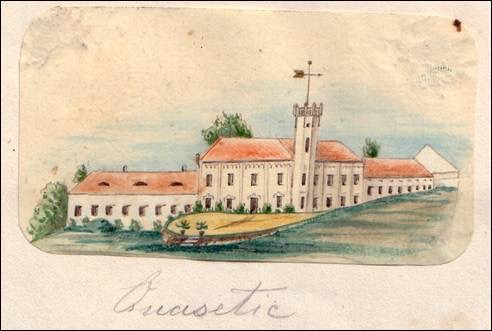
Castle Kvasetice, village Květinov, district Havlíčkův Brod, today a ruin
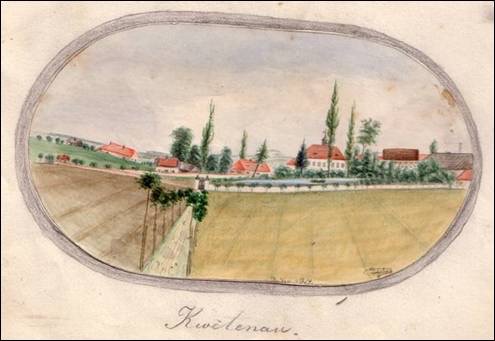
Květinov
Another
drawing by William Richlý has a well -read dating : “Wilím Richly , Kwětinau”
24 January 1860.
A bird signed by William Richlý
Birds signed by William Richlý
William Richly[139] (1837-1904) painted the pictures at the time of conclusion of the cooperation of his uncle and his father at Květinov’s oil factory in the years 1859-1860, when after graduation he returned to Květinov, so here he could perfect his skills in his future management and administration of the estate. William's niece Berta Bártová née Schmidt (1872-1963), who lived at the castle in Věž after 1945 was a painter too.[140]

Vilém Richlý (1837-1904)[141]
The
spa guestlist Karlsbader Curliste Nr.35 of 10th June 1861 announced the arrival of the Krziwaneks on Thursday 6th
June: „Herr Eduard Křivanek,
Gutsbesitzer mit Gemalin und Fräulein Tochter Ernestine aus Věž in
Böhmen“ They stayed in „Gold. Löwe,
Egerstr.“ There were 4 persons
altogether.
In the years 1861-1869 Eduard Krziwanek was a member of the Provincial Assembly of the Czech Kingdom. Elected on 27.3.1861 and also 26 – 28. March 1867 as a landowner to represent the fully owned estate (allod) holders.[142]
The Národní Listy newspaper from March 16, 1867 on page 3 reports on a meeting of mayors of the district in Německý Brod, where Eduard Křivánek and JUDr. Eduard Brzorád, were introduced as candidates to the assembly about whom " we learn about his way of thinking and ideas."
“Letters. From Německý Brod, on 9 March. (Agitation before election).
This day representatives and mayors belonging to the local election district have gathered here invited by the royal and imperial district office. The purpose of this meeting was for the mayors to learn that in the upcoming elections to the parliament it will not be as in the past when the election was directed by the imperial offices, but it will be the resolution of voters themselves, whom they want to choose to take on the election’s management.
On that occasion, however, the men suggested received the trust of the opposing side but not of national parties. - The Apostles appeared at this meeting appointed to convert the people of the country to another belief; we must, however, admit that we expected that the opposing party (if the handful of enemies who is to be found in our district can be called so) will lead other armor-bearer into the battle, than the ones we met.
In fact, mayors David and Isak and Josef Kraus of Lípa appeared before the assembled and began to speak in this sense: Dear citizens, you know that we used to have as our representative in parliament, Mr. Zeleny; this time, however, we will no longer vote for him because he adheres too strongly to the Czech crown, for which he had already received an appropriate reprimand from the very district council (that is, from the mayor and Mr. secretary). We will, therefore, vote not for him any more. - But I recommend a man of great merit of our dear homeland instead. He is a settled down man, born and raised among us. His heart is burning with love for us Czechs, on each occasion he vigorously advocated for us. This man is Mr. Ed. Křivánek, owner of the farm Věž. (Former member of parliament representing the Prince Karl Auersperg landlords’s party, and now again by this party nominated. - original note of the editor). Mr. Kraus undoubtedly saw on the faces of those present, that he had not appointed a darling of our people, or perhaps his own conscience told him not to play the role as praiseworthy so he just added, "but, if you did not have enough confidence in Mr. Křivanek, I will suggest for you to vote for Mr. Schwarzl or JUDr. Ed. Brzorád, but please do not vote for Mr. Zelený.
Although none of the people present said anything, Mr. Kraus could tell from their faces that it will be Mr Křivánek who will be selected, for otherwise it could not be, since Mr. Křivánek has such a powerful protector.
But for what we are especially thankful to Mr. Kraus is, that he told us of the thinking of Dr. Brzorád; we never considered him our sincere fellow citizen, but we have never thought he would let Mr. Kraus nominate him a candidate for parliament especially at a time when such candidature suggests evident direction of political nature, to which the nominee is inclined - But no matter how certain gentlemen stand on their heads, let them consider us villagers to be so short-sighted who can be fooled.
The outcome of elections will show a common sense which we thank God still have, when it comes to a matter so important and so we again elect our former deputy Mr. Zelený.”[143]
Until 1866 E. K. was at the provincial council with his brother-in-law baron Ferdinand Voith von Sterbez and in the years 1866-7 with a landowner in Lžín Antonín Komers. We find a mention about E. K. in the stenographic protocol from 1861, when he wanted to present a draft law on land consolidation with regard to drainage. This point, however, was postponed. It came on the agenda of a sitting two days later on 21 April 1861, however, when he first submitted a proposal for the adoption of a supplementary section of the Act that would allow exemptions (Befreiung) for farmers' sons who attended agricultural school and completed it excellently. Here we might mention that in 1860 Julius Příborský worked as a director of an agricultural school in Libverda and since 1861 as an executive deputy.[144] It should be added that it was in the years 1861-2 that Eduard Carl Edler Křivánek *1844 attended the higher level (Höhere Abtheilung) of Libverda agricultural school. Also the son of AE Komers, Emanuel (1873-4), Julius's younger brother Karl (1853-4), and their nephew Julius Jelinek (1866-7) studied there.[145]
Eduard Krziwanek was a member of the Imperial Council of Austrian Parliament in the years 1863-1866.[146]
According to the „Liste der angekommenen Kur- und Badegäste in der königl. Stadt Kaiser-Karlsbad“ from June 23, 1865 20th of this month Krziwanek Caroline, the wife of a landowner from Věž with daughter, and Mrs. Marie Brzorad, wife of lawyer and notary of Německý Brod arrived in Carlsbad. Their place of stay is listed as, "Rubin, Kreuzg."[147]
In Pražský denník (The Prague daily) in its issue of October 27, 1866 on pages 2 and 3, amongst other honored they published not only the name of Eduard Brzorád, as we already know, but also local mayor of Věž Edward Křivánek:
"His Majesty with his own handwritten memorandum in 26 of October of this year, in recognition of loyalty, especially for the cause of recent events of war, proven excellent in the Czech Kingdom and the Czech capital city of Prague, and in recognition of the abundant acts of patriotism, loving fellowship and genuine affection, showed to wounded and ill soldiers, , as well as in recognition of universal governmental support, as well as of the operations of the army, graciously granted the following awards: Knight Commander's Cross of Fr. Jos. ... Knight's Cross of.,... Golden Cross of Merit with a crown ... Golden Cross of Merit, Silver Cross of Merit ... the crown ... Silver Cross of Merit, the Highest Expression of Satisfaction: ... Christiana Princess Colloredo; ... Ferdinand Menčík in Německý Brod; ... Eduard Brzorad, a municipal councilor in Německý Brod; Vojtěch Weidenhöfer, a municipal councilor in Německý Brod; ... Eduard Křivánek, the local mayor in Věž;… “
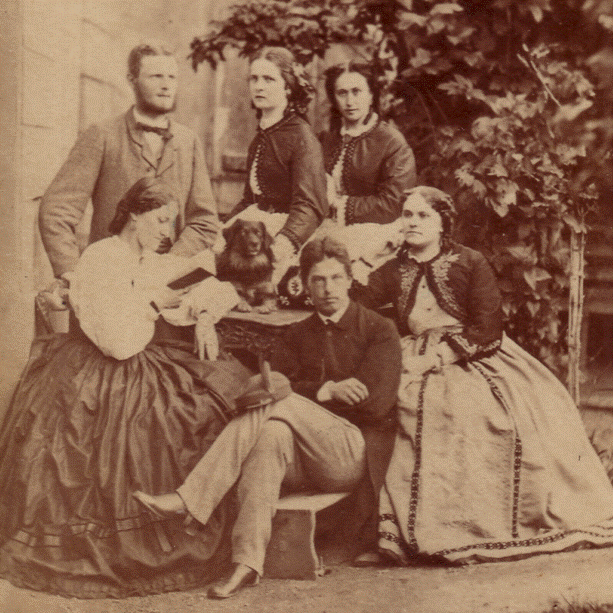
The Křiváneks around 1865. Standing from left : ( ? ) ( ? ), Erna , seated from left: Mary, Karl Baron Kutschera , Hermine[148]
December 24, 1868 at 17:00 in the chapel of Věž, the last daughter - Ernestine Krziwanek (1840-1877) married Karl Baron von Kutschera (1836-1890), 73rd Infantry Regiment captain. Charles's mother was the girlfriend of Caroline "Freundin Jenny," and he was baptized in a family baptismal clothes (Taufzeug) of Carolina. The friendship of Caroline Krziwanek born Baronin von Herites and Johanna Baronin von Kutschera née Countess Pachta and Baroness of Rájov (Pachta whose family estates Bezno were adjacent to Stránov, and Gabel, Czech Jablonné v Podještědí) turned into a relationship now. The wedding announcement that has been preserved in the archives of the National Museum, was sent to “Madame le Baronne Helene Trauttenberg née Comtesse Pachta”. After Jenny and the wives of Count Mirbach, Aloisie and Matilda, Helene was the last of the sisters née Pachta whom we have not mentioned in this work yet.[149] It remains to add that their brother Francis Count Pachta of Rájov (1814-1886) was Ernestine and Karl von Kutschera’s witness at the wedding. The last sibling of the family of Count Pachta from Bezno is Robert (1817-1895), whose descendants live in Germany and Austria today.[150] We will return to the family von Kutschera further below.
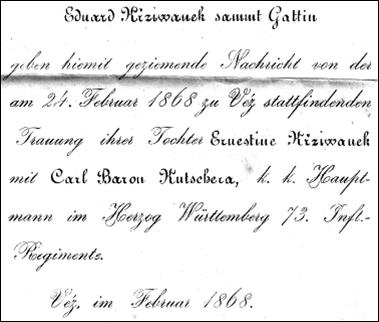
The
wedding announcement, Frána’s archive
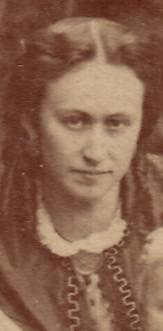
Ernestine Baroness von Kutschera bron Krziwanek (180-1877), around the year 1865, cut out
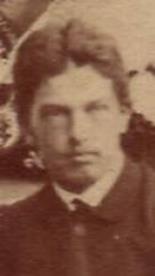
Carl Freiherr von Kutschera (1836-1890), about 1865, cut out
Ennoblement
25.
4. 1869, Wiener Zeitung readers
could read in reports by the court office that His Imperial and Royal Apostolic
Majesty by the supreme decision of 22. April of that year deigned to elevate a
landowner Edward Křiwanek to the noble class in recognition of meritorious
patriotic and society beneficial services without tax.” The report was also released in Prague daily:
“Pražský denník”.[151] His daughter Mary ,made a note about that in
her Blue Memory Book, which says that her father was promoted without asking
for it (Ohne eigene Bewerbung erhoben).
Perhaps she wanted to emphasize that her father was not the bearer of
any orders. Investment of some orders
carried an Imperial patent of nobility but their winner - the candidate had to
ask for it.
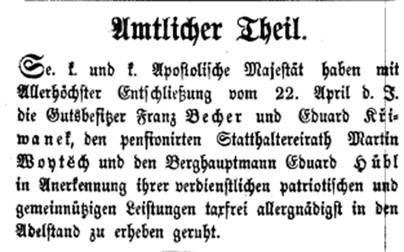
Ennoblement
in Wiener Zeitung from 25. 4. 1869
Ennoblement is confirmed by Karl Friedrich von Frank zu Döfering in his list of ennobled persons Alt-Österreichisches Adels-Lexikon.[152] (Contrary to other contemporary almanacs and schematisms.) The copy of the ennoblement charter, however, according to the staff of Unit 2, SUA in Prague is not located there. Equally unfortunate news was the statement by the director of the Vienna Österreichisches Staatsarchiv Allgemeines Verwaltungsarchiv. A copy of this "Adelsdiplom" was unexpectedly preserved in the annals of the village Věž, although it was started up by the faithful chronicler as late as the year 1888. The chronicle is now stored in the archive SOkA Havlíčkův Brod. Dr. Jan Županič provided an official heading conspectus: "1869 October, Vienna (Wien), Emperor Franz Joseph I. elevates by the supreme decision of April 22, 1869 Edward Krziwánek, landowner in Bohemia, in recognition of his charitable and humanitarian activities to the nobility, awarded him a coat of arms, a predicate “von” and a honorary title “Edler”."
“Wir Franz Joseph
Der Erste von Gottes Gnaden Kaiser von Österreich,
apostolischer König
von Ungarn, König von Böhmen etc.etc. haben nachdem Uns zur Kenntnisz gebracht
wurde,
dasz Unser lieber
und getreuer Eduard Krziwánek in Jahre 1799 in Iglau geboren,
Gutsbesitzer in
Böhmen, sich durch seine Wirksamkeit zur Förderung des National-Wohlstandes,
sowie durch sein
gemeinnütziges und humanitäres Wirken im
Allgemeinen
hervorragende Verdienste envorben hat,
Uns in unserer
kaiserlichen und königlichen Machtvollkommenheit bewogen gefunden,
mit unserer
kaiserlichen Entschlieszung vom 22.April 1869 ihm sammt seinen ehelichen
Nachkommen
den Adelstand
zu verleihen,
demselben die Führung des Ehrenwortes
“Edler”
zu bewilligen und
zugestatten, dasz Derselbe, sowie seine ehelichen nachkommen sich der hach dem
Gesetze
mit dem Adelstande
verbundenen Rechte erfreuen und insbesondere sich des nachstehenden
beschriebenen Wappens bedienen dürfen als:
Im blauen Schilde, welchen
ein silberner Querbalken durchzieht, ein
Thurm aus rötlichem Quaderstein mit schwarzen Thor und zwei Fenstern überdiesem
nebeneinander stehend auf einem aus Fuszrande
aufsteigenden goldenen Dreiberge, auf
der mitleren der drei Thurm ziennen steht eine zum Fluge geschickte
natürliche Lerche mit einer schrägrechts geneigten goldenen Kornähre im
Schnabel. Auf dem Hauptrande des Schildes ruhet ein gekrönter Turmierhelm, von welchem blaue mit
Silber unterlegte Decken herabhangen. Die Helmkrone tragt einen geschlossenen,
blauen, von einem silbernen Querbalken durchzogenen Adlerflug, welchem drei
goldene Kornähren an blätterigen Halmen entwachsen.
Zur Beurkundung
desen haben Wir gegenwärtiges Diplom mit unserem kaiserlichen Namen eigenhändig
uterzeichnet, und Unser kaiserliches Majestatssiegel beifügen lassen.
Gegeben und
ausgefertigetmittelst Unseres lieben und getreuen Ministers des Innern Dr.Carl
Giskra, Ritters Unseres Ordens des Eisernen Krone, erster Klasse, Ritters
Unseres Leopold Ordens etc.
In Unserer
Reichs-Haupt und Residentzstadt Wien, am fünften Oktober des Jahres: Ein
Thausend acht Hundert neun sechzig
Franz Joseph m.p.
Der Minister:
Dr.Carl Giskra, m.p.
Nach Einer
Kaiserlichen und königlichen Apostolischen majestät Hochsteigenem Befehle
Adolf Ritter von
Chaloupka m.p.
k.k.Ministerialrath.”
From
this copy of the ennoblement charter, whose original Věž’s chronicler
probably borrowed from Edward Krziwanek the younger (1844-1896) in 1888, we
learn that the noble title "Adelstand", honorary title nobleman
"Edler" was bestowed by emperor on the revered and loyal Edward
Krziwanek, born in 1799 in Jihlava, a landlord in Bohemia landlords. This was in merit for his strong support of
national welfare, as well as the nonprofit and charitable activities in
connection with the general tasks resulting from them. The title belonged also to all his legitimate
descendants. His wife seemed not to be
included and we know the title was not used in her death notice. It was apparently used on her grave ledger,
though.[153]
All
three daughters were already married at that time, so at first glance the
ennoblement did not concern them since a woman assumes the status from
her husband at her marriage. Ernestine,
however, became a Baroness and Hermine’s descendants reached the nobility
status too, so the Krziwanek name later appears in some of the nobility
almanacs, where they are listed as born "Edlen von Krziwanek.”[154] Even with Marie the title (von) was used on
her death notice, which gives the Czech variant "rozená ze
Křivánku". Here we should bear in
mind, for example, that for admission to a noble institution (E.g.
Damenstifts), or for appointment to certain offices proving the origin from 16,
or 32 noble ancestors was required. Let
us also mention a little known fact that not only the unauthorized use but also
non-use of the title and the coat of arms in official contacts and official
documents was illegal. This included
even the tombstones.[155] The title can also still be seen today on the
grave of Edward Křivánek the younger.
Under the nobility charter Eduard nobleman Křivánek (Edler von
Krziwánek) and his legitimate descendants could use a coat of arms. Against the background of a blue shield,
through which a bar passes, we see a tower (“Věž”) of reddish stone blocks with
a black gate, two windows and three merlons. It stands on three golden triple
hills. There is a lark (“Skřivánek”)
standing on the center merlon on the tower.
It is shown in natural colors with a golden rye cob, slanted to the
right, being held in its beak. The main
shield consists of a crowned tournament helm, from which blue and silver backed
covers hang. The crown on the helm bears
closed blue eagle's wings through which a silver crossbar passes; from the
wings to three golden ears of corn on the stalk full of leaves which are
growing.
Thus
in the coat of arms we see the surname of the nobleman (lark = skřivan), the
estate’s name (tower = Věž) as well as the field in which Eduard Krziwanek
worked (ears - agriculture). Because
there is only one crest helm, it is clear that it is a coat of arms of the
lowest rank nobleman “Edler”.
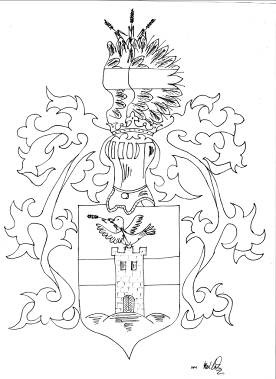
An
illustrative sketch by Onřej von Mrzilek 2006
ALMANACH
ČESKÝCH ŠLECHTICKÝCH A RYTÍŘSKÝCH RODŮ 2010 (CZECH ALMANACH FOR NOBLE AND
KNIGHT FAMILIES 2010) by Karel Vavřínek and his team brought an entry
"Křivánek" in which we find the representation of the coat of arms by
Ing. Arch. Miroslav Sýkora. In this edition, we also find the entry
"Heyrovský of Rowenov" which thanks to the relationship to Nobel
Prize winner Jaroslav Heyrovsky the line of JUDr. Leopold Heyrovsky and Clara
Hanl von Kirchtreu is stated. Other related
entries in this edition are "Neupauer" (The buyer of Nový Stránov
after von Herites) and "Sebenář von Herrenfels" (postmaster and owner
of the home in Německý Brod, where von Herites moved).[156]
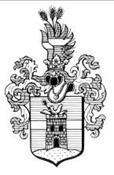
Von
Krziwanek’s coat of arms[157]
The activeness of Edward Krziwanek did not slack off after the ennoblement. In 1869 we find him on the voters list of the municipal council along with honorary citizens Ferdinand Voith von Sterbez, or Edward Brzorád.
From
Schematism for 1870, we know that on
his farm, where a distillery was in operation, Eduard Krziwanek had an
administrator and an “adjutant”.
"In
the country’s Chabrus elections in
Bohemia 22. April 1872, in the landowning
curia, along with the Conservative Party the following members
abstained from voting:
Brzorád Jozef, Chlum, Vidovice; or Komers Antonín and Marie, Lžín, Mostov. Conversely, for the candidates
of the winning party, which supported a centralist, pro-Viennese direction of Cisleithanian
political development the following members voted: Komers Jaroslav Emanuel and
Marie Barons von Lindenbach, Lipková Voda, Vlasenice; Krivánek Edward, Edler,
Věž; Kučerová Johanna Baroness, Madam, Pachta Wilhelmine, Countess,
Trauttenberg Helena, Baroness, Pachta František and Robert, Counts, Bezno;
Karel Ludvík Kučera, Baron, Čelín; Pankrác František, JUDr., Chranšovice,
Chřáštany."(Národní Listy, April 23, 1872)[158]
Thus, with the elimination of a Czech federalist majority the political system
of monarchy after the upheavals of the late '60s and' 70s has stabilized and
the Czech constitutional aspirations were rejected.
At least in the years 1874-6 Eduard Krziwanek was a member of the provincial government subcommittee to organize a land tax in Chrudim. (Another member of the committee was, for example, Count Rudolf Chotek, close to AE Komers and Julius Prziborsky.)
In
January 1876 Eduard Krziwanek
together with his wife Caroline act as godparents at his granddaughter Anna
Brzorádova’s baptism, which took place in Německý Brod, in the Brzoráds home.
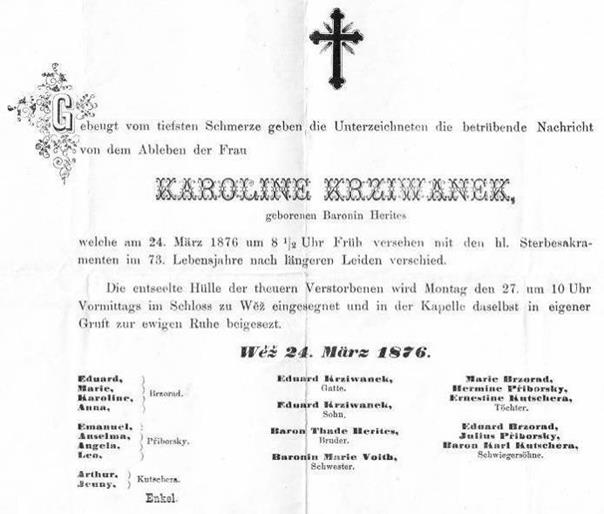
The death notice of Karoline Krziwanek born Baronin von Herites, Druk A. Riedl in Deutschbrod
(Let’s
notice the missing noble title with both Krziwaneks)
In
March 1876 Krziwanek Caroline, née
Baronin von Herites dies and is buried in the chapel in Věž. In June her husband Eduard Edler von
Krziwanek died and is buried next to his mistress (wife). The obituary is sent to Countess Natalie
Wratislav born Mirbach.[159] In 1878,
the Krziwaneks were transported to the grave no. 187 on St. Adalbert Cemetery
in Německý Brod, (Their son Edward von Křivánek the younger was buried in the
next grave no. 188 in 1896.) The graves
are located by the cemetery wall in which the entrance gate is, approximately
in the middle of it. Bequests or other
reports or inheritances are not available.
We only know that for example the Inn At The sun was in 1892, owned by
"Marie Brzorádová and Hermina Příborská, minors Arthur and Johanna Barons
von Kutschera", the two living daughters and a third child, of now already
buried Ernestina.
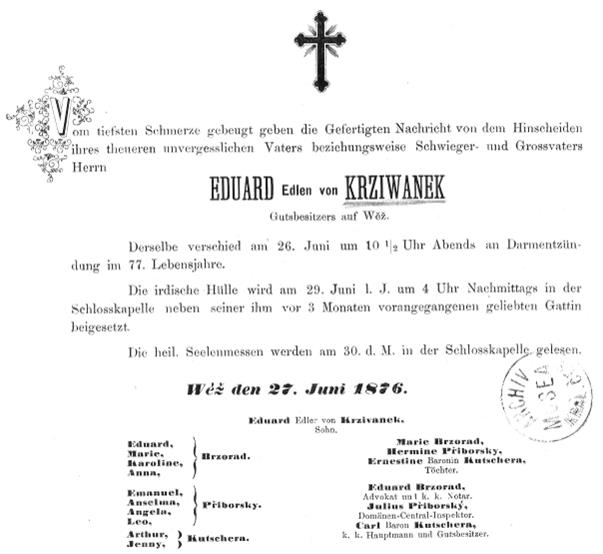
The
obituary of Eduard Edler von Krziwanek ( 1799-1876 ), Druk A. Riedl in
Deutschbrod
KH Borovský and his brother talked about Edward Křivánek – a farmer with respect and even the words of the German economist Leonhard Miksch from 1938 agree with them: “Provincial and imperial deputy Eduard Edler von Krziwanek, owner of the farm Věž and an excellent farmer was the first who managed to raise the revenue of the farming significantly and make vast improvements, namely drains, starting the use of artificial fertilizers, or starting alcohol production. " ... Ein hervorragender Landwirt , war der erste , der durch Drainage , Anwendung von Künstliche Dünger , Begründung der Spirituserzeugung day Ertrag der Landwirtschaft wesentlich zu steigern Verstand."[160]
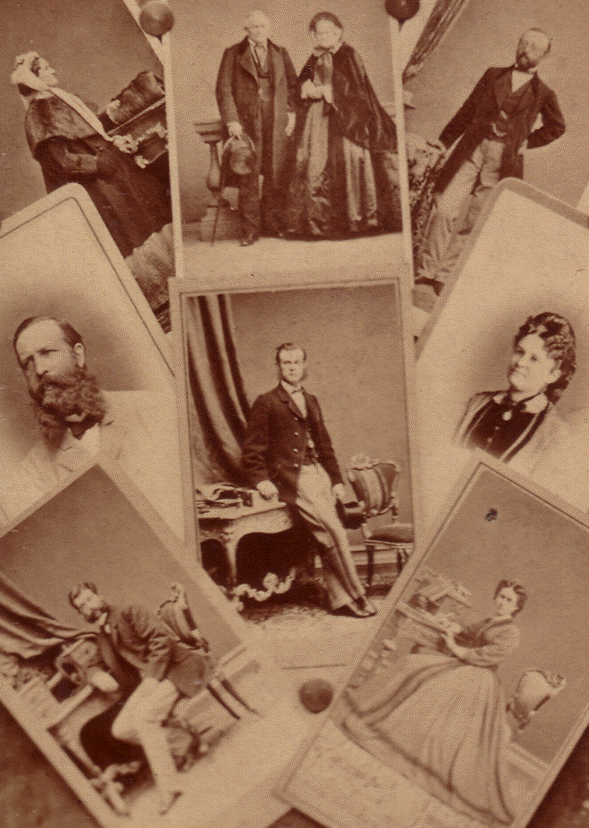
A collage of family of Eduard Edl. von Krziwanek (Frána’s archive)
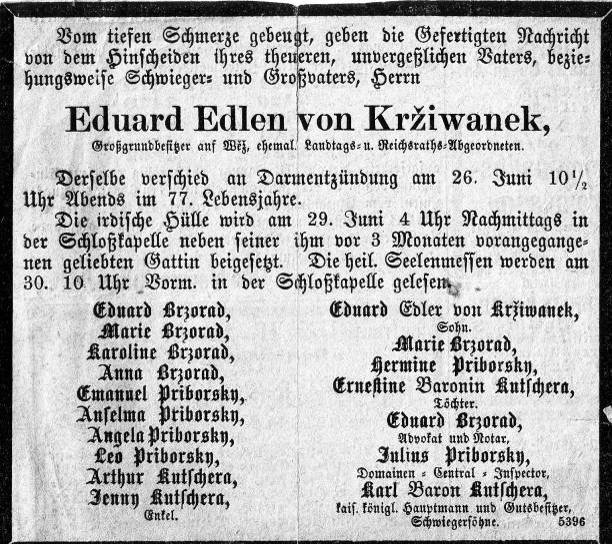
Death
anouncement of Edward Edler von Kržiwanek in newspapers (archive Frana)
The
search for Křivánek graves was successful at St. Adalbert Cemetery in Německý
(today Havlickuv) Brod in 2015. Both tombs were actually located at the
northern wall, roughly in the middle of it. It is not hard to find a headstone
with a cross at the grave of Edward Krziwaneka the younger. (1844-1896). This
is currently also numbered “H 67”.
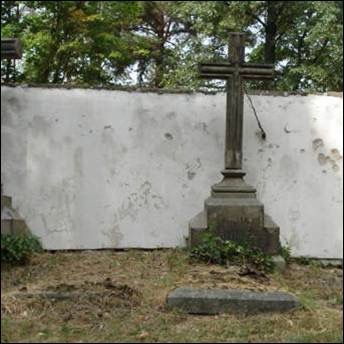
The graves of the Krziwaneks at St.
Adalbert Cemetery in Německý (today Havlickuv) Brod in 2015[161]
Edward’s
parents, originally resting in the chapel of the castle of Věž, were
transported to the adjacent grave (no. 187).
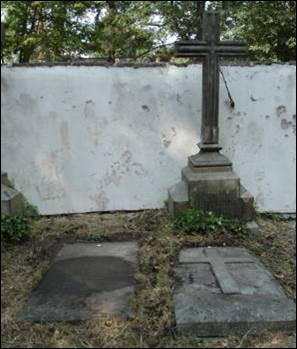
The graves of the Krziwaneks at St.
Adalbert Cemetery in Německý (today Havlickuv) Brod in 2015[162]
After
cleansing and moistening an engraved inscription appeared. A little surprising fact is that the text on
the gravestone ledger is fully in Czech. (Both obituaries were in German.) The second highlight is the title of
Karolina: "Šlechtična (noblewoman) ze Křivánku”. Karoline’s death notice only mentioned
"born Baronin Herites". But the inscription on the gravestone board
says:
„EDUARD
šlechtic
ze
KŘIVÁNKŮ
nar.
17 2?/1 99 zem. 18 26/6 76
KAROLINA
šlechtična
ze
KŘIVÁNKŮ
nar. 18 3/5 04 zem. 18 24/3 76”

The detail of the Krziwaneks’
grave ledger
at St. Adalbert Cemetery in Německý (today Havlickuv) Brod in 2015.[163]
Not
far away, down the aisle is a grave of spouses Johann and Barbara von Herites
into which JD. Eduard Brzorád with his
wife Marie, born Křivánek were also later buried, and which is now labeled B
27. JD. Edward Brzoráda the younger has
his grave in the same aisle too, today marked A 134. These are the three places where we can, when
visiting the picturesque cemetery, come
and pray for the souls of our ancestors.
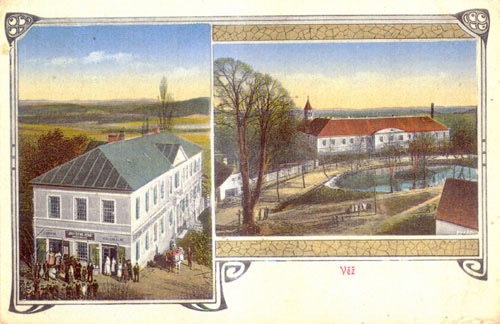
Postcards
with the "New House " and castle Vez

Eduard Edler von Ernest Krziwanek (1799-1876) on the balcony of Věž castle – with greenhouse in the background[164]
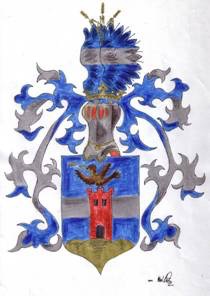
The
sketch of Křivánek’s coat of arms in color.[165]
Ernestine Baroness von Kutschera née von Krziwanek (1840-1877) and Karl Freiherr von Kutschera (1836-1890)
In the family von Kutschera we should not fail to mention Johann Nepomuk Baron von Kutschera (1766-1832). He was an imperial privy councilor (kaiserlicher Geheimrat), one of the highest imperial generals ”Feldzeugmeister.” His father Carl was awarded a hereditary noble title in 1805 after 51 years of faithful service as a simple clerk, administrator of the Zemské Desky, himself the son of Litomerice’s burgher Matthew, who was a manager of the Strahov Premonstratensian estates. Shortly after that, in 1805 Johann Nepomuk was appointed (and remained until his death), first aide to Emperor Francis to whom he was very close. This way he got ahead of other higher nobility at court.[166] “Only in Vienna over sixty officials carried out the oversight of private correspondence and made copies (called intercepts), which traveled daily to the police ministry and then to the emperor's office, where they entertained the adjutant, Baron Kutschera.[167]” He was in favor of Empress Maria Theresa and a certain lady-in-waiting, who sided with him. The adjutant Johann spent time with the emperor not only in tête–à–tête conversations but also with music. The Emperor played violin, but not particularly well and adjutant Johann managed to keep a stone face during some bad notes when he played with him in a quartet.[168] The emperor had therefore forgiven him for absolutely scandalous participation in Vienna nudist balls![169] For his loyal service and unambitious behavior Johann won for himself and his two brothers a baronial title in 1819. He bought a farm in Bohemia called Čelín; being himself a bachelor he bequeathed it to his brother Joseph.
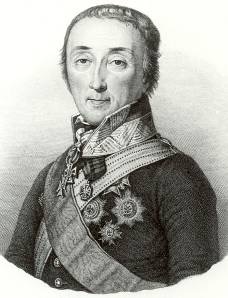
Johann Nepomuk Freiherr von Kutschera (1766-1832)[170]
Josef Carl von Kutschera (1769-1855), grandfather of the groom, who inherited Čelín after his brother, was the imperial and gubernatorial counselor and “podkomoří” (“Unterkämmerer” = high official of the Bohemian Estates) to the Kingdom of Bohemia and a regional governor in Sázava. He was a master of playing the cello.[171] Mainly, however, he was a close friend of Mozart "intimer Freund Mozarts" as stated in his obituary 28. 1. 1855, which further emphasized his role as assessor of the Royal Commission for the Estates Theatre supervision, as well as other credits for a church music society. In the committee, for example Count Johann Pachta sat with him and when deciding on the new Director of the Estates Theatre, he was the only one who stood up for former director and Czech patriot Štěpánek, and against "Viennese Stöger " who was recommended by Archduke Karel František, or Minister Count Kolovrat.[172] (Count Jan Pachta was the famous Prague host of Mozart, who is said to have locked him in his room of his palace in 1778 until he wrote the 6 German Dances. The Pachta band rightaway rehearsed and played to the host later that day before lunch.)[173]
In his room Baron Kutschera had about 30 clocks and etched in the memory of his grandson is a lunch, where, at noon this whole clock arsenal opened fire - "das ganze Uhrenarsenal drauflosschlug."[174]
Nice photos of Chateau Čelina could be found on
http://www.hrady.cz/wnd_show_pic.php?picnum=103869
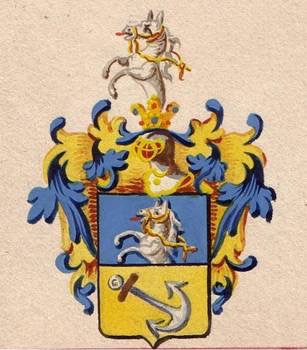
The coat of arms of von Kutschera in color[175]
Joseph's son Johann (1804-1865), who married Jenny Pachta was the imperial and royal court councilor (Hofrat). His son writes about him: "he was serious, keen intellect, knowledgeable and a good caring father. He loved and adored his wife, who loved him too ... with whole fervor. Dad's sharp tongue and wit, his easy irritability towards superiors would not let him reach the level that would correspond to his abilities. His motto was not to get defeated. He, nevertheless, represented that honorable cornerstone of Austrian public servants, for whom Austria could be proud of. Other features were: strong character, as a clerk blameless, the love for the emperor and homeland and rather a freer spirit .. "[176]
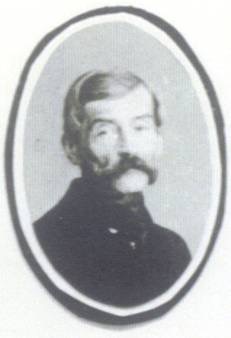
Johann Nepomuk Fr. von Kutschera (1804-1865)[177]
Let’s mention also a letter by Karel Havlíček, in which he writes to his parents to Německý Brod in 1840, before entering the seminary and mentions Baroness Kučerová. We do not know with certainty whether he is talking about "Jenny," her mother in law, or any other character, but the place or time do not dispute that possibility: "News of the intercession of Baroness Kučerová would be quite in place, but I do not care for such recommendations. Where would the world be if females who probably do not understand anything, would recommend men to the priesthood. The Archbishop is a sensible man, my religion professor will recommend me and I think it is the most direct and best way. A professor’s recommendation is the best because he is doing it just from my credits, otherwise I'd never seen him before. However, I can not say whether I will be accepted. However, if I were as sure that I will be hanged, as I am sure of my acceptance, I would not be happy with it at all.“[178]
Apart from Johann (1841-1926, Statthaltereirat, wirklich. Hofrat ), who is the author of family memories and in whose name the line has been extinguished in the next generation, and the Ernestine’s groom Karl, Johann Baron von Kutschera (1804-1865) had only two sons, Oscar and Hugo,both majors who were also the Knights of Malta and remained unmarried.
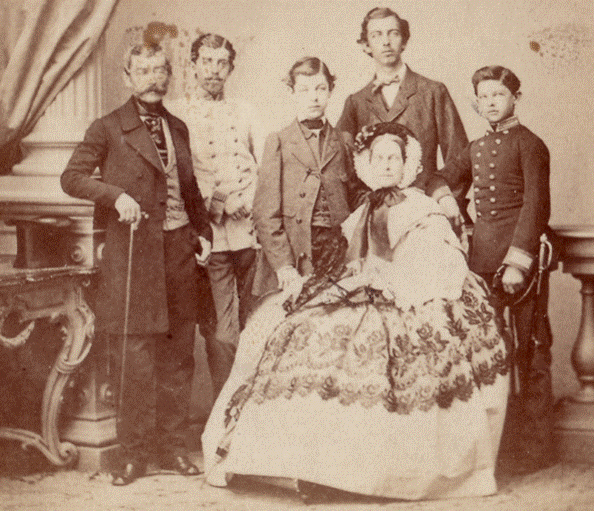
Familie Baron von Kutschera around the years 1858-1860
(from left: Johann *1804, Karl *1836, Oskar *1844, Johanna – Jenny *1806, Johann *1841, Hugo *1847)[179]
Karl Joseph Leo Baron von Kutschera (1836-1890)[180] was born in Vienna. He served in the army in the rank of k. u. k. Captain (Hauptman). His brother Johann said about him, "Karl, less inclined to sciences was soon attracted to a free military life. He was cheerful and of light minds and lived intensely in his beloved Italy, where he served in Rome in the period of ecclesiastical state. He was of a cheerful nature, he eschewed to remain in serious situations and had the means to chase his worries away, for which he was proud. He called it "Abbeuteln " – shaking down.[181] He married twice, left behind five children, and when he fell seriously ill he also took it as it came and peacefully died in age of 52. He lived merrily and merrily died, said all those grieving, but we wept for him."[182] The obituary read that he was the owner of Military Merit Cross with a war decoration and a War Medal.[183]
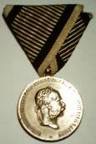
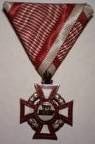
Militär=Verdienstkreuz m.d. Kriegsdecoration (Establised 1849)a Kriegsmedaile (established 1873)
Karl inherited the Čelín estate from his father (+1865) with 285 ha of fields, meadows, pastures, ponds, gardens and woodland, brewery, mill and brick factory. In Čelin there is a nice chateau and chapel probably by JB Santini. He married Ernestine Krziwanek (1840-1877) on December 24, 1868 at 17:00 in the chapel of Věž, as 73rd Infantry Regiment captain.
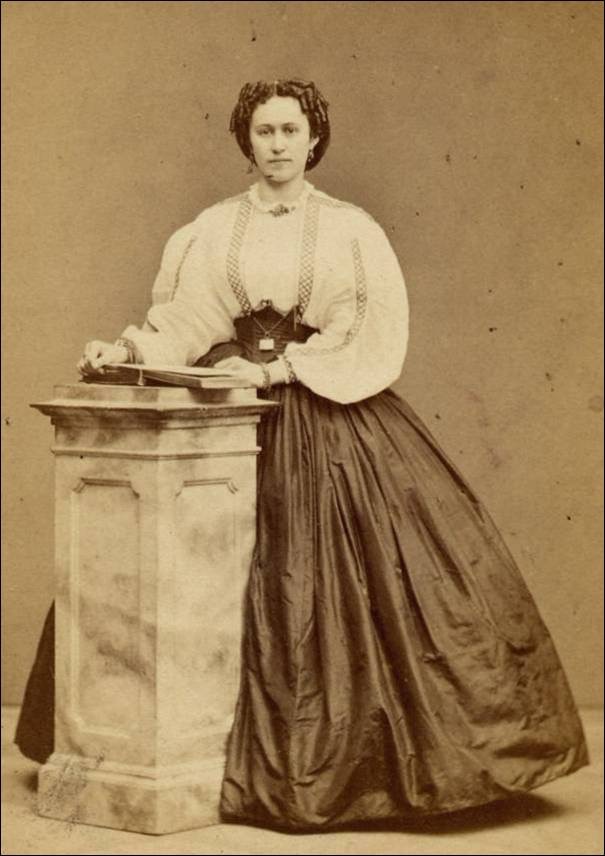
Ernestine Bar. von Kutschera born von Krziwanek in the 1862 at that time 22 years old
(M. L. Winter, Photograph, PRAG, Graben 988) located in Album Voith-Herites von Sterbez
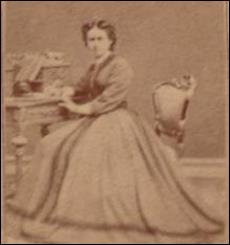
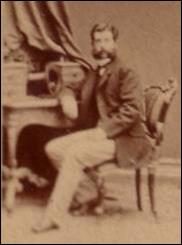
Cut out from the tableau of Ernestine and Karl Freih von Kutschera
Ernestine gave birth to two children. On 12th July 1869 Arthur Franz Oskar (1869-1924) in Vienna and on 8th August 1870 in Věž a daughter Johana Nep. Karolina Wilhelmine Antonia (1870-1948), who was baptized on the 18th.. According to the parish register Karl was a pensioned captain by then and the owner of the manor „Čellin“. His mother Johanna „freyin Kutschera geb. Gfin. Pachta“ resided in Vienna Nr.319 and together with „Eduard Edler von Krziwanek“ (as he put it in his own hand) stood as godparents.
On 8th February 1877 Ernestine died of typhus, and is buried in the family tomb of the von Kutscheras in Borotice. The cemetery has been removed since and there seem to be no trace of the graves near the church.
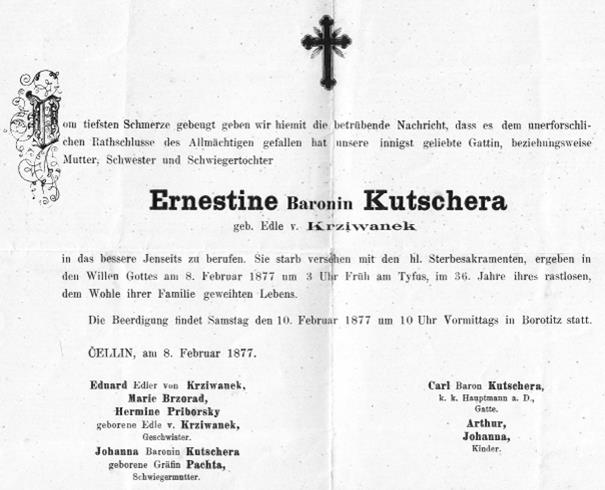
The death notice of Ernestine Baronin von Kutschera born Edle v. Krziwanek
11.4. 1877 Karl was elected in a by-election as member of the provincial Assembly of the Czech Kingdom, as a landowner to represent the fully owned estate (allod) holders, where he works until 1882.[184]
In 1883 he marries again to 25-year Baroness Maria von Kielmannsegg (1858-1945), with whom he has three sons Ernst, Franz and Karl. His new wife unfortunately survived them all - two died in a battle, and the only one grandson from Ernst shot himself. Although Baron Karl survived his first wife Ernestina by 13 years, he died in Heinstetten at age 54 on 3rd July 1890.
In 1892 Arthur and Jenny owned a share of the U Slunce pub in Německý Brod, which was, along with the surrounding fields inherited by all Křivánek’s daughters.
In 1892 Johanna / Jenny née Baronin von Kutschera (1870-1948) married a lieutenant of 14th Artillery Regiment, later a captain, Eugene Renkin (1867-1919) in Schottwien. His father was Edouard Renkin, Consul General of the Kingdom of Belgium, winner of the Leopold Order, Commander of the Austrian Order of Franz Joseph, and Knight of the Order of Iron Crown of the third class; his mother was Philippine Renkin born Lejeune. They lived in Innsbruck and had two children - the third, Jenny (1896*) died at the age of one. Renkin’s son Karl (1895-1917) died on the Italian front in the battle at Sochi wounded to the head, his sister Ernestine née Renkin married an officer - Major Rudolf Schmid. Erna Schmid-Renkin“ died at 34, buried on 25 February 1928 in Innsbruck, where they lived. Their children were Hans and Erni, who was born in 1917 and got married in 1936. They remain the last uncontacted branch of the Krziwaneks descendants so far.
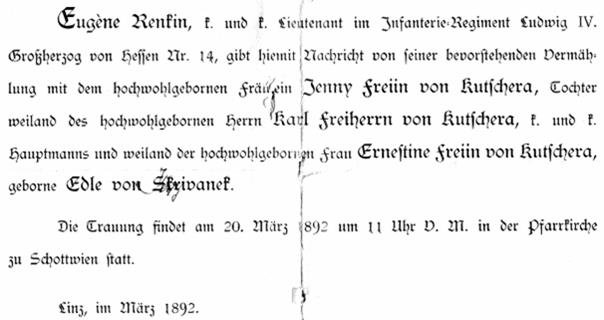
The wedding announcement of Eugene Renkin and Freiin Jenny von Kutschera – take note of "von Skrivanek" corrected to Krziwanek. (Frána’s archive)
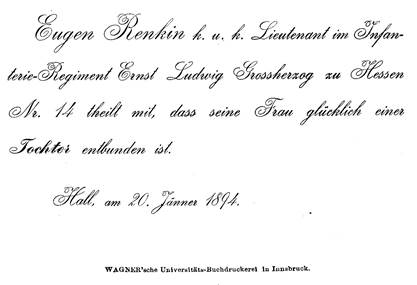
The birth announcement of Erna Schmid-Renkin (1894-1928) (Frána’s archive)
In 1893 Čelín is sold to a business man from Prague, Gustav Adámek, whose descendants still to this day (2017) reside and farm here, after the restitution of 1991.
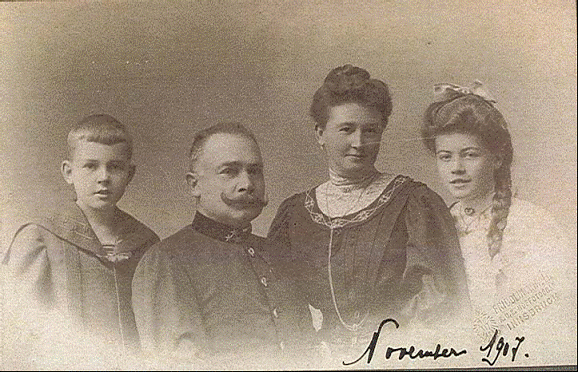
Image 52 Family Renkin 1907, from left: Karl (1895-1917, Hauptm. Eugen, Johanna (1870-1848), Ernestine later Schmid)
Jenny's brother Arthur Baron von Kutschera (1869-1924) was an economist of the Most[185] sugar refinery and that is why his 4 children (Joseph, Erna, Gertrude, Peter) were born in the years (1899-1906) in Bohemia, now defunct Rudelsdorf - Rudolice nad Bílinou.[186] Then, apparently they lived in what is now the non-existing part of Most - Kopisty (Kopitz[187]) where Arthur died, and where his daughter Erna still got married. All Arthur’s children, however, died in Germany, where they were having been expelled from Czechoslovakia.
Josef (1899-1957) went to Munich, where he served as the general secretary of "Deutchen Touring Clubs.” He later died childless suffering the consequences of his Russian captivity.
Gertrude (1904- after 1970) left with her husband, Dr. Walter Reif to Aachen, where he became the director of a big manufacturer of needles - 3,000 employees. Their son Hannes worked after graduating in management, in the export department of one of Munich companies.
Ernestina (*1901- after 1970) married Dipl. Ing. Ernst Hauschild, an engineer and plant manager of the largest mine in Bohemia, who was during the post-war expulsion taken to a Czech concentration camp. Both were then deported to Bavaria, where they worked with cattle and were "allowed" to sleep in the stable. Her sister Gertrude then took them to Aachen to live with her, and Erna later worked as a drafter of plans in a factory for metal goods. Her husband Ernst, who later died from his wounds he collected in the concentration camp, worked as a clerk. Then Ernestine began teaching, because in Prague she she had acquired teacher training qualifications. She found employment in Oberhausen, where her two sons also lived.
The youngest Peter Baron von Kutschera (1906 - after 1970) was seriously wounded in an unfortunate attempt to defuse a mine and practically blinded during the war in Russia . Originally maltster, he retrained to be a masseur and moved with his family to Karlovy Vary (Carlsbad). After the coup he had to leave and found work at his sister Gertude's in Lüdenscheid where he was the city clerk and there led a happy life. The bearer of the name “von Kutschera” was his daughter Ulrike (1940-2014), who married Wilfried Hoffmeister and had three children.[188]
Thus, in this generation, the line of Barons von Kutschera died out in the male line. But now back to Věž.

The coat of arms of von Kutschera in Siebmacher
Eduard Karl Edler von Krziwanek (1844-1896), the owner of Věž
Eduard Krziwanek the younger, was born in Vez 4. 11. 1844 remained the only male descendant. His godfather was Thaddeus and some cousin name Karl Resi. In the years 1855-1856 he studied the first year of the lower secondary school run by the Norbertines in Německý Brod.[189] Then, he probably, moved to German Jihlava. In the years 1861-2 he graduated from AE Komers’s higher agricultural school in Libwerda.[190] According to the stenographic protocol on 19 April 1861 his father suggested at the Provincial Assembly the liberation "Befreiung" of farmers’ sons who completed an agricultural school with excellent results. (From what had they have been freed - honestly we do not know.)
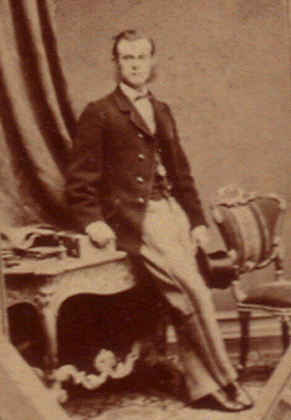
Eduard Carl Edler von Krziwanek (1844-1896)[191]
We can find "Edward Křiwanek, Wirtschaftsadjunkt, Charwatetz[192]" On the lists of honored guests and members who took part in the General Assembly of the Czech Forestry Association (General Versammlung des böhmischen Forstvereines) in Mladá Boleslav in 1863 and from 7. - 9.th August 1865. [193]
When his parents died in 1876, he was 32 years old and it is likely that the estate has been taken over by him already. The manor was officialy transferred according to the Charter of the Regional Court in Kutná Hora, in 1879.[194]
The Schematisms for the years 1880-1881 list him not only as the owner, but also as the administrator of the Věž estate.
Early in 1880, however, the farm was affected by a great fire during which a commemorative book written in Latin burned. The whole castle chapel also burned down, where there was the castle tomb, as well as a part of a residential building. The remaining part of the castle was rescued by firefighters from Brod. Nothing from the chapel was rescued, nobody knew anything about the key; whether it was a result of a confusion or an intention, it could not be explained. [195]
In 1881 the Schematism reported the total area of 312.15 hectares; the distillery and brewery were out of operation. Apart from the normal cereals, cole, potatoes and clover were also grown,
In 1881, Eduard Edler von Krziwanek the younger sold the Věž estate together with the Veselsko farm to Dr. Antonín Waldert, Prague lawyer, for 165.000 Gulden (of Austrian currency). Dr. Waldert had worked with his father in the years 1861-1862 then as the Chomutov lawyer in the provincial assembly. In 1881 he was the deputy to the supreme marshal of the provincial parliament and an assessor to the provincial committee. So at the time, in the years 1877-1882, Dr. Waldert sat in the Bohemian parliament together with a brother-in-law of the seller Eduard Krziwanek, Karl Baron von Kutschera . Dr. Waldert sold everything in 1884 for 155.000, to Dr. Gustav Jahn. In 1882 the Věž chapel of the castle was repaired and according to the Chronicle ,"a model property manager” Hladik hid a soldered metal locker with a memorable deed into its cupola. "

Most likely Eduard Karl Edler von Krziwanek (1844-1896) year 1862 (M. L. Winter, Photograph, PRAG, Graben 988)[196]
According to the Bohemia daily on 25. April 1882 Eduard v. Krziwanek, Gutsbesitzer aus Deutschbrod“ is among the guests who checked in at the hotel Erzherzog Stephan „U Arcivévody Štěpána“ (later Šroubek, even later rebuilt as Europa) on Václavské náměstí[197]
Eduard von Krziwanek Jr. lived at that time on the first floor of the so called "New house" No. 62, where he moved after the sale of the estate. It was made on the condition that the whole floor was reserved for his free use from the buyer Meisel, who had bought the house from the Krziwaneks by the 40s. He had also catered meals brought to him for which he invoiced a considerable part of the outstanding balance from the purchase price of the house and the debt was eventually cleared. Meisel descendants still live today in the Slovak Republic.
In 1877 Eduard von Krziwanek sits on the local council and in 1887 he sat on the first local school board. In 1887 a new school was consecrated and Eduard Edler von Krziwánek marched at the head of the procession, having been appointed the local school supervisor. The whole spectacular event is described in detail in the local chronicle. The local chronicle remembered Eduard Krziwanek elsewhere: "He was on familiar terms with all the citizens, with whom he liked to sit in the pub."
But he died unmarried and childless on 2 December 1896 at age 52 of pneumonia, buried at St. Adalbert Cemetery in Německý Brod to the grave no. 5/188. The register says that „Eduard šlechtic ze Křivánků a former owner of the manor Věž, now an unemployed private person died in house nr. 62 of tuberculosis according to the death certificate.”
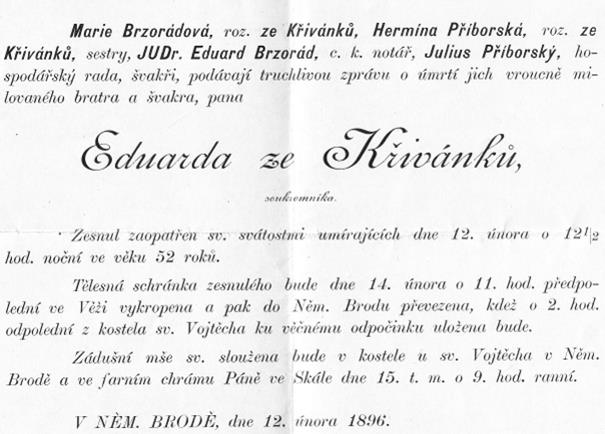
The
death notice of Eduard von Křivánek (1844-1896 )[198]
Below
the difficult to read “Zde odpočívá”
- Final Resting place the grave still (2016) has a very legible
inscription "Eduard ze Křivánků" born November 4, 1844, d. 12
February 1896 on the foot of the tombstone, on which
there is a cross fixed to the cemetery wall.
It can be found in the middle of the wall, in which there is a gateway. one
can easily read “Eduard ze Křivánků”.
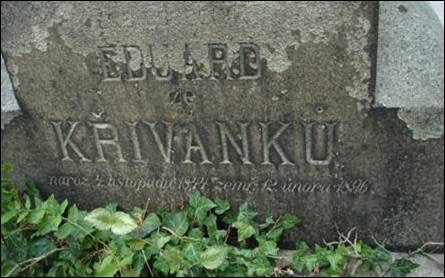
The detail of the grave „H67“ at St.
Adalbert Cemetery in Německý (today Havlickuv) Brod in 2015
Here apparently extinguished the history of the noble family von Krziwanek in the male line. And since we already know the story of Ernestine married Baroness von Kutschera we will return to Marie Brzorádová in a separate chapter "Familie Brzorád" and later on, in the female line only Hermine married Prziborská remains.
Hermine von Krziwanek (1839-1908) and Julius Příborský (1824-1905)[199]
Hermine born Krziwanek (1839-1908) married the agricultural director Julius Prziborsky (1824-1905) in 1857. The witnesses were the bride’s uncle Thaddeus Baron von Herites and the groom’s uncle Anton Emanuel Komers ( 1814-1893). Komers family was, as we shall see, quite patriotic i.e. pro-Austria oriented. That is probably why they preferred communicating in German. In a letter Hermine’s niece (Anna Dostálová née Brzorádová) alludes to the linguistic orientation of the family, when she writes about the teachers’s poor knowledge of Czech at the Czech schools in America, "German women, who have picked up some Czech language. (They know about as much , or even not so much as Příborský family members)."[200] Anna mentioned the Příborskýs family several times. We read about it but later on, where we write about the adoption and marriage of Leo Prziborsky, who became a bridge to families Voith and Herites.
Familie Prziborski
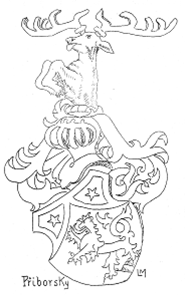
Coat of arms
of Příborský[201]
The Příborský family came to Humpolec in the late 17th century. A legend tells of a widow with two sons. Of Julio's ancestors let’s mention Jakub Příborský (1732-1812), who, after The Patent of Tolerantion had been issued joined the Protestants in 1781. He married a protestant in 1783 and came to Humpolec and when an evangelical priest and teacher came to Humpolec, they both received and shared accommodations at Jakub Příborský’s. The community worships were in the barn of this leading member of the community in summer and in the winter directly in his apartment. In 1797, however, a Protestant pastor Vojtěch Špinar "dealt a heavy blow to the Evangelical Church's choir. He left them, having converted to the Catholic faith.[202] "His example was followed by several families. The family of Jakub's son František Saleský[203] (1769-1822) was among them. Jakub was a weaver, a cloth salesman and Mayor of Humpolec, who even received his coat of arms from Emperor Francis I (resp. II.), for serving his country by manufacturing uniforms for the army in his factory. The coat of arms was then used by his family for generations. Unfortunately the relevant document burned in Humpolec in 1901. The sealer with the coat of arms, however, was in the possession of his descendant Kamillo Příborský, who also used the walking stick with the same coat of arms on the handle as late as after WW2. The coat of arms can be seen on the tin (silver?) tray, which is owned by the descendants to this date.
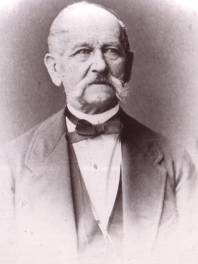
Příborský Ernst ( 1803-1878)
A
very important figure for other family history was Franz's son Ernst
(1803-1878), the director of Count Collonitz’s estates in Gross-Schützen in Hungary, who lived with
his employer on friendly terms. His efficiency and foresight earned him a
considerable fortune. Since he remained
unmarried, he donated this to the educational and family foundation for the
descendants of his siblings. Originally
it was about 160,000 gulden, from which before the war over hundred people
drew/benefited. A new school was built
in Humpolec from the foundation money in the years 1907-8. Despite the war and inflation 450 000 CZK
still remained in the foundation in
1936. The last chairman of the board of
trustees had to, in 1945, pass all the assets on to the state, and he himself,
despite being a bank clerk, was placed into production work.
What we also know about Ernest is that he that he sealed the same way as his father with the family crest. His will is also interesting because it expresses fear of the so-called "apparent death" and coming back alive after his burial. L. Miksch believes that Ernst read terrifying novella of EA Poe's "The Premature Burial". Therefore he expressly asks that his body was to be laid after his death in a room until the doctor arrives, and performs some operation on him – such as cutting of his veins – which will make his revival impossible.
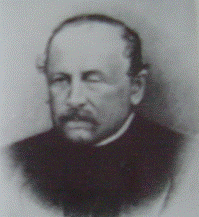
Kajetán Příborský (1796-1870)
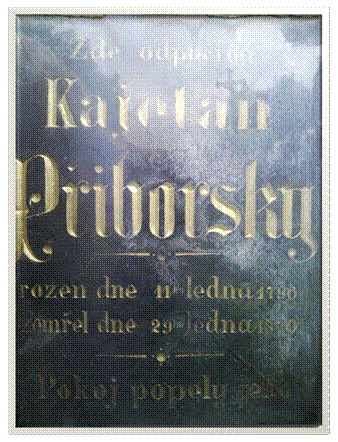
Kajetán
Příborsky’s grave stone at Humpolec’s cemetary [204]
Of course we are also interested in Ernst's brother Kajetan (1796-1870), also a master draper and merchant after his father, whose business dealings, however, extended far beyond the borders of the Austro - Hungarian monarchy. Kajetan, Julius's father was a one-eyed commander in 1848 Humpolec’s National Guard, consisting of 200 townspeople. He was nicknamed "Žižka" after a wild (brave) Hussite leader. (In the German typescript copy preserved by the descendants there is a word " braven" written in hand above the original " wilden"). Whether they had other common characteristics is unknown. Anyway, he left a reputation as a strong and hard man. Kajetán’s wife Kateřina, the daughter of a draper Matouš Komers was the godmother of Humpolec National Guard’s flag, which was donated by her brother AE Komers, at the value of 300 gulden.
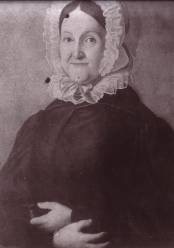
Kateřina
Příborská born Komers *1799[205]
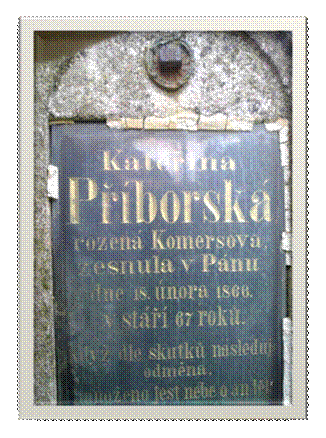
Grave stone of Kateřina Příborská, born Komersová, in Humpolec’s cemetary[206]
Kajetán’s son, Julius Příborský was the head of the family foundation set up by his uncle and he outlived all his siblings. He actively participated in the lives of his close ones and so let us first talk about them. There were 12 siblings of Julius Příborský, who were the children of the owner of a textile factory in Humpolec Kajetán and Kateřina, sister of the knight Komers and barons of Lindenbach.
Let’s mention at least the officers who chose the path of their uncles - Lieutenant Emanuel (1831-1859), who was killed in Italy and captain Mořic / Maurice (1822 -1854), who died of cholera in Venice. Maurice was a very young captain but mainly a friend of KH Borovský from his youth, when together they were reportedly the terrors of Brod’s grammar school. Also Havlíček’s letter of January 1839, which is "the first evidence of his “Czechness", because in it he renounced German language " taking hold of the holy melodious mother tongue", was sent to Maurice.[207] In response, Moritz also wrote: "... So hear the advice, from although immature, nevertheless your sincere friend: move away, step away, because you are not worthy to accede to the altar; you can be a good teacher in the Jesuit order, but will you be also a good priest?"[208]
Of the other brothers we should also mention Eduard (1835-1856), who died by falling into a boiler in the brewery.
Karl (1837-1895), director of the estate of His Serene Highness Prince Kinsky in Chrudim, graduated as one of the first from the Libverda school. He was a member of administration board of the local sugar refinery, a member of the local school board and member of many humanitarian and patriotic groups.[209] Let’s us mention that his wife Hermine was born Hanl von Kirchtreu, and her brother later married Julius Prziborsky’s daughter Angela.
Brother Herrman (1834-1883) studied engineering in Prague and Vienna. He was active in the construction of railway Prague-Duchcov-Most. There he was also an inspector and later an Administrative Director. For some time he lived in England, where he contracted a lung disease, of which he died. One of his daughters was married to the court councilor (Hofrath) and the head of the department of Imperial Finance Ministery, Robert von Zverina; the descendant of the second daughter is an economist Leonhard Miksch; the third daughter worked as a teacher of piano and singing in Berlin.
Finally, brother Kajetan (1830-1883) owned a textile factory in Humpolec. His son Kamillo, an authorized representative and director of the insurance association of Austro-Hungarian sugar industry in Prague, stayed at Julius’s in Štěpánská street, and also took over the administration of the foundation. At an advanced age - 50 years old he married a Jewish woman Elsa Grimm, who was in 1943 under the pretext of some sort arrested; Kamillo died due to this strain. Elsa subsequently died in a concentration camp. Their apartment, which at that time comprised of the majority of family treasures and documents was officially cleared up and nothing remained. They were childless.
Kamillo had a sister Herma who married a pharmacist Otto Schreiber. Their son, Jaroslav Schreiber was adopted by Kamillo. But he was the last chairman of the Board of Trustees of the Příborský foundation. In 1945, he had to hand over all assets to the state and in the fifties he was even as a bank clerk forced to work in production industry. He died in 1974/5. Jaroslav's daughter Sonja is now apparently the last surviving bearer of this name.[210] Jaroslav had a sister Milada, married Blažková, author of the book Legends of the Příborský family, whose grandson, MUDr.[211] Pávek is the owner of the family archives now.
From the position that Julius and his brothers attained, it is clear that the financial support from their father's brother Ernst, along with the influence of their mother’s siblings - barons Komers von Lindenbach and knight Komers - were of great importance. We can even say that without a closer acquaintance with the family Komers it would be difficult to understand the future events in the following generations of the Příborský family.
Due to the early death of his first wife and through his trading in cloth and fabric in Humpolec Matouš Komers attained a decent fortune. Thus the two oldest sons, later Barons von Lindenbach, managed to graduate in law. Karl Eduard Baron von Lindenbach (1794-1870) became a military auditor, the general and court auditor and chief of a section of the War Department, and was awarded the Order of Leopold (1854 - Ritterstand), the Order of the Iron Crown II. Class (1862 - Freiherrenstand) and the papal Order of Christ. He was a landowner at Vlásenice and Lipková Voda, where he and his descendants lived.[213] Emanuel Heinrich Baron von Lindenbach (1808-1889) was a lawyer, president of the Higher Regional Court and the Austrian Minister of Justice, Knight of the Order of Leopold (1858 - Ritterstand). In 1867 he asked to be dismissed from his position at the Minister of Justice and for his services he was awarded the Grand Cross of the Leopold order, and in 1869 was promoted to Baron and received his coat of arms. He died at the castle Žak (Žáky) near Čáslav.
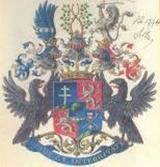
The coat of arms of Emanuel Heinrich baron von Lindenbach (since 1869)
Anton Emanuel Ritter von Komers (1814-1893)
Due to failures in business the Komers family became poor and the younger son Antonín Emanuel (1814-1893) managed to finish only high school; he had 15 siblings in total. Antonin Emanuel started work in agriculture. “A turnover in his fate came unexpectedly. When Count Franz Thun Hohenstein the younger took over the administration of all his father's estates, he was looking for a secretary. Older officials alerted him to AE Komers, to his talents and abilities. He was accepted and worked to the full satisfaction of the young nobleman. It was neither a small nor an easy task. Patrimonial nobility at the time had great power and responsibility. The owner of the manor had to make many decisions personally and had extensive correspondence, demanding from his secretary wide views, practical experience, education, knowledge and fast readiness. The two young men soon developed a warm friendship. Even late in life Thun Francis used to say that he considered the choice of Komers as his secretary and adviser the happiest act of his life."[214]
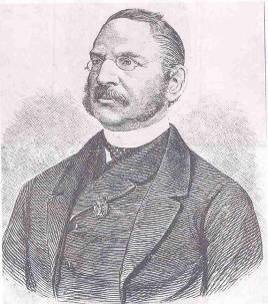
Anton
Emanuel Ritter von Komers (1814-1893)[215]
Count Thun even paid for Komers for his studies at Hohenheim economic school near Stuttgart together with the costs of study tours during the holidays. He did so on the basis of good experience with his work, but also through an intercession. VV Tomek writes: "The favor was procured by two of his older brothers, who were classmates with young Count Franz and Leo Thun at the law faculty of the Prague University."[216]
Then, in 1840, Komers became the director of the estate in Peruc. František Palacký had advised VV Tomek to organize Thun’s archive. He then writes: "The director or the head of the farm was Komers, now a renowned economic councilor and a wealthy businessman, at that time a handsome young man, twenty seven years old. I was very interested in getting to know him. But by then it was already obvious to observe that the man was seeking to achieve something bigger in honor and in wealth.”[217] On the estate production greatly increased as a result of the reforms which were introduced. In the years 1842-3, when there was great poverty, Komers proved successful, as he suggested to the manorial lords that they supply various extra work to ensure that the people were earning money from autumn until the new harvest, a total of 9 months. Count Franz Thun (1809-1870) was as the first-born, an heir to ancestral property and in 1844 he appointed Komers the central director of his estate. As a result of his misalliance marriage, however, the succession was abandoned.
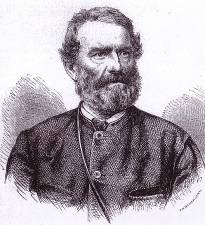
Count
Franz Thun Hohenstein (1809-1870)[218]
In 1845 Komers married the daughter of a rich Prague citizen Jan Jindřich, Marie Kateřina. She, however, suffered for a long time from tuberculosis. A dedicated husband, Komers saw to her regular stays in the Swiss Alps in Merano, Nice and other spas.[219]
In 1849, as we know, KH Borovský resigned from his Parliamentary position in the Imperial Council and in his place Komers was elected. In the National Literary Archive we find this letter Komers wrote to Havlíček: "I just received a private message that I was in the Humpolec district elected to parliament. Wanting to leave there shortly, I hope I will not miss you in Prague, because I will stick around there just for one day. Please write me a brief message, where in the morning or in the afternoon I can catch you. I'd like to talk to you about some important things. That as your successor / although without your excellent skills / - I will join your side, as a valiant federalist, a Bohemian by body and soul, loving our nation and homeland - is no need to describe further."
Since 1849 the central headquarters of Thun’s goods moved to Prague, where it was at the address of Komers’ in Štěpánská Street No. 633 / II.
In 1850, on Komer’s initiative, The Patriotic - Economic Society, of which he was a decisive member, established the agricultural school in Libverda near Děčín, where he became director himself. This in its time was a very progressive and important institution , where the lectures were also introduced by Komers in Czech, and was attended by a number of Příborský family members. [220] Count Chotek ordered that the places of economic officials could only be given to those who would be able to produce a certificate from the Libverda agricultural school.[221] Later in 1900 the school was taken over by the German Polytechnic Institute.
Komers was closely watched by Count Jindřich Chotek in the agricultural publications of The Patriotic Economic Society and acquired himself his book about the Peruc exemplary estate.[222] Already in the 50s he would drive there himself and make notes about his crop rotation system. In 1856 Komers decided to invest a substantial dowry of his wife into agriculture. In his scientific work he devoted himself to sugar and in the fifties he published a substantial systematic work about it.[223] Then he became a partner of Count Jindřich Chotek in building a sugar refinery in Veltrusy - in Úžice. He pledged to introduce the cultivation of beets, while there would not be a decrease in other agricultural regime. For its engagement in Thun services, he commissioned Julius Příborský to do the immediate management.[224] As a result, Komers took over the inspection of Veltrusy and later the Nové Dvory farm. Thus in 1859 a new central authority began - The Chief Directorate which managed both Chotek estates.[225]
By analysis of Veltrusy estate’s management Komers detected that it was on the edge of possible losses, and therefore took over the milk production and put it under his own supervision. He created better records of budgets by industry and of individual farms and leased unprofitable farms.[226] Besides the cost savings he focused on economic education of the clerks. By the accounting revisions in 1860 he found that the highest expenditure consisted of pension payments for former employees. He carried out the headcount reduction and redeployment. To improve yield and grain farms beet cultivation he set target numbers to be achieved in production by a specific date. In the case of non-compliance with these standards, he threatened by leasing such courts. In cattle breeding he focused on efficient species and increase of milk yield.[227]
By 1858 he had also built the sugar refinery in Peruc, where the Count Thun joined him as a companion. Having successfully built the Úžice refinery, Komers built another one in Ovčáry in 1860 for which he bought new machines from Daněk et al company from Karlín and for better transport of material he had railway siding built there.[228]
Komers supported his hometown Humpolec, where he very generously contributed to the building of a school, created an endowment fund for it and the construction of the Evangelical church and a hospital. For example, when in 1861 he read in Čas magazine that executors were visiting Humpolec’s cloth makers, he sent 100 gulden to the city council to help those poor who fell in debt.[229]
In 1861 Komers bought the Lžín estate for his family . Here he founded the alley, planted a park, and set up the islands on the pond. At his place the name day of his wife used to be noisily celebrated, while gaiety was arranged and children given a treat."[230]
In 1863 he bought the manor Mostov near Cheb. He had both castles rebuilt in a similar romantic style. The family then lived in Prague[231] but also in Mostov, where Komers’s wife died in 1876.[232]
Nice images of the castle could be found here
http://www.hrady.cz/wnd_show_pic.php?picnum=124375
In 1870 his gifted son Karel Komers (1846-1870) died in his last year of law studies.
In 1871 AE Komers received the Order of the Iron Crown IIIrd class and it was followed in 1873 by the awarding of a knighthood with the predicate "von Komers".[233] It is interesting that he chose a different predicate and the coat of arms from his brothers barons von Lindenbach.
In 1872, Count Chotek promoted Czech as the official language of his estates. Komers welcomed the decision, although he himself spoke mostly German. At its agricultural schools, however, he tried to use both languages. In his written statement he claimed that the change was also welcomed by all administrative bodies, but for many officials Czech language represented a big problem.[234]
The Vienna Stock Exchange crash in May 1873 launched the Great Depression. The Chotek estate certainly faced big problems and in 1874 Komers decided to retire. The Chief Directorate was taken over by Julius Příborský, as well as the position in the Úžice sugar factory, for which Komers’s contract expired in 1876.[235]
In 1874. he also retired from the services to Thun The brother of his successor, the young Count Jaroslav Thun wrote about him: "unpopular figure was omnipotent Chief Economic Councillor AE Komers, who created cumbersome paperwork that bothers us to this day."[236] The Historian Jan Galandauer adds: „Economic Councillor Komers is in the literature considered very capable expert and co-creator of the "economic miracle" of Thun’s domain; we are unable to judge what is legitimate in Jaroslav Thun’s complaints.[237]
Like his father, however, in his old age AE Komers faces the collapse of his property. JB Lambl in the Economic dictionary adds that by no fault of his own. The fault could be the economic turmoil in the monarchy. German economist Leonhard Miksch then states that Komers was heavily involved in the land credit institution "Bodenkreditanstalt" that as a result of bad speculations in the 70’s went bankrupt.[238]
Lžín was sold in 1881 to Count Rudolf Chotek, then Mostov to Baron George Haas of Hasenfels in 1885. The two estates had the total of 820 ha. In 1886 both houses in Prague in Stepanska St. (1671 / II) were sold.
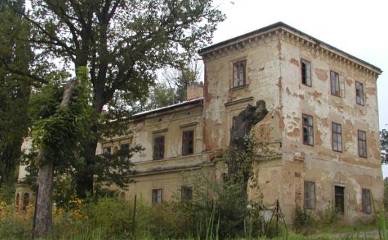
Lžín at the beginning of the 90’s of the 20 century
AE
Knight von Komers is dying apart from all his social life and affairs and
without any personal property in 1893
while living with one of his nieces in Jihlava.
Son Emanuel, who in the years 1873-4 graduated from his father's school in Libverda is at first the landowner in Mostov, then he lived with his wife and daughter in Prague, later in Vienna, where they all died. We will return to the younger son, František, because he married Julius Příborský’s daughter.
Julius Prziborski (1824-1905)
Julius Prziborski was born on the 24th of August 1824 in the city of Humpolec.[239] According to his own notes he was much influenced by his mother's religious and moral education. [240] He attended the primary school in his native town of Humpolec; despite difficulties with his German he attended the next level in Jihlava. He attended gymnasium – the secondary school in Jihlava and also in Německý Brod in the years 1836-9, together with later famous composer Bedřich Smetana, who was the same age.[241] Because of his uncertain (zweifelhaftem) study results, the father decided that Julius should prepare for business in his company. At that time, however, Uncle "Toni" - AE Komers stopped on his way from Hohenheim’s Academy in Humpolec and persuaded his father to have Julius complete a course in agriculture and forestry at the Prague Technical school and start a career as a manager. Julius completed the two years of the course in the years 1840 - 1841 with very good results/grades, but also with great suffering, because he was provided only 10 gulden per month to cover all his needs except clothing.
In 1841, he joined the Count Franz Thun as a trainee of economic governance led by his uncle Komers. Julius writes: "During my time spent doing inferior work a desire was aroused in me for higher professional education, which could only be offered in a foreign vocational school. Fulfilling this desire came up by a chance. One Sunday afternoon, during an occasional visit of Peruc, Jindřich, Komers’s father in-law, came to my room where I was employed studying books on arable farming. In an interview with him, I mentioned my desire for further professional education at Hohenheims Academy, for which I lacked the funds. Afterwards in his noble manner that simple man, known as a philanthropist in Prague offered me 500 gulden to cover expenses incurred. Supported by this gift and others expected from my relatives, I have asked his Excellence Count Thun for a vacation, which I was also provided. The political events of 1848 had resulted in the Hohenheim’s educational institute being closed indefinitely and Austria’s cancellation of patrimonial jurisdiction and the corvée. Thus the planned visit to an educational institution was spoiled and as a result of the measures mentioned, the field of crop production seemed to offer much less prospects. In this mostly professional matter, I decided at the age of 23 years, to choose a career offering good prospects for intelligent people, such as military career, for which I was promised patronage from both uncles Karl and Manni - Karl Edward and Heinrich Emanuel Komers. At my personal delivery of the written request for a waiver of service his Excellency, however in a friendly way stated that as such a qualified clerk I do not have to be afraid about my existence even in the changed administrative circumstances. I was also told to remain committed to my previous field, as I later decided."
Julius thus remained in Thun’s
services and by 1852 he was appointed the head of Peruc. On the 9th of August 1853 Hermann Příborský
wrote to his brother Kajetán about Julius: "Julius's mother cannot speak
highly enough of him. In every respect
he is an example of perfection. Mother
spent the day with him, which she counts as the most beautiful day in her
life."[242]
From 1852 to 1866, the economic manager and director Julius also became a
member of Patriotic Society.[243]
In 1855, Julius's brother Emanuel writes a letter to their mother that there is nothing new regarding Julius’s marriage: "Meine Liebe Gute unvergleichliche Mutterlinka! (Father was addressed - Mein guter Fatinek) ... Julius Heiratsgeschichte noch immer am alten Fleck steht... I am extremely interested in the outcome of this matter in fact I am also partly the cause of this relationship.”[244]
In 1855 due to the intercession from Count Jindřich Chotek and A. Komers he was released from the services to Count Thun to introduce the beet processing factory (Rübenbau) at the manor Veltrus and to build their joint venture, sugar factory in Úžice. That, at the time was a very significant undertaking, and helped the Veltrusy estate and the whole region of Povltaví.[245] The community of Veltrusy appointed him an honorary citizen.[246]
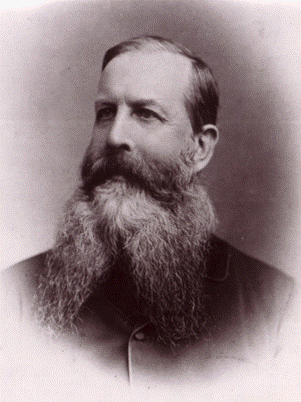
Wirtschaftsrat Julius Prziborski, Verwaltungsrat der Prag-Brüxer Eisebahn.
Präsident d. Brüxer Zuckerfabrick[247]
Julius
was well built in height, a very aristocratic-looking man with big,
wide blue eyes, rich brown hair and a reddish fair beard. As an old man he was still considered one of
the nicest looking men in Prague. A
narrow head with long wavy beard reminded one of the Emperor Frederick. Julius was very strict and doggedly honest
(von unbeugsamer Rechtichkeit). The
sketch of Ex Libris, which his brother Herman drew for him carries the motto:
"Tireless honest effort provides, if not success, at least a clear
conscience - Rastlos ehrenhaftes Streben gewährt, wenn nicht Erfolg, doch
ruhiges Bewußtsein." Julius, however, was also a success.[248]
On the 18th of August 1857 at 17:00 Julius as the director of Veltrusy married Hermine von Krziwanek in the chapel of Věž’s castle. Their great-niece remembers: "Julius's wife was a lady of noble and generous behavior and generous manners. They married the same year as my grandfather (Julius's brother Kajetán) and grandmother, but certainly in a much more luxurious way. On a long, long wedding table was a row of sugar loaves, wreathed with flowers. This decoration was procured by the newly established sugar refinery in Most, with which Julius was affiliated."[249]
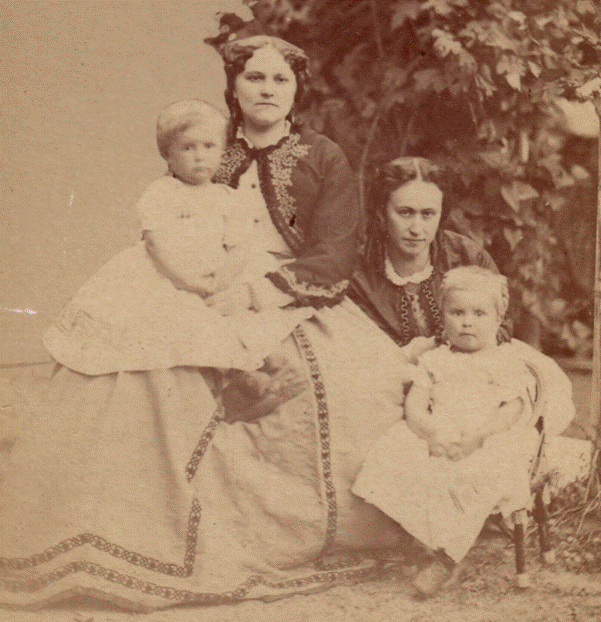
Hermine and her sister Erna and daughters Ella and Selma
After the wedding in September 1857, Julius returned from Veltrusy, despite offers from Count Chotek, to Peruc to a position of economic director, where he would remain until 1870. From Peruc Julius directed the agricultural school in Děčín - Libverda, which was founded by his uncle in 1850, for two years. During the crisis of the Libverda school in 1860, AE Komers appointed him his successor, and after his return his deputy in “all cases of his frequent busyness”.[250]
Julius was in frequent contact with his uncle "Toni": "Throughout the long period of Komers’ service to the Thuns, Peruc was his main interest. There were held first experiments with the use of modern machinery, growing of sugar beets, and a sugar refinery was built etc. The fundamentals of good management set by Komers yielded striking results, but only in years later - under the administration of Julius Příborský. Komers visited Peruc often, and not always in the functions and responsibilities of the director of its central government. Each year Komers spent several summer months in Peruc with his entire family. Count Franz Anton Thun-Hohenstein offered Komers accommodation in Peruc castle, and furnished the whole summer residence from his own expenses.”[251]
In 1870 Julius was “Exc. Gf. Thun'scher Wirthschafts- und Fabriks Director in Peruc”. In Peruc there was a "Zuckerfabrik (a sugar refinery, where "Brzorad, besold. Volontaire" is listed among staff), Brauerei, Spiritus und Presshefenfabrik (yeast) in Teleč.” He was also the central inspector of Komers’ estate in Mostov.[252]
At the chateau in Peruc all four children were born. 1859 Emanuel, 1863 twins Angella and Anselma, whom even Julius could not tell apart, and finally in 1867 Leo. But the brothers also stayed here. In a letter from 1866, after the death of his mother, Julius's brother Hermann writes to their Father: “I'll be comfortably spending the three free days that I get in Peruc, among our loved ones. All are healthy and happy. Julius is very busy and since yesterday here in Prague. About his relocation to Prague I myself know nothing, but it will be discussed, not even Komers, a man who always knows everything, knows anything about it, at least not in the family circle. For Julius naturally, this uncertainty is not pleasant. ... You may be aware that Julius is involved in the purchase of a coal mine. Tomorrow the business transaction - Komers-Thun-Chotek- and another two or three individuals - will be closed. The capital amounts to 200,000 gulden. God bless this endeavor. If conditions do not change for the worse, it will be a very good deal. With the insignificant amount that Julius could invest in this transaction he can not gain or lose a lot.”[253]
By the time he was employed as
Director of the Peruc estate, Julius Příborský was elected as mayor of the
regional council in Louny. In contrast,
he refused the candidacy to the Bohemian Diet, proposed by the municipality
Louny constituency, partly for concerns of job overload, partly because he
wanted to stay away from any nationalistic frictions.
After the death of Count Jindřich Chotek (1802-1864) the control of the estate in Nové Dvory was taken over by his son, Count Rudolf Karel (1832-1894). He reduced paperwork, and he took care of the greater part of government agendas. In 1871 a part of Komers’ duties was transferred to the Inspector J. Příborský. He brought a new vigor into operation. He paid special attention to regular weekly debriefings and the initiative of subordinate officials. Protocols of meetings should have allowed the chief directorate get informed about the normal operation duties of subordinates. Komers’s hands were freed to manage the two sugar factories. An important, though formal change was the introduction of the Czech language into official business at the beginning of 1872.[254]
In 1870 Julius became the headquarter inspector of the Thun estates in Prague, but he did not become the supreme economic councilor after Komers’s retirement in 1874, despite a binding promise.
The Thuns’ domain in 1874, after the death of Count Franz Anton, is taken over by his son Frederick, Count Thun (1810 to 1881) and its management is entrusted to his son František and not to Příborský. Julius did not accept the worse conditions he was offered and asked for retirement. Count Thun informed Count Chotek about that, and he immediately approached Julius and offered him a position of Administrative Director and Economic Council of his estate.[255]
After a joint lease of the sugar factory expired in Úžice and Ovčáry Komers left as the Executive Director the Chotek’s domains and in his place they appointed Julius Příborský, who finally retired from the Thuns’ services.
Immediately he proceeded to reorganize the management system. The change consisted of the creation of the central Prague headquarters, which collected the entire agenda. Another change consisted of simplifying a not very lucid double-entry bookkeeping. Furthermore, on the basis of the current results of economic activity he set standards for the income of the various branches of production, and was concerned about maximum cost reduction.[256] Julius Příborský worked as Economic Council to the Central Directorate of Administration of the Choteks’s estates in Nový Dvur, Bělušice and was the procurator of the Count's sugar factories in Ovčáry and Úžice.[257]]
The images of the castle Kačina are here:
http://www.hrady.cz/wnd_show_pic.php?picnum=40191
Julius writes about Count Chotek’s offer later on: "So surprising and honorable this offer seemed to me; its final adoption, however, was made difficult for me by two circumstances. Namely - to me not unfamiliar - adverse financial circumstances of the Count and the settlement of the company contract concerning the establishment of a sugar factory, which I had to take into account for my good personal relationship with Komers. I have made my entry into this responsibility requiring position after a full check of assets and under the condition, that the settlement with Komers will be held under the participation of the count's attorney, Dr. Schicker. The balance based on the multi-annual averages compiled, showed annual expenditure in asset management of 70,000 gulden. During a hearing that was held at my express request with the Countess present, I explained that I was ready to enter this difficult as well a responsible position requiring reliability with the deployment of all of my forces supported by my honest will, if new reforms are made, which I find necessary as regards to the management of the Counts households and with respect to the overall administration. I could not refrain from expressing my rejection and my criticism of the overload of assets, especially the long term debt in the amount of 1,200,000 gulden and I stressed that rehabilitation (recovery) seems to be possible only with undiminished loan (ungeschwächtem Credit).” Julius Příborský took over the asset management in 1876 and within five years he succeeded in increasing revenue and savings and even achieved a surplus balance in the Count's household.[258]
Julius Příborský fought the difficult economic situation very vigorously. In his statements provided to employees he set as his principle rational management and a "spirit of enterprise".[259] He strived to continue to reduce the cost and plan the revenue, which he calculated as the average yield over the past years. 1875 he reduced the extent of land in direct management and increased the size of the leased land by 1045 ha. Thus the sell-off process, and leasing of the entire estate started. The measure was rational as he obtained capital and reduced management costs. At the same time the tools from the leased yards were transferred to the land remaining in direct management. The continuing economic depression, however, did not allow the trend to be reversed. ... Příborský, however tried to save the estate. On the 13th of June 1876 he presented a reform plan. His principle was to decentralize the various courts and empower farmers, who would get the opportunity to develop their own initiatives. It turned out that revenues from smaller leased yards far outweigh the gains from a centralized manor estate. The Count accepted the plan, but insisted that the revenues cannot fall below a minimum threshold. However, the system did not work to their liking, so he continued leasing especially the arable fields. Forest management remained in direct management. Of the industrial enterprises the sugar refinery in Ovčáry and other surviving companies were leased and only a brickyard in Ovčáry remained in the direct management.[260]
The 1882 silver wedding at the the Choteks' beautiful chateau Kačina by Nový Dvůr is recalled by the great-niece: "How wonderful and merry it was when Uncle Julius and Aunt Hermine Příborský celebrated their silver wedding at the castle Kačina near Nový Dvůr... There were about 40 guests, Count Chotek the first among them. Congratulations, toasts, dancing, walks in the park, roses everywhere, lots of the youth and lots of dignity.”[261] At this time, Julius had a magnificent castle Kačina from the Choteks available as his summer residence. In 1885 the daughter of his already dead brother Hermann was there on her summer vacations.[262]
In 1883 Julius is a witness at the wedding of his niece Marie Brzorádová and Aleš Komers in Německý Brod.[263]
Julius wrote about the so far successful elimination of Chotek’s debt, "The anticipated success of this long-term work and strenuous activities on my part, however became, due to the forces outside of my jurisdiction, spoiled by the Count himself. The first stumbling block was caused by the Count’s lifestyle, and a split (Zerwürfniss) in the family that caused the friendly side to my cause to denounce an existing loan and demand an immediate repayment of a promissory notes issued in the amount of 200,000 gulden. By using the reserve fund, accumulated on the mortgage, the undermining of confidence and loss of credit was removed, but the reserve was reduced to a minimum. Despite all pleas and reproaches to the count, to stop his lavish, large sums absorbing way of life, he attempted to obtain the required sum from usurers, which in 1884 completely undermined our commercial loan, which made the continuation of my governance impossible.”[264] It should be added, that in 1884, the only son of Count, Jan Rudolf Chotek had just died. His funeral was a great event, and in Prague it was attended by all members of the Chotek family , but also by "all Prague’s nobles." The casket then traveled to Nový Dvůr[265] via the northwest railway ", accompanied by Count Arnošt Chotek and ... Julius Příborský."[266] About the Count Rudolf Karel (1832-1894), we read:
With him, however, began the decline of the family and its domains. Although initially he administered the whole business well, after his father's model, after the death of the only son Jan Rudolph in 1884, he lost interest in everything and hopelessly lived the life of waste."[267] Psychic disorders appeared that made it difficult for him to manage the estate rationally.
In 1886 JuliusPříborský asked for dismissal from Count Chotek’s services, "I separated myself convinced that I fulfilled my role according to my best knowledge and skills with real sacrifice and through my dedication, which was confirmed to me by my employer who with full-hearted gratitude and respect manifested this by recognizing this in a personal letter of December 15, 1888." Within three years, however, Count Rudolf declared bankruptcy, and the estate is spared only by the intervention of his younger brother Emerich who is appointed its curator. The owner of the manor fled abroad. But we should also bear in mind that in the 80s of the 19th century there was a crisis of sugar; the situation in the grain trade was worsened by Hungarian competition and the imports from abroad became cheaper.[268]
At the time of the acceptance of the inspection of other estates of Count Chotek the sugar refinery in Most was established in which Julius Příborský took a part. Then he was the vice-president and later also the president of the board of directors for 25 years. Julius in cooperation with director Mikulecky, in the interest of Louny and neighboring districts originated the establishment of the Prague-Most railway. The founding committee, whose founding was assigned to Julius, consisted (besides him) of the director Friedrich Mikulecky, Count Thun as president, Count Martinitz, Prince Lobkowitz, Prince Kinsky, Count Rudolf Chotek and Anton Emanuel Komers. Julius was as a trustee of the committee sent to Vienna, where he in three months managed to push through a concession, which was not an easy task because he had to fight with a rival group led by the industrialist Liebig, who was supported by influential ministers. Julius was then a member of the board until the takeover by the state, with Komers as the president.[269]
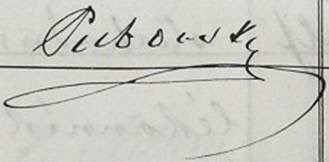
The signature of Julius Prziborsky in the list of citizens of Prague from 19. 3. 1878
Since 1877 - taking over Chotek’s services - Julius lived with his family in Prague, in the today destroyed house in Štěpánská 69.[270] The Grandniece of Julius writes : "From my very early childhood I remember their luxury apartment building with an elevator (on the current site of Lucerna palace) and the gifts from them, a Madonna on a chain and a coffee set decorated with forget-me-not flowers for my doll house in a red basket . ... " At this address we also find a nephew – Kamil Příborský, who later led the family foundation. Kamillo, first a clerk and later attorney and then director of the insurance association of Austro-Hungarian sugar factories.
Chateau Věž was sold after the death of the Krziwanek’s and Hermine P. wished to buy it back when Julius was in retirement. But then they chose a permanent residence in Prague."[271]
At a time when two daughters still lived with their parents, on 9th April 1885 a news item appeared in the Národní Listy newspaper, denouncing the support of Schulverein and naming particularly Selma and Ella:
"The German ladies and girls in Prague. With the ladies it is needed to keep in all circumstances, a certain refinement, a sharp word that a man can withstand, would not be in place with a woman, even if no matter how much deserved. In spite of that we can not ignore the agitation that from the militant circle of biased men is transferred into the society of women and girls and which try to poison better and tenderer feelings in their hearts with nationalistic hostility. We mean the agitation in favor of Schulverein and the establishment of so-called women's branches of the alliance, whose tendency and whose activities must be failed by the judgement of every man, who has some moral principles and whose heart is not deserted and inaccessible for nobler feelings. Also in Prague, now they are starting such women's branch, also in Prague they call together "German women and girls" to gather in the association for protection of the vulnerable "mother" language. For what are these women and girls resorting! To protect endangered mother tongue. Undoubtedly in Holešovice, in Libeň, and in Vršovice, where these institutions are established, their purpose is to suppress the love and even respect for their native tongue in Czech girls, there they are to be robbed of a jewel, which their mothers put in their hearts. Lo and behold, the German women and girls, who gather to help in this immoral mission, under the guise that that they want to protect the mother tongue of little German children, are robbing the Czech children of their mother tongue! How strange such a girl looks and how utterly embarrassing impression gives she, who puts herself at disposal for such a low agitation. We feel sorry for her. The proclamation, which invited the ladies in Prague for accession, has 140 signatures, among which are found no less than 25 signatures of wives and daughters of local German professors and 55 wives and daughters of Jewish bankers and merchants, then the signatures of both daughters of the Economic Council, Mr. P ř i b o r s k ý, who presents himself everywhere as a C z e c h , who is in the service of a Czech chevalier, and who is a native of Humpolec and therefore anything but German. And that Misses Ella and Selma are not German even on their mother’s side is evident from the fact, that their mother was born K ř i v á n e k from V ě ž by N ě m e c k ý B r o d and that both were born in Czech P e r u c by Louny. If such daughters of such families will help the Schulverein, then the association will not get served well, for the two young ladies must be a warning to their parents, as one can see the best in them what the Czech children can become via G e r m a n s c h o o l ."[272]
Even a satirical poem about Selma and Ella was published in the Prague funny newspaper Humoristické Listy on 17th April 1885[273]:
„Dcerušky
rady Příborského
Jsou
obě kdesi od Peruce,
kde,
jak dí báje, Božena
kdys
Oldřichovi obě ruce
podala,
láskou zmožena.
Tak
narozeny v českém kraji,
kde
všade květ se rumění,
„Kochšule“
proto nejvíc dbají
a
německého umění,
pravý
to skvost rodiště svého
dcerušky
rady Příborského.
Ó
velký otče vlastenecký!
Kdo
zazlít by ti moh’, pro Bůh,
že
dcerušky tvé mrav německý
teď
opájí a vzlet i duch?!
Vždyť
vše, co české, u sta hromů!
je
z Němců hlavy plamenné:
i
knedlíky a zelí k tomu, -
proč
nepít tedy z pramene?
Kdo
proto vinit můž ze zlého
dcerušky
rady Příborského.
A
potom! .. Dívek srdce něžná
pro
bídu mají soucit hned,
vždy
dokořán jich ručka sněžná
a
srdce samý jas i květ.
Kdo
proto zazlít můž’ , že blaze
v
nich k utlačeným soucit vzrost’?
Vždyť
toho času s Němci v Praze
je
bídné to přec víc než dost!
Kdo
láti chce, jsa ducha ctného
dceruškám
rady Příborského?!“
On the issue of
language in the Příborskýs family should be added that Julius probably really
felt a Czech and an Austrian patriot - following the example of his teacher
Komers. Both
obviously have not seen an obstacle in a bilingual education, for example, it
was Julius who introduced Czech as the official language to Chotek’s estates![274] It was rather Hermine, who was probably
raised in the German language so that, like her father she felt the need to
protect the German element.
According to the economist Miksch Julius Příborský was involved in public life during his service with Count Chotek, both personally and literally. He was president of the agricultural society, and later agricultural association, president of Association (Spiritunsvereinigung) of distillers, and the Commission for agricultural exhibitions, member of the Provincial Cultural Council (Landeskulturrat, Landeskulturausschuss), the Management Board of the insurance association of sugar factories and the Supervisory Board of agricultural Kreditbank. Like his uncle Anton Emanuel Komers he was also foremost in taking part in the establishment of Czech agriculture.
Julius died on 2nd May 1905, and buried at Olšany cemetery, on the 5th.[275] His obituary was printed in Bohemia daily nr. 121 on the 4th May on pages 5-6:
Domänenrat Prziborski +. Vorgestern ist hier der Domänenrat a.
D. Herr Julius P r z i b o r s k i nach kurzem Leiden im 81. Lebensjahre
gestorben. Mit ihm scheidet eine um die Entwicklung der Landeskultur in Böhmen
hochverdiente, weithin bekannte und geachtete Persönlichkeit aus dem Leben. Der
Verblichene war in Jahre 1825 geboren, widmete sich nach zurückgelegten Studien
mit besonderer Vorliebe der Landwirdschaft und später dem Lehrfache, in welchem
er als Professor an der landwirdschaftlichen Lehranstalt zu Tetchen-Libwerd mit
ausgezeichenetem Erfolge wirgte. Sodann folgte er dem Rufe des Grafen Franz
Thun sen., auf dessen Domänen er als direktor und Inspektor ein weiteres
dankbares Feld seiner ersprießlichen Wirksamkeit fand. Im Jahre 1878 war Jul.
Prziborski zum Wirtschaftsrat für sämtliche Domänen des Grafen Rudolf Chotek
ernannt. Sein vorzügliches Wirken hatte die Aufmerksamkeit öffentlicher Kreise
zur Folge, so daß er in den mannigfachen landwirtschaftlichen Körperschaften zu
Ehrenstellen berufen wurde. In früheren Jahren hatte er der Hauptanteil an der
Veranstaltung der landwirtschaftlichen Austellungen. Er war seinerzeit Vizepräsident des Landeskulturates für
Böhmen, Präsident der ersten Brüxer Zuckerfabriks-Aktiengesselchaft,
Verwaltungsrat der Prag-Duxer Bahn etc. Wirtschaftsrat Prziborski hinterläßt
nebst der Witwe, Frau Hermien Prziborski geb. von Krziwanek, zwei Söhne, die
Herren Finanzrat Eman. Prziborski und JUDr. Leo Prziborski und zwei Töchter,
Frau Selma von Komers (Gemahlin des Ritter von Komers), und Frau Ella von
Hanl-Kirchtreu. – Das Leichenbegängnis findet morgen, Freitag, den 5.d. um 4
Uhr nachm. von der St. Stephanskirche aus statt. (Bohemia 4.5.1908, pages 5-6)
The report from the funeral appeared in the same paper two days later:
Leichenbegängnis. Aus der St. Stefandskirche fand gestern
nachmittags das Leichenbegängnis des Herrn Julius P r z i b o r
s k i, Domänenrates a. D., gewesen Vizepräsidenten des
Landeskulturrates und ehemaligen Präsidenten der Ersten Brüxer
Zuckerfabriks-Aktiengesellschaft, statt. Die vielen Kränze, die den Katafalk
umgaben, und due überaus zahlreiche Beteiligung von Trauergästen aus den
vornehmsten Gesselschaftskreisen zeigten, welcher Wertschätzung, Hochachtung
und Beliebtheit der Dahingeschiedene sich erfreute. Blumengewinde – es waren
ihrer über 50 – hatten an der Bahre u. a.
niederlegen lasen: Der Assekuranzverein der Zuckerfabrikanten, der
Vizepräsident des Oberlandesgerichtes Dr. Ripka mit Gemahlin, Statthaltereirat
Dr. Brosche, Baron Kutschera, Frau Prof. V. Herrmann, Herr und Frau
Oberingenieur Steiml, Her rund Frau Dr. Wien, Her rund Frau Karl Rex, Her rund
Frau Miksch, Her rund Frau Renkin, Herr und Frau Langhans, Herr und Frau v.
Hanel, Herr und Frau Richard Krumbholz, Herr und Frau Porak, Herr und Frau
Plzak, Familie Baron Voith-Herites, Frau v. Görner, Ritter v. Daubek, Her rund Frau Baron von Komers, Her rund Frau
v. Rimay, Her rund Frau Karl Kirchner, Frau v. Dotzauer, Frau Hofrat Stransky,
Frau v. Bundschuch, Frau Joh. Bečvář, Her rund Frau Danzer, Her rund Frau Dr.
Schmeykal, Die Familien Kajetan Prziborski, Zabusch und Schwarz, Richard und
Fanny Fiedler, Jenny und Wladimír Cavalir, Oberst v. Werner, Hofrat Ritter v.
Šafařík-Pštross, die Familien Dr. Ritter und Ritter v. Russheim, Hauptman
Kabler und Frau, Hauptmann Ichl und Frau, Herr und Frau Dr. Funke, Herr und
Frau Prof. Re. Dr. Kirpal u. a. Der Einseguung, welche Pfarrer Batha unter
Assistenz vornahm, wohnten bei: der Vizepräsident des Oberlandesgerichtes Dr.
Ripka, der Vizepräsident der Finanz-Landesdirektion Tersch, der Vizepräsident
des Landesschulrates Zabusch, Hofrat Šafařík, Ritter von Pštross,
Statthalterei-Präsidialschef Hofrat Dr. Ritter von Herget, Regiurunfsrat
Brechler Ritter von Troskovitz, Regiurungsrat Prof. Dr. Lambl, Prof. Dr.
Dittrich, Prof. Dr. Rex, die Oberfinanzräte Lauermann, Hummel, Kornalik,
Präsidialschef der Finanzlandes-Direktion Finanzrat Rossa, Oberlandesgerichtsrat
Kiesling, der ehemalige Präsident des Oberlandesgerichtes Jansa, Regiurungsrat
Hiller, Gymnasialdirektor Anton Maria Marx, Direktor Riemer, Ritter von
Russheim, Franz Richter, Komerzialrat Hans Waldek, Offiziere, Advokaten, Beamte
und zahlreiche andere Trauergäste. Um den Sarg bildeten Offizianten der
Fuchschen Entreprise (Korngasse) bewegliches Spalier. Der Zug bewegte sich zum
Wolschaner Friedhofe, wo die Beisetzung erfolgte. (Bohemia 6.5.1905, strana 6)
His grandniece writes, "He was 82 years old and had already buried all his brothers and sisters, in whose lives he had been so vividly involved."[276]
The wife Hermine then lives with her already widowed daughter Ella at today’s Jirásek square nr. 5., and died there in 1908. The report from the funeral was brought by Bohemia daily:
Leichenbegängnis. Gestern nachmittag fand von der Stefanskirche
aus das Leichenbegängnis der Frau
Hermine v. P r z i b o r s k i
statt. Ein grosser Kreis von Freunden und Bekannten, welche die nun
Verstorbene ihrer selten edlen Charakterigenschaften willen, sowie wegen ihres
unermüdlichen Wirkens auf Humanitärem Gebiete hochgeschätzt hatten, war um den
Sarg geschart, der in der Kirche vor dem Altare inmitten eines wahren Haines
schöner Kranzspenden durch die Leichenbestattunganstalt „Beutler & Fuchs“
aufgebahrt war. Nach der feierlichen Einsegnung durch den Hauptpfarrer Batha
wurde der Sarg in den Galaleichenwagen gehoben, dem ein mit Blumenspenden über
und über behangener Kranzwagen vorausfuhr. Unter den dem Leichenwagen folgenden
Leibtragenden befanden sich: Der Vizepräsident der Finanzlaubesdirektion
Tersch, Vizepräsident des Landesschulrates Zabusch, Oberstaatsanwalt Hofrat
Merhaut, Hofrat Morstadt, der englische Konsul Wentworth-Forbes, der Rektor der
tscheschischen Universität Professor Heyrovsky, Univ.-Prof. Dr. Otavsky,
Oberfinanzräte Sauermann und Hummel, Finnazrat Tessař, viele Offiziere, Prager
Advokaten u. v. a. Ausser den Nächsten Anggehörigen hatten u. a. Kränze gespendet: Viktor und Josza Porak,
Familie Krumbholz, Familie Prziborski-Schreiber, Familie Hermine Prziborski,
Familie von Rymayi, Eugen und Jenny Renkin, Oberstleutnant Mattas und
Schwester, Laura Jicinsky, Julius Plzák, Marie Jensovsky, Antonie Schwarz,
Antonie Krzevisnki, Marie von Hanl-Kirchtreu, Ernst von Hanl-Kirchtreu, Baron
Vincenz Voith Herites-Sterbez, Eugenie Kavalier, Vizepräsident Zabusch und
Frau, Adele Charaus, Deutsche Kochschule, Excellenz Baron Hugo Komers und
Gemahlin, Familie Karl Rex, Nora von Görner, Dr. Hanl und Frau, Regierungsrat Danzer,
Louise Margulies und Helene Rex, Marie Conrad, Johanna Bečwař, Dr. Emil
Turnwald, Dr. Berg, Eleonore von Dotzauer, Dr. Reiter (Budweis), Johnny
Klettetschka (Budweis), Die Beamtenschaft der Finanzbezirksdirektion Budweis,
Familie Oberst von Werner, Emma von Komers, Marie von Hees, Familie Lorenz,
Frau Präsident Vilma v. Ripka, Karl Kirchner, Oberlandesgerichtsrat Josef
Neiml, Baron und Baronin Arthur Kutschera. (Bohemia, 6.10.1908, strana 8)
The Prziborski’s Olšany tomb where Julius and Hermine were buried was reportedly canceled in 1950s.[277] It was probably located in IX. field.[278]
Milada Blažková in her Legend of the genus Příborský translates the text of Miksch’s chronicle as an appendix to Julio's biography: "From a happy family life, a close relationship arose that worked well into the next generation. With pride we look back on a track formed within a few decades. The Příborský, tall, blond and blue-eyed in the their clan, they felt as the nobles, not in terms of rights, but their obligations, to which they were committed. They did not know the feelings of subordination, they had their internal freedom and self-esteem, which is so distant from both arrogance and lowliness. They mixed with any society without prejudice, freely and were able to maintain their noble posture and behavior even in poverty and misery, because they did not measure humanity by external signs or social status. The noble facial expression of Julius Prziborski expresses his unswerving rigor and fairness. It is expressed in ex libris, given to Julius by his brother Hermann and for the offspring it is the epitome of the family’s character. The moto from Ex Libris says, "Rastlos ehrenhaftes Streben gewährt, wenn nicht Erfolg, doch ruhiges Bewußtsein."
Emanuell 'Mani' Prziborski (1859-1921)
The eldest son of Julius and Hermine Příborský, Emanuell, also called Eman, or 'Mani' Prziborski (1859-1921) studied law in Prague and then became a finance councilor of the Provincial Financial Directorate in Prague, where he won the Jubilee Commemorative Medal for public service. From 1903 on, he was at the Imperial district headquarters in the České Budějovice, where he became the chief financial advisor of the imperial tax authority, later he became its president and received the Jubilee Cross medal for civilian state service. On July 20, 1901 Emanuel received permission to write his name as "Prziborski" by imperial gubernium in Prague. Other family members of this generation have made the same change to their name.[279] Julius’s grandniece recalls: '' Emanuel 'Mani' was a bachelor, gourmand and Seladon, a social butterfly. Witness at the wedding of my parents[280] and their frequent guest after the wedding. My birth he welcomed apparently by a longer, humorous toast. He had been a friend of Uncle Kamil.[281]”
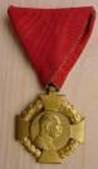
Jubilee Medal, Jubilee Cross
In the collection of studies on modern history we read about the turbulent circumstances of the appointment of Mani Prziborsky as CFO in Czech Budejovice in 1908: "... Almost continual battle led the Czechs and Germans at every appointment (for appointments to financial directorate - ed. Ed.) In counties bordering the national border or within the mixed regions ... the Czech side tried to occupy the two places with their nationals ... In České Budějovice, however vice president Tersch, in agreement with the Ministry of Finance is going to appoint Prziborsky as Chief Financial council , who claimed allegiance to the German nationality. Representatives of Czech politics, especially The Young Czechs protested against a similar solution. ... For the Vienna Treasury this created an almost impossible situation ... The task was taken over by the agrarian deputy prof. dr. Brdlík. Along with Budějovice’s financial council or Harmach they convinced Prziborsky of the necessity to pass into the hands of the Minister Prášek statements about his future neutrality in all national issues. Shortly afterwards Prziborski wrote (4. 2. 1908) to Karl Prasek: “ At the same time I would like to assure Your Excellency that I will try ensure the objective conduct of national affairs, to satisfy your Excellency." Together with a personal audience with the minister-countryman this letter allowed Prziborsky to reach the position of the district financial headquarters in České Budějovice. 25) As compensation the Czechs won the post of Director of the post office in České Budejovice and a Czech official was appointed the head of the main customs office in Prague.[282]
Emanuel Prziborski dies without descendants in 1921 in České Budějovice, where he had been joined by his already widowed sister Ella since 1907. The grave nr. 6-9-3/J at České Budějovice St. Ottilie’s cemetary, where they were both buried, was cancelled in 1951.
Ella née Prziborski (1863-1936) and Captain Karl Hánl Edler von Kirchtreu (1848-1897).
Angella (also known as Angelika, Angel, Ella) Hanl Edle von Kirchtreu born Prziborski (1863-1936) was born in Peruc No. 1. This is the chateau where her parents and her twin sister Anselma with their brother Emanuel apparently lived until 1877, when the family moved to Štěpánská street in Prague. In 1891 she married Lieutenant Karl Hanl von Kirchtreu (1848-1897). She had probably already known the groom. Ella’s uncle, Karel Prziborski, Chief Economic Advisor in Chrudim, was married to Maria née Hanl von Kirchtreu, the groom's sister.
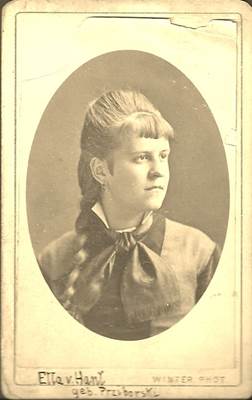
Ella Hanl von Kirchtreu née Prziborski (1863-1936)[283]
The Hanls came to the peerage thanks to ThDr. Karl Borromeus Hanl Baron von Kirchtreu (1782-1875), bishop of Hradec Králové,[284] the son of poor parents.[285] He was raised to the rank of Barons on the 40th anniversary of his ordination at the age of 90!
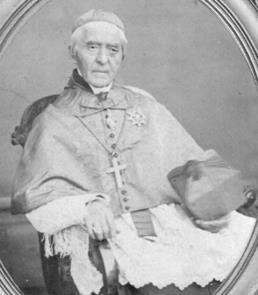
ThDr. Karl Boromeus Hanl baron von Kirchtreu[286]
Right
then he asked for a transfer of the baronial title to his nephew, the District
Governor Karl Hanl (1813-1879), who "has been loyal in service to the
State for 35 years.” The relevant
officials, both in the rank of Barons, however, came from the lower nobility
and disagreed with such rapid social advancement of an ordinary district
governor. So they suggested just a
simple nobility, which was approved by the emperor. Thus the district governor became a nobleman
- Edler von Kirchtreu.[287] It is just this district governor, who also
advanced from a poor background, who was the father of Angella Příborski’s
groom. Besides the building, nr. 1 in
Tomášská street in Prague’s Lesser Town, he had also owned since 1876 the
estate of Hudlice with a little castle[288]. After his death it was divided by thirds,
shared by his daughters and sold in 1886.
In 1885 Sylva Příborská later Miksch spent summer vacations in Hudlice
(an orphan after Ing. Herman Příborský).
Also her father used to be a frequent guest there as he worked on the
construction of railroads in the vicinity of Beroun. It was particularly nice in Hudlice, they
said. Numerous forest trails and hikes
remained in her memories forever. The
wide family circle used to meet here, so there was a a lively life in a
spacious residential house of the estate "Gutshaus". [289]
The company, which used to meet in Hudlice, consisted of the family circle of
Hanl’s, [290]
namely Karl Hanl, his wife and her unmarried sister Fanny von Stranka u.
Greifenfels, who operated a boarding house for girls in Prague, uncle Bishop
Hanl, daughter Clara and her husband Professor Leopold Heyrovsky, daughter
Hermine and her husband Karl Příborský , economic director in Chrudim, son
Karl, who was later married by Ella Příborská, and Ernst, later Doctor of
Laws. Later on the Hánls owned a mill
near Prachatice, where the family also used to meet.[291]
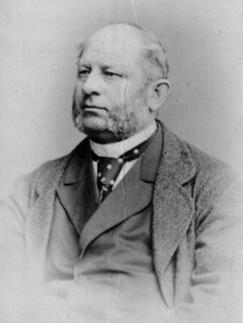
Karl Hanl the Edler from Kirchtreu ( 1813-1879 ) district Governor[292]
The groom's mother died when he was one year old; Karl’s other siblings were later born by Maria Theresia born Stransky von Stranka und Greiffenfels (*1829) later on. (The writer Jiri Stransky stems from this family.) The family used to meet "at Grandma’s" in Tomášská street in Prague. Ella's husband (since 1898 in the police report in Prague “Angelika” is crossed out and it is written “Ella”) Karl Hanl Edler von Kirchtreu, who later became a captain in the 3rd cavalry regiment, where he had already been since the cadet school, had one brother, Dr. Ernst Hanl von Kirchtreu, a secretary of the German section of the land committee and also sister Hermine, who married an economic director in Choceň Karl Příborský, and a sister Klara, who married a professor of law JUDr. Leopold Heyrovský, the father of the Nobel Prize winner, Prof. Dr. Jaroslav Heyrovský. Thus our Ella was an aunt of this famous Czech.
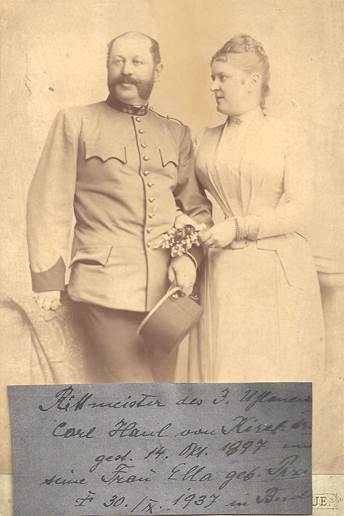
Rittmeister Carl Hanl von Kirchtreu (1848-1897) a
jeho manželka Ella rozená Prziborski (1863-1936)[293]
Jaroslav Heyrovsky's sister Klara married a painter Hofbauer and captured the pieces of family history of Stránský and Hanl with a picture of her grandmother's home in her book "Among scientists and artists".[294] Captain Karl Hanl is mentioned in the book as follows: "A tram has a stop just in front of my grandmother's house. (Tomášská 1) The oldest grandmother's son, big, strong and kindhearted Uncle Karl with beautiful, bright blue eyes and black "sideburns", who is an officer at the Uhlans, during his vacations often looks out of the windows and always knows already which tram number would be coming" (before 1890).[295]

Malostranské Square in Prague Lesser Town, Correspondenz Karte, before 1916[296]
Ella married him in 1891 when she was 28 and Karl was 43. They only had one son Karl Hanl von Kirchtreu (1891-1915, the fourth Karl in the clan. But Ella's husband died when his son was just six - in 1897 in Vinohrady no. 18 in Prague, and was buried in the Olšany cemetary. Ella then lived at several locations in Prague, for a while she was living with her parents at Štěpánská; after her father's death, we find her in the directory listed with her mother as co-owner of the house at No. 1982 / II., which is no. 5 on today’s Jiráskovo Square. Her mother died there in 1908 and Ella in about 1910 moved to her brother Mani’s to České Budějovice.
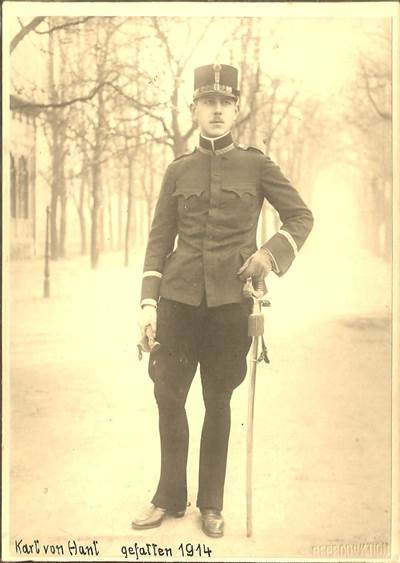
Karl Hanl von Kirchtreu (1891-1914) [297]
Kari Hanl is remembered in comparison to her cousin Ilka Komers as "quite a different, gentle, nice boy."[298] An only son Karl (Kari) Hanl Edler from Kirchtreu (1891-1914), Lt. of 13th Dragoons was killed at the age of 23 during the attack on Russians in Galicia on 31 August 1914, two months after the announcement of mobilization, freshly graduated from the cadet academy. Dying instantly shot in the left eye, he was buried in the same spot, on the edge of the forest, north of the village Sanovka. On September 24, 1914 the daily Bohemia brought this text of the letter of the heroic death of Lieutenant Karl von Hanl Kirchtreu sent by the command of the 13th Dragoons to his mother.
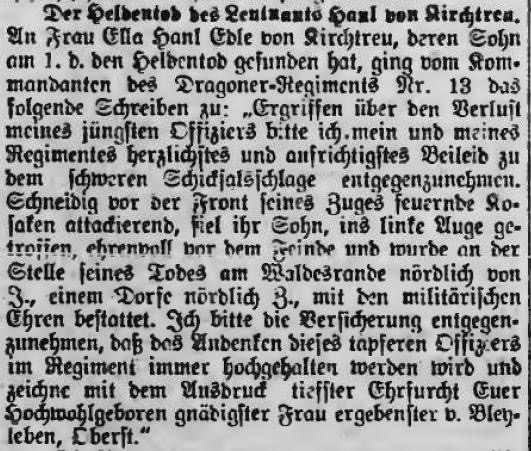
The letter sent informing Ella Hanl about the deat of her son.[299]
According to the Bohemia daily from 14. October 1915 Ella invested 30 000 K in the third state war loan “Die Kriegsanleihe”.[300]
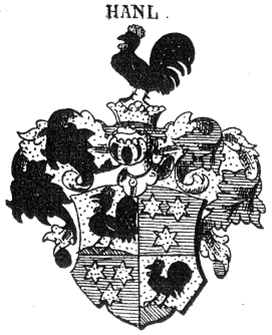
The Coat of arms of Hanl Edler von Kirchtreu in Siebmacher[301]
Ella's brother Emanuel died in Budějovice on May 1821 and in July of that year Ella received the right of domicile. She lived some time in the “Vienna suburb” nr. 494), which is the exquisite corner house on the corner of Žižkova street (today 223/9) just opposite the mouth of the Čechova street. - Basically across the street from the house no. 24, where her brother Emanuel Prziborski lived. German economist Miksch, who apparently knew Ella writes: "Ella lived in her noble (vornehmen) apartment furnished with numerous images of ancestors. She was smart, energetic, rejoicing in the life of a woman, who was, as much as she could be, with her sad fate, satisfied. (Sie war ein Kluger, energischer, lebensfroher Mensch, der sich, so gut es ging, mit seinem traurigen Schicksal abfand.) Extensive social contacts with the aristocracy of southern Bohemia allowed her to experience less solitude.”[302] She herself died in České Budějovice’s hospital in the year 1936, buried with her brother Mani, in grave nr. 6-9-3/J at České Budějovice St. Ottilie’s cemetary, which was cancelled in 1951.[303]
We can now focus our attention to her Ella’s twin sister - Selma.
Anselma née Prziborski (1863-1934) and JD Franz Ritter von Komers (1848-1935) [304]
Anselmsa
(Selma) Prziborski (1863-1934), like her twin-sister Ella, was born in Peruc in
1863. In 1886 she married the son of
father's uncle, AE Komers. The groom was JUDr. Franz Emanuel Ritter von Komers
(1848-1935) then a county commissioner
in Carlsbad. His dictionary entry says,
“He studied law in Prague and worked at various district offices. In 1893 he was appointed a regional governor
in Landškroun, where he worked until his retirement in 1908. As an Austrian monarchist he tried to be
neutral in the ethnically edgy environment. This led to conflicts mainly with
to the Berlin oriented Germans; attacks
against him can be found in both the contemporary German and Czech
nationalistic print. At the time
of the Hilsner trial he suppressed a wave of anti-Semitism in
the region. After the founding of the
republic in 1923 he opted for citizenship in the city of Graz.”[305]

Selma von Komers née Prziborski (1863-1934)[306]
As we already know AE Komers and Julius Prziborski not only worked together all of their lives, but they and their families lived together mainly in the summer in Peruc and after 1877 in Štěpánská street in Prague. The children therefore had surely known each other since a young age. We may add that at the time of the wedding of Selma and Frantz Komers, the groom’s father, Anton Emanuel had already retired and had no assets - the family estate with the castle in Lžín was sold in 1881, the one in Mostov in 1885. The bride was sent off from the Prziborskis in Štěpánska 69.
The bridegroom had already graduated as a doctor of law in 1878 and initially worked as a private lawyer in Trutnov. But then he joined the Office of the Stadtholder in Prague and in the civil service he had remained since. He alternated the offices and cities where he worked. The wedding witnesses were the unfortunate Count Rudolf Chotek (1832-1894), who was close to both the fathers and the bridegroom's uncle Heinrich Emanuel Komers Baron von Lindenbach (1808-1889), former president of the Highest Regional Court and the Austrian Minister of Justice. In 1886 the Komers brothers sold their Prague houses. Perhaps due to the close (family) relationship the couple's first child was born dead, and later, in 1888, still in Carlsbad an only daughter Helen Angela Julie Hermina (Ilka) was born.
In 1893 came the last promotion and the lawyer Franz von Komers became a county commissioner in Landškroun, where he moved with his family. This peak of his career is very closely mapped in the work by Marie Macková: “An Official of His Majesty."[307] Franz was a loyal Austrian official using German in his office. However, unlike the supporters of The All-German party (Alldeutsche Vereinigung), he did not have a problem with the coexistence of multiple nations or with using more than one language. Practically his political positions were based on the positions of his father, who called himself a federalist, and as we know, did not hesitate to introduce some Czech lectures at his agricultural college, when he found it necessary. Lanškroun was decidedly politically oriented to the right wing All German party of the cumbrous anti-Semitic deputy (stripped of knighthood for public violence), Otto Schönerer and Karl Wolf.
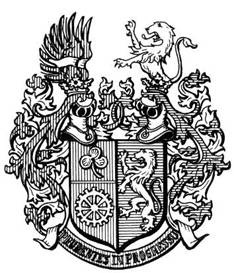
Ritter von Komers ( 1873)[308]
In 1897 for example, reflecting the current atmosphere, the public found an Israelite from Usti guilty of the ritual murder of a deceased girl. Komers first called the gendarmerie in Usti for help (eight men strong) and also the newly established municipal police. Then he emphatically rejected the overall incrimination of the local Jews and ordered the district doctor to exhume the buried body. The subsequent autopsy confirmed that no one was guilty of the crime. Thus he quieted the rising avalanche of anti-Jewish riots and storms. For the role played by Selma von Komers née Prziborski herself, we quote the next story directly from the work by M. Macková:
"As an educated and loyal servant of Habsburk’s monarchy, Dr. Komers, however, bore up well in the conflict with the element characterized by an aversion to all things Non-German – Semites, Slavs, but also to the very Austrian throne. He managed to defend its position not only through official channels - with the full support of his superiors, but also in the press, both in the Czech and German language. ... It was the language laws declared in 1897 by Count Casimir Badeni, Prime Minister of His Majesty, that became particularly sensitive in Lanškroun. It was the notorious linguistic regulation for the Czechs, equalizing, in short, Czech with German in official contacts. In all consequences , it especially targeted the German-speaking civil servants in linguistically mixed areas, because the number of those with active knowledge of Czech was decidedly smaller than the number of their Czech-speaking colleagues with an active knowledge of German. Consequences could not be long awaited, and the most scandalous, apart from the demonstrations, newspaper campaigns and other violence, resulted in the fall of 1897, when one of the "two men of (allgerman) party, deputy of the Imperial Council Karl Hermann Wolf acted so offensively against the Prime Minister that this tall count with remains of his white hair and a neatly manicured mustache challenged him to a duel. Mr. Wolf, however, lost his nerve and fired a little sooner. This was not consistent with good behavior, but it had the effect of seriously injuring the hand of Count Badeni. The social sensation brought about the Emperor’s visit of the wounded prime minister and it somewhat tarnished the schönerian’s reputation. However, it established a precedent that allowed supporters of AllGermans to resist the state power by all means, even those less tolerable. ...
The year was 1899, and as a precursor to the upcoming parliamentary elections Karl Hermann Wolf took off on a campaign tour of the country. On the way to Lanškroun he had already experienced an unfortunate incident at the Česká Třebová train station, where he was attacked according to his own statement, "von mehreren čechischen Burschen" (by several Czech youths). In addition, his pre-election meeting in Lanškroun had been banned the governor (Komers – editor’s note). On August 14, 1899, therefore, instead of the meeting, despite the captain's ban, the demonstration was held at the monument of Emperor Joseph II. According to the minutes of the city council meeting of Lanškroun there were sung "innocent German songs." Dr. Komers enforced his somewhat sagging authority by police assistance. The City Council unanimously immediately expressed outrage over the fact that an act or ban of such events rests solely on the goodwill and willingness of the district governor, who, also in their opinion, has been hurting the city for two years with his vindictiveness. The City Council resolutely demanded the governor’s resignation because the Slavic spirit of his policy unsettles the local population so that it will not be possible to keep the peace between them and keep order. ...
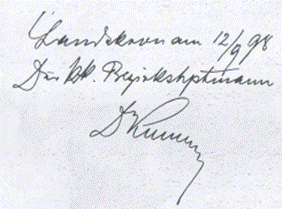
The statement of the city council, however, does not mention that deputy Wolf, accompanied by his apparently quite numerous supporters chanted under the windows of the governor’s house something about a cheeky dummy and the police did not intervene. Nor does it describe a minor incident at the governor’s office, when, after an exchange of views with the Governor, Wolf left the room not only with an emphatic slam of the door, but also with verbal accompaniment. The problem was that instead of the anteroom or the hallway he stepped into the governor’s private quarters (according to the former custom it was immediately adjacent to the official room) and a shower of verbal rudeness passed at the feet of the governor’s wife. She apparently showed enough ingenuity and with grace she threw the rowdy out into the hallway. Of course, Dr. Komers sued KH Wolf for a private offense, and also for utterances such as "Sassy aristocrat!" and "Cheeky bastard!"
Dr. Komers eventually won at the court. But the whole thing had a parliamentary sequel. On March 2, 1900 Karl Hermann Wolf interrpelated in favor of his Lanškroun’s followers. He pointed out the conduct of the district governor, referring back to the year 1897 ... but the Stadtholder office stood by His Majesty’s official, besides the loyal one in his own convictions, and without any more comments swept the interpellation off the table.
Titular Stadtholder Councilor (Titular Statthaltereirath – since 1903[309]), Franz von Komers, and finally the district governor in Lanškroun, a region of Chrudim, was retired by a decision of 30 November 1908 no. 11 808 MI.”[310]
The fact that Dr. Franz Ritter von Komers was awarded the Royal Prussian Order of the Red Eagle class III[311] and probably also the Honorary Cross of domestic order of Prince Schaumburg-Lippe[312]indicates that he did not side overly with the Czechs.
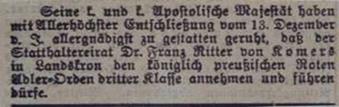
Granting of the Royal Prussian order of the Red Eagle III.class,
probably in 1905.[313]
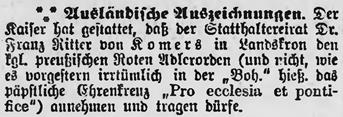
Correction of the false announcement of Ritter Komers’s getting the „Pro ecclesia et pontifice“ order in daily Bohemia from January 1906.[314]
Regarding the Komers' next stay, we only know that in 1911 the couple registered at Prague's Smíchov. At a later time and after 1912 they are registered in Austrian Graz (Liebiggasse 12 Gradz, Steiermark).
Selma died of a stroke on July 29, 1934. Her husband Franz Ritter von Komers of old age later in Graz Nov. 21, 1935 at the age of 86.[315]
The one daughter Ilka (1888-1945) is remembered by her cousin: "Ilka - Helena was that curly child that I liked so much on the photo at Aunt Erna’s."[316] " I knew the Komers, Aunt Selma and Ilka, who did not know - because of her pride - how to hold her head, she especially looked at me contemptuously, because I did not speak German. It was Kari, the Aunt Hanl’s son, who was very different, delicate, and a nice guy. How hard would it be for this elitist family to bear these times. ... Also very dr. Leo was nice... "[317]
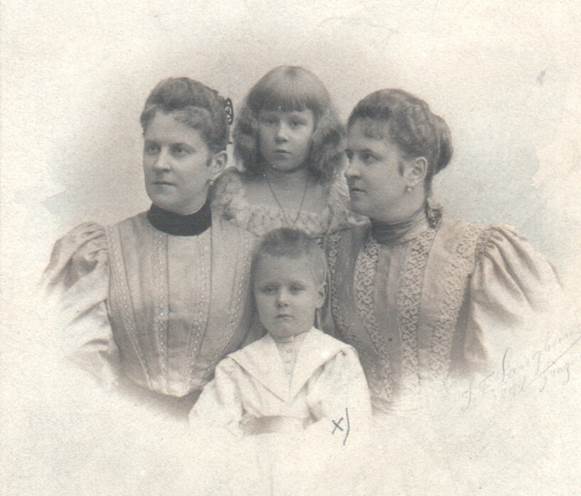
Selma von Komers and Ella Hanl von Kirchtreu, Cari Han lat the bottom, Ilka von Komers at the top; photo J. F. Langhans Prague 1891/2[318]
According to the registration from
08/24/1923 Helene von Komers was in Graz from January 25, 1926. She lived with her parents in Liebiggasse 12
on the first floor. After the death of
her mother on the 8th of May 1935 she went to an
apartment on the 3rd floor of the same building as „HM” = Haupt Mieter - the main tenant, and remained
there till the end of January 1940.[319] On the 2nd of March 1940
she married Friedrich Poten, born 20.8.1875.
Friedrich Ernst Augustin Poten was born in Lachodowen, parish of
Wyzniay, district Przemislany. In 1875
he was a captain of row boat (Linienschiffskapitan) off duty. He was the son of Ernst Friedrich Karl
Potential, who was Feldmarschall-Leutenant, born in 1845 in Lachodowen and
Sofia née Lang, born in 1854 in the Petz in Galicia, married in Lemberg. The groom's residence was Leopoldsdorf im
Marchfeld.[320] Friedrich Poten died on 30 December 1944 and
Helene followed him 19 November 1945.
Else Fritschl sums up Helen's fate as follows: Helene married into an old Austrian military family. As Helen's occupation is listed as "Private", she lived off the property of her parents. Because all property fell victim to inflation after the First World War, the inheritance after the death of her parents could not be big. Marriage to 65-year-old retired captain was no marriage for love. He died before the war ended and Helene experienced poverty again, as the entire property went away. She died there in the first hungry months of 1945. There was not enough to eat, with nothing to heat, she was by herself[321] lonely and abandoned.[322]
JUDr. Leo Prziborski-Voith-Herites (1867-1940)
The last sibling of the Prziborskis was the youngest brother Leo (1867-1940), who belongs to the end of the story of not only this family, but also the whole von Herites and von Krziwanek family. He was born in the chateau in Peruc. His godmother was his grandmother Caroline Krziwanek and aunt Marie Brzorádová.
The register of doctors at German Charles-Ferdinand University in Prague (1882-1892) dates the doctorate of Leo Prziborski to 21 December 1891. In a note about his grammar school education it says "Prag" with a question mark. Leo was still with his parents in Prague in Štěpánska in 1896, but was already known as JD. Leopold Prziborski, attorney. Attorney Lev Prziborski in Prague was entered into the list of lawyers according to the Národní Listy daily of September 29, 1898, p.6.
Another newspaper article “Sunday rest in law firms”, : At the instigation of the board of health insurance funds of candidates of advocacy and advocacy officers in Prague and suburbs, a rest day at the law offices for Sunday and holiday was introduced for the summer period that is till 30 September, by closure of their offices by the following doctors. ... Prziborski (all year), ... (Národní Listy 14th July 1900, p.2)
In 1901 as an attorney in Prague he married Maria Anna Porák de Varna (1882-1957). In a letter of 1902 Leo's cousin Anna Dostálová responds to the news of Leo's wedding: "Leo has also got married!? Well, I believe there was a lot of splendor and luxury at the wedding, when he got a half a million bride. But it is strange that no one from Kolin attended! I think they feared that those gentle Prziborskis will, as usual, insult them with their disregard. Hermína[323] is apparently still sick, the poor have already suffered so much and what about Berta?”[324]
Familie Porak de Varna
The bride’s father, Victor Porák de Varna (*1852 Trutnov +1932 Český Krumlov) was an industrial entrepreneur, farmer and politician.[325] He studied at the Technical University in Prague and Vienna, and toured Europe.[326]
From 1881 on Viktor’s wife was Isza / Josefine (* 1860 in Prague), daughter of Felix Rimay de Gidofalva, the stableman to Prince Lobkovic at the Prague Castle (* 1798 Lwow, Poland, + 1880 Prague).
Her brother Arthur Rimay di Gidofalva (*1865 Prague), an art dealer in Prague, belonged to the Prague Theosophical Lodge at the Blue Star, together with Baron Adolf Leonhardi, Count Jan Harrach, Gustav Meyrink, Karel Weinfurter, Julius Zeyer and Emanuel of Lešehrad.[327] He used to go to the house No. 53 in Latrán, Český Krumlov, which belonged to his brother-in-law’s family – Porák, where he also invited his friends. This house can be found in Meyrink's novel Der Weiße Dominikan. [328] Karel Weinfurter and Gustav Meyerink and Arthur Rimay di Gidofalva met in the Prague café in Příkopy street after 4 pm and then again in the evening. Weinfurter writes: "Our third companion was a friend Baron Rimay, who later developer into an enthusiastic occultist and a diligent mystic. Our main effort was to reach psychic power, as is the case with every beginner ... "[329] Meyrink describes an incident when they agreed that by thinking of Arthur, he would knock on a table with a stick near him in his sleep. This really happened in Arthur's apartment at the appointed time - at 1 in the night and woke up the maid and the mother. [330]
Finally, in his article on G. Meyerink, editor Weinfurter mentions once again a member of his then-lodge, "baron" Rimay: "This baron Rimay told our editor years ago how his sister was operated on under anesthesia at a certain Prague health clinic. After a successful operation, she told her brother how suddenly she felt very light under the narcotics and hovering above the top of the sanatorium's roof, feeling being pushed higher and higher, away from her body. Three times, however, she was pulled back to the body lying on the operating table with an unknown force, and three times she was thrust away from from the body above the roof. The fourth time, she was forced to enter her body, losing consciousness. Rimay then told the editor Weinfurter that at the time of the surgery he lay in his apartment on the sofa, and concentrated on his sister, to be rescued. The operation was very dangerous and difficult, and Rimay's attributed her well-being and saving to his efforts. The assisting doctors confirmed that during the operation her pulse went suddenly very weak three times, so they feared that the lady would die on the operating table."[331]
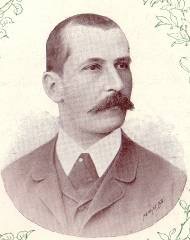
Viktor Porak de Varna (1852-1932)
Together with
his brothers Ernst, Alfonso, Hugo and Anton, Viktor Porák became, after
the death of their mother
Anna in 1885, a co-owner of
the biggest weaving factory in Europe. It was founded
by his mother's father Jan Faltis in Nové Buky and Trutnov. In 1874 Viktor's mother was therefore
one of five
heirs to a nearly eight million gulden fortune. It is no wonder
that in 1876 she bought Krumlov's graphite mine that was managed by her husband, a Lišov’s native, a National Party /
Staročech (Old-Czech) deputy,
Trutnov’s mayor, MD. Anton Porák (1815-1892).[332]
Since 1877 Viktor Porák was an administration engineer of the Prince Schwarzenberg’s goods in Krumlov.[333] The Schwarzenberg graphite mines were close to Krumlov in Černa v Pošumaví and the director who later worked with Viktor worked in Krumlov and did the "analyses and inspections", was Příborský family’s distant relative.[334] The five Porák’s brothers then got the graphite mine firm Krumauer Grafitwerke Brüder und Porák Graphitbergbau from their mother. Viktor became the director in the company. At the same time in 1885 the brothers founded the company Moldaumühle in Kienberg – Vltava’s mill in Loučovice.
Ernest left
Krumlov for Loučovice, building
there a highly successful modern paper factory and in 1895 after a friendly agreement with his brothers he became its sole owner.[335] (The plant was in family hands
till 1945, in 1946 it was confiscated under the Beneš decrees. The production continues there to this day).[336] According to a dubious mention in the letter to her relatives Kurt Prziborski was still employed
there in the '50s.
From 1893 to at least 1902 Viktor owned an estate in Třebětice (also Třebnice) district of Sedlčany with 260 ha, the castle with a chapel and a park.[337] There he was even a member of the regional council.”[338] Viktor Porák de Varna bought Třebnice as the co-owner of graphite factory in Český Krumlov from the widow of Vilém Pistorius in 1893 for 175 000 gulden.[339]. He sold it to Mrs. Agnes and Mr. Čeněk Šembera in 1904 for 180,000 gulden[340].
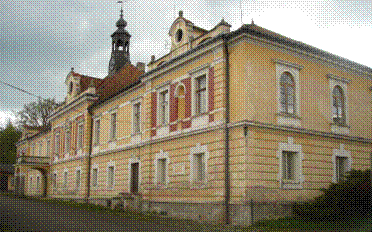
Třebnice near Sedlčany, castle with park, May 2008
Two years after the brewery ceased operations in 1892, Porák de Varna set up a distillery instead. Next to the entrance to the courtyard beside the road, on the stepped base stands the statue of St. John N. By it there are four rounded, granite pillars, which have stone slabs with an iron cross on their tops instead of the roof. Around the statue there is a garden, enclosed by a wooden fence.
In the trees of a nice park near the
distillery there is a view of a one storey castle with a tower and a chiming
clock. All of the castle equipment and things from the 18th century are reminder of
Radetsky. Immediately upon entering the
hall, beneath the vaulted ceiling, we see two black marble slabs on which a
Czech and German inscription says: "Here was born imperial and royal Field
Marshal Count Radetzky von Radetz November on 2, 1766, died at the Villa Rente
in Milan on 5 January 1858."
Behind this hall there is a vaulted
chapel, richly and tastefully decorated.
The altar has a painting of the Madonna with the baby and on the sides
the relics of saints in richly gilded, baroque frames. On the side walls between the various
pictures four baroque mirrors stand. At
the back in a baroque gilt cabinet Christ on the cross is hanging between two
old paintings on canvas. The chapel,
which has a row of nicely carved pews, is dimly lit by two vaulted windows
fitted with painted glasses.
Even all the rooms and halls on the upper floor preserve with reverence the character of 18th century, especially the Radecký’s times. In the bedroom there is an ancient, ornately inlaid wardrobe and a portrait of Radetzky’s mother in a bonnet with prayers in her hands. In one room there is a wonderful collection of plates, various containers and pots from Radetzky’s household; in another a collection of weapons and hunting trophies; and in another on the old inlaid cabinet with three armoured drawers a set Marshal’s parents’ pewter dishes; next a finely hewn white marble bust of Radetzky and a large alabaster vase. For other inventory, mostly originating from Radetzky’s household, we find: writings and books after Radecký in an old wardrobe, Radetzky’s writing utensils spread on the table, painting symbolically suggesting the lineage of the Radecký family with an interesting view of Třebnice from the 18th century in the background, a beautiful vase engraved with Japanese figures and an old painting on canvas, representing a shepherdess with a child, grazing herd of cows, sheep and goats in front of a castle ruins.
Worth mentioning is a painting in a rich, baroque frame, representing life-size effigy of prof. Mittwalsk7, Prague's renowned ophthalmologist at the end of the last century. The professor was Pistorius’s daughter’s groom, but the wedding did not take place, because Mittwalský had died shortly before...[341]
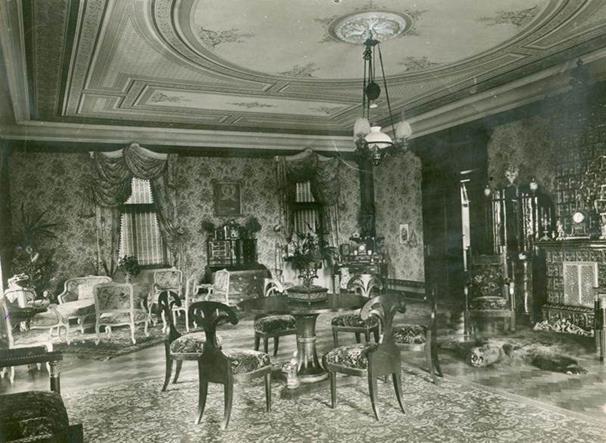
The interior of the Třebnice castle, about the 20’s of the 19th century.[342]
In 1895 Viktor becomes the sole owner of Krumlov’s graphite mines. The graphite mine firm in Krumlov experienced its peak between the years 1897 - 1906, when Krumlov mining company of Porak’s brothers exported pressed blocks of refined graphite to Germany, Britain and America.[343]
Alongside these small but prosperous mines, Viktor also owned deposits and a smaller company in Madagascar. [344] This mine in Antsirabe, where uranium deposits were found, was taken over from Viktor in 1910, by his brother Ernest's son, Richard.[345] The corporate archive mentions the exports of graphite from Ceylon, aquamarine, turmalin from Madagascar and the establishment of a company in Madagascar, 1905-1915.[346]
The graphite plants in Bruck an der Mur, where the company also mined, should be mentioned too. In the corporate archives of Brothers Porák’s Graphite Minings an item „Bruck a.d. Mur” was preserved: records of findings of graphite, graphite mining permits, equipment inventory 1905-1911 or correspondence with customers of the sawmill in “Bruck / Mur 1889-1908”.[347] According to the Industry Yearbook of 1923 the company was managed by the attorney Dr. Leo Prziborski-Voith Fabriksdirektor. 160-200 employees produced 400 tons of graphite per year.[348]
The Brothers Victor and Ernest as Krumlov’s industrialists were active in national activity and supported the Czech element in the city. Besides the Readers’ Club - Čtenářská Beseda and a Czech School, in 1883 thanks to the two brothers there was founded a Czech financial institution - credit union Záložna. This institution on whose committee Victor and Ernest sat served to protect vulnerable populations from usury (up to 20% interest rates at that time for a short term loans).[349]
On the 20th of June 1918 Viktor Porák became an honorary citizen of the town of Český Krumlov. A diploma is loosely inserted in the book of honorary citizens of the city.[350] The honorary citizenship was granted to him unanimously in recognition of his special merits in the village. The book then states that he was awarded with respect to his function as a member of the municipal committee and in recognition of the numerous and excellent social assistances. Particularly noted was how he helped the town in building a slaughterhouse where he sold his land on favorable terms, or how he made his private property - gorgeous, especially his convenient residence of Rabenstein – Havrani Skala - accessible to public.
After the decline of shipping (the import of salt on ships virtually ended) at the end of the 19th century Zelená Ratolest (Green Bough - the oldest house in Husova Street in České Budejovice) was owned by Kotva company for whom the entire complex was bought from the knight Lanna by Viktor Porák. The premises were rented then by the Zátkas Brothers company for grain warehouses. In 1909, the Zátkas Brothers bought the entire Zelená Ratolest.[351]
In the description of the mining industry in the České Budějovice region in 1901 we read, “... graphite mines in Český Krumlov have 28 simple mining claims (a mining claim is a rectangle or square of 45,116 m2 and go into unlimited depth) in Č. Krumlov, Přísečna and Kladno. The owner is Viktor Porák de Varna, plenipotentiary Ignatius Jirasek, a mining director in Č. Krumlov. The plant employs 1 overman, 1 climber, 3 supervisors, 196 workers. In two graphite refineries there are 12 milling machines, one spherical machine, 5 combined cylinder sifters, 1 bellows “družidlo”, 18 desludge pits and mixers, four filter presses, 20 drying rooms, 2 evaporating furnaces, furthermore in the plant there is black wash factory (raven silver ) with 10 presses, hacksaw. ... The owners of lignite (brown coal) mines in the municipalities of Vrábeč, Lipi and Boršová are the Porák brothers in Č. Krumlov.”[352] Coal deposits Koroseky (Hynek and Hermína) – The lignite mine Koroseky is owned by the Krumlov graphite factory of Bros. Porák in Krumlov. The mine owner is Viktor Porák de Varna.[353]
The noble title “de Varna” was gained by the brothers Viktor, Ernst, Anton and Alfons - Hugo had already died - Porák in Trenčín, Slovakia (then Upper Hungary) where they visited a notary on October 17, 1895, having a predicate to be added to their name, based on the proof of noble origins of their alleged Hungarian ancestors “Porák (Varnam)”. The original Hungarian document was deposited in the regional archive in Trenčín and thus the brothers, under the decree of 1730, were true and undisputed imperial nobility. The legislation in Hungary at that time allowed one to adopt and hold the noble predicate confirmed only by a notary. In Austria it had to be granted by the emperor.[354] According to Prof. Alwin Porák extensive documentation concerning the authorization of four brothers to hold the predicate “de Varna” is found in Austrian Staats-Allgemeines Verwaltungsarchiv.”[355].
The Imperial and Royal Ministry of Interior, according to the document dated June 2, 1899[356] authorized Victor Porák and his brothers and their marital descendants to use the validated Hungarian nobility recognized as a foreign simple nobility in the periphery of the Kingdom and countries in the Imperial Council and so to bear and write their name as “Porak von Varna”.
This verdict in the respective Registers was marked in various registers retrospectively. (Eg. In the register of the birth of his daughter in Český Krumlov, or in the form of residential applications in Prague) This permission was according to the documents found in National Archive the outcome of the requests directed to the Interior Ministry - as Viktor writes himself on one of the documents – “the owner of the estate Třebnice a provincial deputy "Viktor Porák de Warna"”. He delivered his "Adelstestimonium" to the ministry in August 1896.[357]
The descendants of Ernst use the title "de Varna" until today.[358] The following events offer explanation why Viktor Porák no longer used his. The question remains to what extent the whole affair also contributed to the suspension of approval of Čeňek Baron Voith-Herites von Sterbez’s request for the transfer of his title to Leo.
The Newspaper Plzeňské listy on 28th October 1902 reports that among the deceived by Müller von Mildenberg[359] is Viktor Porák de Varna, the owner of the hotel Union in Trutnov.”[360] The Národní Politika daily of 4th November 1902 brought a report from a trial under the heading “Mass production of noble titles” (the crime of fraud), “…Wholesaler Mr. Viktor Porák, concluded a contract with Müller von Mildenberg to give him the sum of 16,000 crowns plus the reimbursement of cash expenses in exchange for the recognition of his noble title to which he believed himself to be entitled. Among the documents for this application two interesting papers are found, namely, "rescript of Emperor Charles VI.", secondly, "the ruling of the appellate court in Prague" from 1767.” The judge described them as counterfeited and so he also found Mr. Miller guilty of forging the parish registers which he had corrected so that they contained Porak de Varna ancestors who had never lived.[361]
In the case of “Porák de Varna” Müller von Mildenberg commited 8 forgeries and counterfeits – false additions and pasted notes in registers in the archives of the city of Kadaň then the rescript of Emperor Charles VI. from 21st October 1735 of aristocratic origin and also the ruling of the appellate court in Prague from November 13, 1767.[362] Müller von Mildenberg was sentenced to 2 years in prison and covering the costs of the trial in amount of 5485 crowns 85 hal.[363]
Finally, we may add also a bit dubious coat of arms, whose blazon was found in Viennese archive together with the documents of granting the Ritterstand – knighthood on 2nd June 1899 to Viktor Porak, a knight of The Order of the Iron Crown by Karel Vavřínek, who included it in his Almanach.[364]
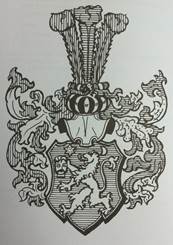
The coat of arms of Viktor Porák de Varna (1852-1932)[365]
Viktor Porák was in the years 1895 - 1901 elected a Member of the Bohemian Diet as a landowner to represent the fully owned estate (allod) holders,[366] where he sat near Edward Brzorád (1856-1904). But now back to Leo.

JUDr. Leo Prziborski is in 1901 adopted by his mother's cousin Vincent Baron Voith = Herites von Sterbez (1842 to 1912), and adopted the name Voith Herites Prziborski. (The adoption was approved in 1905.[367] .) To the question of transferring the noble title it needs to be noted that Bertha's death notice from 1920 gave the predicate with Hermine and Anna Maria née von Lindenkron, but none with Leo. (It was at that time already illegal and under heavy fine, but apparently no has ever been fined for that).[368] Thus, we can probably say that the Republic has not stripped the aristocratic family von Herites of their title or predicate. The family, as we know from the correspondence of Leo's cousin Anna Dostalova, apparently wanted to transfer the title. Anna described the adoption as a favorite dream and the warmest desire of her aunt Hermine Prziborski. But at the same time she was surprised over the decision of her Kolin’s relatives who have stayed in warm touch with her despite the sea separating them, and in her letter she wrote about Leo: "I do not know how he suddenly gained so much love in Kolin, because as Kolin’s Hermina writes he became allegedly,"ein Feiner Mann" for her and apparently he is now quite different. (Do not write about it to Prague, Hermina does not want that). Well, the aunt Prziborski will be on her high horse when her son will be a Baron! '"[369]
In the following letter of the same year, Anna writes to her sister : "So the aunt Hermína [370] was very upset with you? Maybe she was worried that son of yours, even not yet born, would cut her from the nobility status! If Leo gets to the title also some money on top of it, I wish him this from the bottom of my heart; never in my dreams I thought of waiting for a heritage from anyone, all the less from the Voiths and I don’t think you or Marinka relished such thoughts. That the Kolin clan is somewhat distant to us and more friendlier to Příborskýs, I am also not surprised; they always loved something more "classy" and you know that our family always stood a few degrees lower than the family of Příborský. But I am not bothered by that and never will be. "[371]
The National Archives keeps a file from Stadtholder’s office regarding the application of Vinzenz Freiherr "Vaith-Herites von Sterber" (sic!) for the delegation of his nobility to the adopted son Leo Prziborski. The dating of the documents begins in August 1901. The last document is from 11. 2. 1902. The most interesting is probably the document entitled "Verzeichnis Über die bei Statthalterei eingelagten Gesuche um Bewilligung von Namensänderungen", which, in addition to justification for the application, states the assets and reputation of the applicant and his adopted son as well.
„Verzeichnis
Über die bei Statthalterei eingelagten Gesuche um Bewilligung
von Namensänderungen
Postzahl
Stattheltereizahl
123713
u.
179956
Name u. Charakter des Gesuchstellers
Oberlandesgericht um Gutachten über das MajestätsGesuch des
k.u.k. Majors a.D. Vinzenz Freiherrn Voith Herites von Sterbez um Übertragung
seines Adels an seinen Adoptivsohn Herrn Leo Prziborski, Advokaten in Prag.
Gesuchgründe
Gesuchsteller ist nebst seinem Bruder Rudolf Freiherrn Voith von
Sterbez Besitzer der Domäne Vosečany der letzte Abstämmling der freiherrl.
Familie Voith von Sterbez.
Gesuchsteller wurde vom + Thaddäus Freiherrn von Herites /:
Bruder seiner Mutter :/ dem letzten Sprossen dieser freiherrl. Familie
adoptiert u. führt in Folge a. h. Entschliessung vom 16/12 1864 den Namen
Freiherr Voith-Herites von Sterbez.
Da nun Bittsteller der Letzte des Namens Herites ist, so würde
nicht nur der Name und Adel der Familie Voith von Sterbez, sondern auch der
Name und Adel der Familie von Herites
aussterben.
Der Adoptivsohn Dr. Leo Prziborski ist ein Enkel der Karoline
Freiin von Herites /: einer Schwester der Mutter der Gesuchstellers. :/
Sowohl die Vorfahren der Familie Voith von Sterbez als auch jene
der Familie von Herites haben zumeist als k.u.k. Offiziere gedient u. der Urgrossvater sowie
auch der Grossvater des Bittstellers den Marie Theresien Orden erworben.
Anhörung der Unterbehörden
Nach Ausserung der… … Gesuchsteller, Besitzer eines
verschuldeten Hauses daselbst u. Nutzniesser der von seinem Adoptivvater weiter
hinterlassenen Obligationen von 70.000 Kr.
Geniesst wegen seines makellosen Charakters und seiner
Herzensgüte grösste Achtung und Verehrung. u. wird sein Gesuch zur feierlichen
Berücksichtigung empfohlen.
Laut Bericht der Polizei-Dion. Lebt Herr Leo Prziborski bei
seinen Eltern, sein Vater pens. Domänenrath geniesst eine Pension von 9.600 Kr.
und ein Privatvermögen von 200.000 Kr.
Dr. Leo Prziborski, besitzt ein Privatvermögen von 30 000 K ist
mit Maria Porak von Varna, welche aus einern vermögenden Hause start, verlobt,
wohlverhalten u. rücksichtswürdig.
Schlussfassung S. Excellenz.“[372]
In the years 1900 - 1908 Leo works as a lawyer in Prague, where in 1902, the only son, Curt, is born.
The Národní Politika daily on May 28, 1909 reports "From the circles of law" that "Dr. Leo Prziborski-Voith-Herites, a lawyer, relocated from Prague to Vienna."
The list of fresh entries in the register of Chamber of commerce provided by Národní Listy on November 16, 1913 contains the information "the in Krumlov’s graphite factory Brothers Porák conferred procuration to Dr. Leo Prziborski-Voith and to Frant. Conte Magnoni in Vienna.
From 1914, Leo is a lawyer at the judicial court in Vienna, where he lived first on Kolowratring, still with a home jurisdiction in Prague. In 1914 his cousin Anna Dostálová in America does not have any news "about Příborskýs nor Jenny; I know nothing apart from what you sometimes write or Hermína or Marinka do; believe me, it seems to me that they don’t even belong to our family. They live a completely different life than we do, they have completely different interests and concerns, and they have never really paid much attention to me, and I have done the same, after all.“[373]
According to the announcement in Wiener Zeitung 1915 was on 28. 5. at Provincial Court Dr. Leo Prziborski-Voith, Wien I. Weihburggasse 18, bankruptcy trustee for a clothing merchant Franz Kocik, Favoritenstrasse 73, Vienna X.[374]
A reserve infantry member, "Titularkorporal" titula corporal and
one-year volunteer: Prziborski, Leo, Dr. Jur., 28th Infantry Regiment, a clerk
at the Imperial Military Prosecutor at the military headquarters in Prague was
under imperial rule Department of Defense to 1. 4. 1917 appointed the trainee at
the provincial defense court in Prague. (Verordnungsblatt für
die kaiserlich-königliche Landwehr; Personal angelegenheiten; Verordnungen des
k. k. Ministeriums für Landesverteidigung. Ernannt werden: auf Grund der A. H.
E. vom 16. September 1916: mit 1. April 1917 zu Landsturmgerichtspraktikanten:
... der Landsturminfanterist, Titularkorporal mit
Einjährig-Freiwilligenabzeichen: Prziborski, Leo, Dr. jur., des
Infanterieregiments Nr. 28, Schriftführer (zapisovatel) beim k. k.
Militäranwalt (vojenslý prokurátor) des Militär- kommandanten in Prag;)[375]
When Leo joined his
father-in-law’s enterprise is uncertain. From the business yearbook we know
that in 1923
the Krumlov’s graphite mines were run by attorney Dr. Leo Prziborski-Voith
Fabriksdirektor.[376] However, the post-war period marked the end
of their prosperity.[377] In
1925
Krumlov’s credit union received the rights to a forced auction, but found no
one interested in the graphite mines, and so in 1926 the company forced
auction ended. The
final official disposal of their assets occur no later than 1929.
In the twenties Leo also became the chairman of the Family Foundation: "Leo was a kind of family magistrate, an advisor, the chairman of the Board of the family Foundation of Ernest Příborský, all of these functions he inherited from his nonesuch father. "Reliable" Leo he used to be called, that is all I know.”[378] When in 1925 he is registering in Vienna’s Heumarkt, where he also died in 1940, he fully belongs to Vienna.
In 1940, the
estate of Ferdinand Freiherr Voith from Šternbec was
taken into Čáslav’s Museum "from the heirs from Kolin via Čáslav’s dean
Al. Dostal"[379]
and now belongs to the funds of Archives in Kutná Hora.[380]
Leo’s wife Mary Anne after the war in 1946 remarries the section chief Dr. Franz Ritter von Srbik (1877-1958) [381], the brother of the Minister of Education, a prominent historian and professor at the University of Vienna Heinrich Ritter von Srbik.
Kurt Leo Julius Prziborski-Voith-Herites (1902-1943)
Son Leo Kurt Julius Prziborski (1902-1943), born in Prague, attended Ober-gymnasium zu den Schotten in Vienna in 1911, in 1913 a grammar school in Horn. According to the German economist Miksch „an only son of his parents attended a business college "Handelshochschule" in Vienna and was employed in business as "Kaufmännischer Angestellter.”[382]
In 1939 he registered to stay in the Austrian town of Bruck an der Mur, Schillerstraße 4. Here in 1940 he registered as a treasurer, declared the evangelical religion and a citizen of the German Empire. His link to the graphite factory managed by his father is unknown. According to the registration card he died 17th August 1943 In World War II unmarried and childless. [383] He died by Nester in Russia carrying 'Erkennungsmarke "-113- Ldsch. Btl. 921. He belonged to the unit Greandier 10th Regiment 499 of the German Wehrmacht.[384]
And
here the story of the family von Herites actually ends. That is if Kurt didn’t have a brother, we do
not know about, or if he did not manage to adopt someone. Milada Blažková wrote in her Legends of the
Prziborski clan that "Kurt, the only male descendant of Kajetán lives,
perhaps still now, in 1956, in South Bohemia and is employed in the factory
once belonging to his grandfather after his mother, Porák."[385]
Kurt's cousin Marie Kordulová sent her this note in a letter: "... the son
of uncle Leo Příborský - Kurt Voigt is an engineer in the paper mill of his
uncle (Kienberg at Vyšší Brod) a young man told me this, who was working here
at a temporary job."[386] But according to the lists of employees
stored in the corporate funds deposited in SOA CB, however, we can say with
certainty that in 1945 Kurt was not employed in Loučovice, and due to the
post-war situation of the German-speaking employees we can hardly suppose that Kurt got hired to this nationalized
company.
But we should not forget that the last bearer of the name Voith-Herites was at least until her marriage to Dr. Franz von Srbik in 1946, the widow of Leo Prziborski, Anna Marie, born Porák Ritter von Varna, who died in 1957. The estate after her husband, who dies a year later, was taken over by his brother, who was unfortunately not at the best terms with him. Probably this is the reason why, according to the statement of his child, in the Srbik family archives unfortunately nothing was preserved in relation to František and his wife.[387]
This work has repeatedly proved that the family tradition and sense of belonging is handed in the female line as well. If we are to examine the offspring in von Herites and Krziwanek families that way, we have yet to see one last daughter of the Křiváneks and that is Marie. The story of the family of her husband and their descendants forms another part of this project under the heading “Familie Brzorád”. The mother of the groom was, however, born Delorme and with this family we will get acquainted in the part “Familie Delorme”.
The original Czech
version is available here
 .
.


